Managing changes in data systems is crucial to avoid errors, downtime, and compliance violations. A well-structured change approval process can ensure updates are safe, documented, and traceable. Here's a quick summary of the key takeaways:
- Key Principles: Focus on traceability, separation of duties, and risk-based reviews to ensure compliance and minimize errors.
- Efficient Workflows: Use clear categories for changes (e.g., standard, major) and require detailed tickets with testing and rollback plans.
- Automation: Leverage tools like Git and CI/CD pipelines for automated checks, faster approvals, and audit trails.
- Metrics to Track: Monitor metrics like Mean Time to Approve (MTTA), rollback frequency, and incident rates to improve processes.
- Governance: Assign clear roles and responsibilities, and involve Change Advisory Boards (CAB) only for complex, high-risk updates.
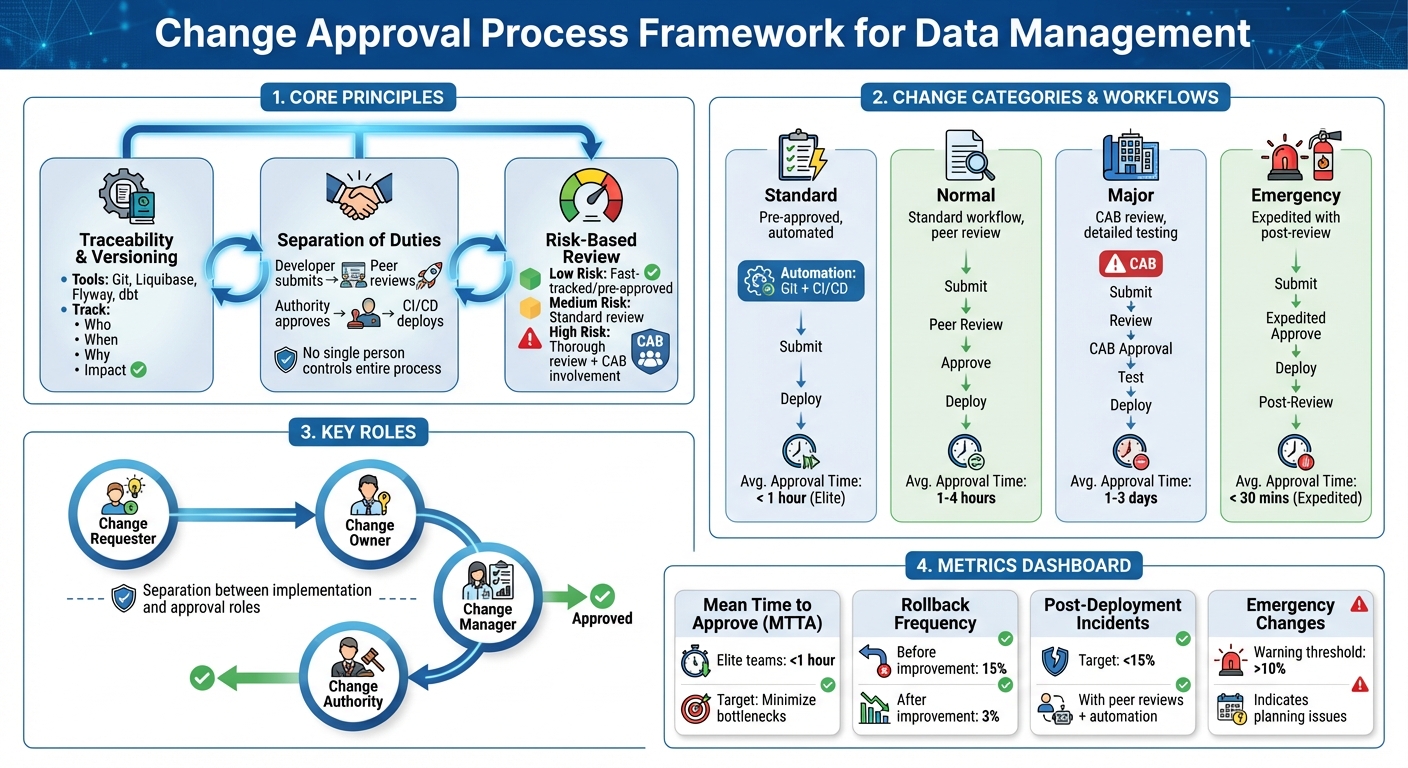
Change Approval Process Framework for Data Management
Change Management 101: For Data Projects | Talking About Change Management
Core Principles of Change Approval
A strong change approval process is built on three essential principles: traceability and versioning, separation of duties, and risk-based review and auditability. Together, these principles ensure compliance, minimize errors, block unauthorized changes, and maintain the stability of data systems. When applied effectively, they provide the foundation for advanced strategies like version control and independent reviews.
Traceability and Versioning
Every change to databases, ETL pipelines, or data models should be meticulously recorded - capturing details like who made the change, when it happened, why it was necessary, and its potential impact. The most effective way to manage this is by treating data changes as code, using tools like Git. Version control systems (e.g., Git) and management tools (e.g., Liquibase, Flyway) make it possible to uniquely identify and track each change.
Similarly, ETL pipelines and data models should be defined as code, using tools like dbt or YAML-based configurations. Any modifications can then be handled through pull requests, creating a clear and reviewable history. Automated checks can be integrated to validate changes before deployment. By linking change tickets directly to specific commits or pull requests, you establish a seamless trail from the initial business request to the final deployment. This level of transparency not only supports compliance efforts but also ensures audit readiness.
Separation of Duties
Separation of duties is essential to prevent any single individual from having unchecked control over a change. The person proposing or implementing a change should not be the one approving or deploying it. Regulatory standards often mandate independent approvals to maintain accountability.
In practice, developers submit changes through pull requests, which are then reviewed by peers. A designated authority, such as a product owner or data lead, provides the final approval. Even small teams can implement this principle by combining peer reviews with automated checks. Production deployment rights should be limited to a select group of maintainers or controlled through a CI/CD system that only activates after approvals are secured. For higher-risk changes - especially those involving sensitive financial data or personally identifiable information - additional sign-offs from risk, security, or compliance teams are strongly recommended.
Risk-Based Review and Auditability
Not every change warrants the same level of scrutiny, which is why a risk-based approach is key. Changes should be classified as low, medium, or high risk, with the depth of review adjusted accordingly. For example, high-risk changes - like altering data retention policies for regulated information or dropping columns critical to financial processes - require thorough reviews, detailed test evidence, and well-documented rollback plans. On the other hand, low-risk changes, such as adding non-breaking fields for internal analytics, can often be fast-tracked or pre-approved.
Auditability is achieved by maintaining a complete record for every change. This includes the original request, risk assessment, approvals, testing documentation, deployment logs, and outcomes. Using an IT service management (ITSM) or ticketing tool that tracks each step with timestamps and user identities ensures that auditors can verify who approved what, when, and under what circumstances. Integrating these tools with your version control system creates a comprehensive and verifiable audit trail.
Best Practices for Change Approval
Follow these strategies to create a change approval process that works efficiently while avoiding unnecessary red tape.
Establish Governance and Define Roles
Start by setting up a governance structure that keeps things organized and effective. For many organizations, this means forming a Change Advisory Board (CAB) to handle medium- and high-risk changes. Typically, a change manager leads the CAB, taking charge of preparing tickets, running review meetings, and securing final approvals. To keep things efficient, focus the CAB's efforts on complex, cross-domain changes, leaving minor updates out of their scope.
Clearly define the roles involved in the process. For example:
- Change Requester: Initiates the change.
- Change Owner: Oversees the implementation.
- Change Manager: Coordinates the entire process.
- Change Authority: Makes the final approval decision.
Avoid situations where the same person implements and approves a change. For low-risk, routine updates, delegate approval authority to product or data owners. Reserve CAB involvement for changes with broader or higher-impact implications.
Standardize Change Request Workflows
Organize your change requests by creating clear categories - such as standard, normal, major, or emergency - and design specific workflows for each type. Every change ticket should include key details like:
- The reason for the change
- Affected systems
- Business impact
- Technical risks
- Deployment and rollback plans
Using a centralized ITSM tool can help enforce these standards. It ensures mandatory fields are completed, routes approvals efficiently, and logs timestamps for audit purposes. Well-structured workflows reduce downtime, align IT changes with business objectives, and eliminate unnecessary delays. This kind of organization naturally supports thorough pre-approval testing.
Enforce Testing Before Approval
Make non-production testing a non-negotiable step in the approval process. Require evidence of regression tests, data validation (such as schema checks and record counts), and performance testing in staging environments. For changes that affect users, secure User Acceptance Testing (UAT) sign-off from data owners.
Every change should also include a detailed rollback plan. This plan must outline specific triggers and steps for reversing the change if needed. Approvers should confirm that the rollback plan is practical and has been pre-tested. According to DORA's 2019 State of DevOps report, teams that rely on lightweight, peer-based approvals - like pull request reviews paired with automated testing - perform better in software delivery compared to those using external approval boards for most changes. The goal is to move approvals closer to the work while keeping essential controls in place.
sbb-itb-d1a6c90
Using Technology to Improve Approvals
Automate Approvals with Version Control and CI/CD
Data teams are increasingly turning to Git and CI/CD pipelines to simplify and strengthen the approval process. These tools enforce automated checks at every stage of development, running tasks like static analysis, schema validation, data quality tests, and performance checks. When changes pass these tests, lower-risk updates can be automatically approved and moved to the next environment. For higher-risk updates - such as changes to revenue-critical tables - approval gates are triggered, routing the changes to designated reviewers or a Change Advisory Board (CAB) for further scrutiny.
This approach not only speeds up the approval process but also creates an audit trail that links commits to their corresponding change tickets. This is particularly useful for meeting compliance requirements under U.S. regulations. According to the 2019 DORA State of DevOps report, teams that incorporate peer reviews and automated testing see higher deployment frequencies and quicker recovery times after failures. Interestingly, external approval boards tend to increase lead times without reducing change failure rates, making automation and peer review far more effective for modern workflows.
To make the most of these automated processes, choosing the right tools is key to maintaining efficient and reliable governance.
Use BizBot for Tool Discovery

Selecting the right tools to complete your automated approval infrastructure can feel overwhelming, especially for small and mid-sized U.S. businesses. That’s where BizBot comes in. This platform offers a curated directory of business tools designed to support governance with structured oversight and clear documentation. Categories include board management, legal compliance, and subscription management, all of which can help formalize your change approval processes while ensuring critical tools remain active and aligned with your budget.
BizBot also highlights ITSM, workflow automation, and GRC tools that integrate seamlessly with version control systems and CI/CD pipelines. By bridging technical change-approval systems with broader governance and financial controls, BizBot helps businesses strengthen their compliance efforts without requiring deep expertise in every tool category. This ensures your systems are not only efficient but also aligned with regulatory and operational needs.
Monitoring and Improvement
Track Key Metrics
To truly understand and refine your change approval process, you need to measure it effectively. Focus on a few core metrics that balance both speed and stability. For instance, Mean Time to Approve (MTTA) tracks how long changes linger waiting for approval. Elite teams often achieve MTTA in under an hour by leveraging peer reviews and automation. Breaking MTTA down by risk level and approval path can help you identify where bottlenecks occur.
Another critical metric is rollback frequency, which shows how often approved changes fail and need to be reversed. A rollback rate of 15% might point to inadequate pre-approval testing. One example: teams that introduced documented back-out plans before approvals managed to cut rollback rates from 15% to just 3%. Similarly, post-deployment incident rates - which track issues arising after changes go live - should stay below 15% with strong peer reviews and automated testing in place. If more than 10% of your changes are being processed as emergencies, it may indicate issues with your planning process.
To gain deeper insights, segment these metrics by factors like change type (e.g., schema updates versus ETL pipelines), risk level, and environment. Use ITSM or CI/CD tools to automatically capture timestamps, ensuring your data reflects real-world performance. These metrics provide a solid foundation for targeted reviews and improvement.
Conduct Regular Reviews
Metrics are only useful if they lead to action. To turn data into improvements, schedule regular review sessions - either monthly or quarterly - with your Change Advisory Board, change managers, and key data stakeholders. Use these sessions to analyze metrics reports, audit delayed or failed tickets, and identify patterns. For example, you might notice recurring issues with specific change types, like schema updates, or slower approval times from certain reviewers.
For every failed change or major delay, conduct a blameless review. Document the details: the change itself, what went wrong, and any steps or checks that were missed. Use these insights to refine your approval criteria, update checklists, or adjust automation rules. Research from DORA shows that closely monitoring approval wait times can help reduce incident rates. This feedback loop is essential for reinforcing the testing and automation practices discussed earlier.
These reviews should aim to simplify and improve your approval process, not add unnecessary layers. For example, low-risk data updates that rarely fail could be auto-approved or delegated to the team level. Keeping time-stamped logs of decisions and post-implementation reviews not only supports compliance with U.S. regulations but also makes internal audits more straightforward and efficient.
Conclusion
Creating an effective change approval process for data management doesn’t have to be complicated. By focusing on key practices like clear governance, standardized workflows, mandatory testing, automation, and continuous monitoring, you can minimize risks while keeping workflows efficient. Defining who approves specific types of changes and setting consistent guidelines for standard, normal, and emergency requests helps eliminate confusion and avoid unnecessary delays.
Delegating approval for low-risk changes to teams closer to the action while reserving formal reviews for high-risk cases ensures a balanced approach. This strategy not only streamlines decision-making but also reinforces earlier points about governance and testing.
Technology plays a crucial role in making this process smoother. Automated tools and ticketing systems catch issues early and provide audit trails to meet compliance requirements. Metrics dashboards - tracking things like failed changes and approval wait times - help pinpoint bottlenecks and fine-tune your workflows. For small and mid-sized businesses in the U.S., tools like BizBot offer curated solutions that integrate seamlessly into your processes, boosting both efficiency and compliance.
The right change approval process strikes a balance between speed and safety. With smart governance, well-defined processes, thorough testing, and the right tools, you can reduce failed deployments, improve turnaround times, and meet compliance standards - all while enabling your team to deliver value faster and more confidently.
FAQs
How do automation tools like Git and CI/CD streamline the change approval process?
Automation tools like Git and CI/CD make the change approval process faster and easier by cutting down on manual steps and simplifying workflows. These tools support continuous integration and delivery, automatically testing and validating changes before they’re deployed.
By handling tasks such as code testing, version control, and deployment, they help speed up release cycles, enhance code quality, and ensure compliance. Plus, they create traceable audit logs, which simplify tracking changes and meeting regulatory standards.
What key roles are involved in a change approval process for data management?
A solid change approval process in data management relies on clearly defined roles working in harmony:
- Change Initiators: These individuals propose updates or modifications, ensuring their suggestions align with the organization's objectives and priorities.
- Change Reviewers or Approvers: Their job is to carefully evaluate proposed changes, checking for accuracy, compliance, and any potential risks before giving the green light.
- Change Managers or Coordinators: They oversee the entire process, ensuring smooth communication among stakeholders and that deadlines are met.
- Executive or Senior Management: For high-impact changes, this group provides the final approval, ensuring the changes fit within the broader strategic goals of the organization.
Each role plays a critical part in maintaining an efficient and accountable change process.
Why is it important to separate responsibilities in data management change approvals?
Separating responsibilities in data management change approvals is key to ensuring accuracy, accountability, and compliance. When no single person has full control over the process, it minimizes the chances of mistakes, fraud, or unauthorized changes slipping through.
This approach establishes a solid system of checks and balances, helping to spot potential problems early and ensuring all changes stick to the rules. It also promotes transparency and strengthens trust in your organization’s data management practices.