Want to improve your chat system's performance? Here's the key: Track the right KPIs. Chat Key Performance Indicators (KPIs) measure how well your chat system supports customers and drives business outcomes. From response times to customer satisfaction, these metrics reveal what’s working and where to improve.
Key Highlights:
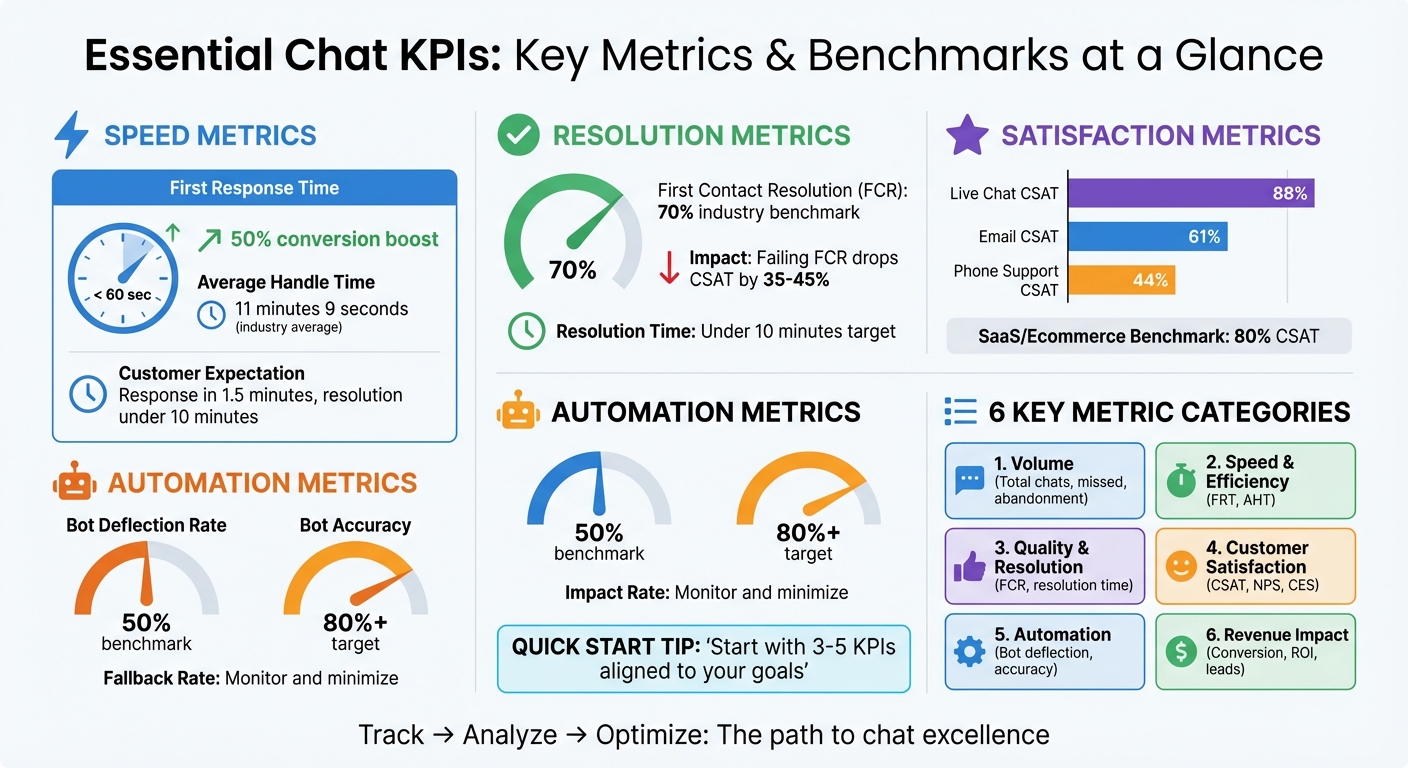
- Speed matters: Responding under 60 seconds can boost conversions by 50%.
- Resolution is critical: Aim for a 70% First Contact Resolution (FCR) rate to keep customers happy.
- Chatbots must deliver: Deflection rates of 50% and accuracy above 80% ensure efficiency.
- Customer satisfaction leads: Live chat averages an 88% CSAT score, outperforming email and phone support.
Core Metrics to Track:
- Volume: Total chats, missed interactions, abandonment rates.
- Speed: First Response Time (FRT), Average Handle Time (AHT).
- Resolution: First Contact Resolution (FCR), resolution time.
- Customer Satisfaction: CSAT, Net Promoter Score (NPS).
- Automation: Bot deflection rate, bot accuracy, fallback rate.
- Revenue Impact: Conversion rates, ROI, lead generation.
By focusing on these metrics and aligning them with business goals, you’ll enhance customer experience, optimize operations, and increase revenue. Start small - track 3-5 KPIs that matter most to your goals, and use the insights to improve your chat system step by step.
Essential Chat KPIs and Performance Benchmarks Guide
What Are The KPI For Customer Service? - BusinessGuide360.com
sbb-itb-d1a6c90
How to Measure Chat Performance
Evaluating chat performance means keeping an eye on specific metrics that reveal how well your chat channel supports customers and contributes to your bottom line. These numbers not only help fine-tune customer support but also play a role in driving business growth.
Categories of Chat Metrics
Chat metrics generally fall into six key areas: volume, speed and efficiency, quality and resolution, customer satisfaction, automation, and revenue.
- Volume metrics: These track total chats, missed interactions, and abandonment rates, helping you understand customer demand and identify where staffing might need adjustments.
- Speed and efficiency metrics: Metrics like First Response Time (FRT) and Average Response Time (ART) show how quickly your team addresses customer inquiries.
- Quality and resolution metrics: First Contact Resolution (FCR) measures how often issues are solved during the first interaction, offering insight into agent effectiveness.
- Customer satisfaction metrics: Tools like Customer Satisfaction (CSAT) scores and Net Promoter Score (NPS) gauge how customers feel about their experience.
- Automation metrics: These assess how well AI handles customer inquiries, focusing on bot deflection rates and accuracy in understanding questions.
- Revenue metrics: By tracking conversion rates, lead generation, and ROI, these metrics connect chat interactions to financial outcomes.
Additional metrics, such as agent utilization rate - which measures the percentage of time agents spend actively engaging with customers - can provide deeper insights into operational efficiency.
How Chat Metrics Align with Business Goals
Each metric ties back to specific business objectives. For example:
- Customer service goals: Metrics like FCR (with an industry benchmark of around 70%), CSAT, and ART help ensure customers receive prompt, high-quality support, which directly impacts retention.
- Sales and marketing goals: Monitoring chat-to-conversion rates can highlight how effectively chats drive sales.
- Operational efficiency: Keeping an eye on chatbot deflection rates (benchmark: 50%), agent utilization, and chat volume can guide staffing and cost-saving strategies.
- Financial performance: Calculating ROI and payback periods justifies investments in chat technology, while maintaining low fallback rates and AI accuracy above 80% ensures your system works efficiently.
Data Sources for Chat KPI Tracking
Accurate measurement relies on pulling data from a variety of sources to get the full picture.
- Chat logs and transcripts: These offer valuable qualitative insights into how well agents handle customer issues.
- CRM systems: Platforms like Salesforce and Zendesk link chat data to customer profiles and purchase histories, making it easier to track loyalty over time.
- Built-in analytics dashboards: Modern chat tools provide real-time data on key metrics like volume, response times, and agent utilization.
- Post-chat surveys: Collect customer feedback directly through CSAT, NPS, or Customer Effort Score ratings.
- NLP analytics for AI systems: These specialized tools measure how accurately bots interpret user queries and pinpoint where fallback responses occur.
- Website analytics: By comparing conversion rates of users who engaged with chat against those who didn’t, you can assess chat’s impact on sales.
- Ticketing and billing systems: These help calculate the financial benefits of chat, such as revenue generated per interaction or savings from automation.
Key Chat KPIs and How to Measure Them
To understand how your chat system performs, tracking the right metrics is crucial. These KPIs cover everything from managing customer interactions to assessing the effectiveness of AI tools.
Volume and Workload Metrics
Total chat volume counts all initiated sessions, whether completed, missed, or abandoned. This metric provides insights into customer demand patterns and helps identify times when additional staffing may be needed. For instance, businesses often encounter spikes during busy seasons, making it essential to plan ahead.
Missed chats refer to customer requests that go unanswered. A high rate here might indicate gaps in staffing or scheduling.
Agent utilization rate measures the percentage of time agents are actively engaged in chats or wrapping up sessions versus being idle. The formula is: (Monthly chats × Average Handle Time) ÷ (Hours worked in month × 60). Keeping an eye on this helps balance workload without overburdening agents.
Chat concurrency tracks how many chats an agent handles at the same time. High concurrency levels could signal understaffing or highlight areas where agents might need more training.
Next, let’s dive into metrics that assess speed and efficiency.
Speed and Efficiency Metrics
First Response Time (FRT) measures the time it takes for an agent to respond to a customer after a chat is initiated: First agent message timestamp – Customer chat initiated timestamp. Customers generally expect a reply within 1.5 minutes, and responding in under 60 seconds can boost conversions by 50%. Use the median instead of the average to avoid skewed data from outliers.
Average Handle Time (AHT) reflects the average duration of a chat session, including wrap-up time. The industry average is around 11 minutes and 9 seconds. Calculate it as: (Total chat time + Total wrap-up time) ÷ Number of live chats handled.
Queue wait time measures how long customers wait in the queue before connecting to an agent. Prolonged waits can increase abandonment rates and negatively affect satisfaction scores. In fact, about one-third of poor CSAT ratings stem from slow responses or resolutions.
Quality and Resolution Metrics
First Contact Resolution (FCR) is a key measure of efficiency, showing the percentage of issues resolved in a single interaction. The formula is: (Chats resolved with a single reply ÷ Total chats) × 100%. The industry average hovers around 70%, and failing to resolve issues on the first attempt can drop CSAT ratings by 35%-45%. Companies with higher FCR rates tend to retain more customers.
Resolution time measures how long it takes to resolve an issue from the start of a chat: Chat resolved timestamp – Customer chat initiated timestamp. Benchmarks typically fall under 10 minutes.
Human takeover rate tracks how often a chatbot hands off a conversation to a human agent. A high rate might indicate that the chatbot needs better training or that certain queries should be routed directly to agents.
Customer Satisfaction and Experience Metrics
Customer Satisfaction Score (CSAT) comes from post-chat surveys, often rated on a 1-5 scale. The formula is: (Number of satisfied responses ÷ Total number of responses) × 100%. Live chat typically scores an 88% CSAT, outperforming email (61%) and phone support (44%). For SaaS and ecommerce, the average benchmark is around 80%. Keep surveys brief - one or two questions - to encourage higher response rates, which often exceed 20% for low-effort surveys.
Net Promoter Score (NPS) measures customer loyalty by asking how likely they are to recommend your brand. It’s a strong indicator of whether your chat experience fosters loyalty or leads to churn.
Customer Effort Score (CES) evaluates how easy it was for a customer to resolve their issue. Lower effort scores often lead to better retention and repeat business.
Automation and AI-Specific Metrics
Bot deflection rate, also known as containment rate, measures the percentage of chats resolved by a bot without needing human intervention: (Chats resolved by chatbot ÷ Total chatbot chats) × 100%. The industry standard is around 50%. Tracking this separately from human-handled chats helps pinpoint which queries work well with automation.
Bot accuracy measures how well a bot understands user intent and provides correct answers. It’s calculated as: (Total messages – Fallback messages) ÷ Total messages × 100%. Ideally, bots should aim for an accuracy score of 80% or higher.
"Accuracy is the baseline requirement of your AI-powered chatbot. Without it, hopes of reducing customer friction and accelerating revenue aren't realistic." - Mark Kilens, VP of Content and Community, Drift
Fallback rate tracks the percentage of messages where the bot fails to understand or provide a relevant response: (Failed responses ÷ Total user messages) × 100%. Regularly reviewing fallback messages can help identify areas where the bot needs additional training.
| Metric | Formula |
|---|---|
| First Response Time (FRT) | First agent message timestamp – Customer chat initiated timestamp |
| First Contact Resolution (FCR) | (Chats resolved with a single reply ÷ Total chats) × 100% |
| Agent Utilization Rate | (Monthly chats × AHT) ÷ (Hours worked in month × 60) |
| CSAT Score | (Number of satisfied responses ÷ Total number of responses) × 100% |
| Bot Deflection Rate | (Chats resolved by chatbot ÷ Total chatbot chats) × 100% |
| Bot Accuracy | (Total messages – Fallback messages) ÷ Total messages × 100% |
| Fallback Rate | (Failed responses ÷ Total user messages) × 100% |
Implementing Chat KPIs in Your Business
Measuring chat performance effectively is key to driving both operational efficiency and revenue growth. Now that we've covered the core metrics, it’s time to put those insights to work. This involves aligning KPIs with your business goals, choosing the right tools, and creating dashboards that guide smart decisions.
Aligning KPIs With Business Goals
Every KPI should tie directly to a specific business goal. For instance, if reducing churn is your priority, focus on metrics like Retention Rate and CSAT (Customer Satisfaction Score). If you're aiming to improve how quickly issues are resolved, track First Contact Resolution (FCR) and Goal Completion Rate (GCR). And if growth is your target, prioritize Conversion Rate and Lead Generation.
"If you don't understand the details of your business, you are going to fail." - Jeff Bezos, Founder, Amazon
Organize your KPIs into categories like user experience, business impact, and technical efficiency. This ensures you're addressing the needs of all stakeholders. Additionally, segment KPIs by channel to allocate resources effectively. For example, WhatsApp might be a strong channel for generating leads, while your website chat could handle a higher volume of support inquiries.
| Business Objective | Primary KPI to Track | Success Indicator |
|---|---|---|
| Reduce Churn | Retention Rate / CSAT | High returning user rate and positive chat ratings |
| Improve Resolution | First Contact Resolution (FCR) | Issues resolved on the first try without follow-ups |
| Drive Growth | Conversion Rate / Lead Gen | Increased sign-ups, sales, or subscriptions via chat |
| Operational Efficiency | Deflection Rate / Self-Service Rate | More queries resolved without human involvement |
| Technical Accuracy | Fallback Rate / Confusion Rate | Fewer "I don't understand" responses from bots |
Once your goals and KPIs are aligned, the next step is choosing the right tools to track them.
Choosing Tools for KPI Tracking
The tools you use should have built-in analytics that allow for real-time monitoring. This helps managers quickly spot and address issues, especially during peak hours or technical disruptions.
Your chat software should integrate seamlessly with CRM and help desk platforms like Zoho CRM or Salesforce. This integration provides a complete view of the customer journey. If you're using AI-powered bots, look for features like Intent Analytics and Fallback Rate tracking to identify where the chatbot's natural language processing might need improvement.
Avoid using generic dashboards designed for other digital channels like social media or web traffic. Instead, opt for tools specifically built for conversational interactions. Multi-channel segmentation is also vital - your tools should break down KPIs by platform (e.g., WhatsApp, Facebook Messenger, Webchat) so you can see which channels are driving the most engagement or conversions.
For businesses managing multiple software subscriptions, platforms like BizBot can simplify the process. They help you identify the best tools for tracking KPIs and optimize your subscription costs - especially useful for small businesses juggling multiple systems.
Once you’ve chosen the right tools, the focus shifts to structuring data effectively and setting clear performance targets.
Creating Dashboards and Setting Targets
Design dashboards tailored to different audiences. For operations teams, include metrics like Chat Volume, Peak Hours, and Missed Chats to help with staffing and resource planning. For executives, focus on customer-centric metrics like CSAT, NPS (Net Promoter Score), and CES (Customer Effort Score) to gauge customer loyalty and satisfaction.
When dealing with time-based metrics like First Response Time (FRT), use the median instead of the average to avoid skewed results from outliers. Assign labels or tags to conversations to identify recurring issues, such as billing questions or technical problems. This makes it easier to spot trends and refine insights.
For AI bots, aim for an accuracy rate of 80% or higher. For human agents, set a First Contact Resolution (FCR) benchmark at around 70%. Resolution time targets can vary depending on the complexity of inquiries - while simpler issues should be resolved in under 10 minutes, more technical problems may require longer.
Retention tracking is also crucial. Monitor customer retention at intervals like Day 1, Week 1, Month 1, and Month 3 to identify where drop-offs occur.
Lastly, calculate ROI to justify further investments in optimization. Use this formula:
ROI = (Monetary Value Generated – Total Investment) ÷ Total Investment × 100
Advanced Techniques for Improving Chat KPIs
Once you've established your KPIs and dashboards, it's time to refine your strategy by digging deeper into the data. Start by segmenting your metrics. For example, tracking the Bot Experience Score by contact reason - whether it's billing or technical support - can highlight areas needing improvement. Similarly, comparing metrics for new users against returning users can reveal if your chatbot consistently delivers value. A 50% returning user rate is often seen as a strong indicator of sustained engagement.
Another powerful approach is intent-based segmentation. By identifying which queries lead to fallback responses or negative sentiment, you can pinpoint gaps in your bot's training data. Temporal segmentation, such as analyzing chat volume by day and hour, can help ensure adequate staffing during busy periods. Don't overlook agent-level analysis either - metrics like messages per chat or resolution time, broken down by individual agents, can uncover coaching opportunities and highlight behaviors worth replicating. These insights naturally set the stage for benchmarking and predictive strategies.
Segmentation and Cohort Analysis
Segmenting KPIs by customer type or lifecycle stage can uncover valuable insights. For example, tracking retention rates at Day 1, Week 1, and Month 1 can pinpoint where customers are dropping off in their journey. Negative signal filtering - starting at 100% and deducting for repeated bot responses, customer paraphrasing, or mid-conversation drop-offs - can help refine your analysis. Pre-chat qualification enables skill-based routing, directing users to specialized agents and significantly cutting down resolution times. Additionally, monitoring "volunteer" users - those who engage with the bot unprompted - can provide insights into organic interest and the success of your conversational marketing efforts.
| Segmentation Category | Key Metrics to Track | Business Benefit |
|---|---|---|
| Customer Type | Retention Rate, GCR | Evaluates how well the bot meets the needs of VIP vs. standard users |
| Product Area/Tag | Volume, Resolution Time | Identifies features or services causing frequent issues |
| User Lifecycle | Activation Rate, New Users | Assesses the effectiveness of marketing campaigns and onboarding |
| Intent Category | Fallback Rate, Exit Rate | Highlights gaps in the bot’s knowledge or training data |
| Temporal (Time/Day) | Interaction Volume | Helps optimize staffing to align with peak demand |
Once you've segmented your data, compare it against industry benchmarks to set more precise goals.
Benchmarking and Trade-Offs
To set realistic targets, compare your chatbot's performance with industry standards. For example, customers typically expect a first response in under 1.5 minutes and full issue resolution in under 10 minutes. For AI-powered bots, aim for an accuracy score of 80% or higher. The average First Contact Resolution (FCR) rate is about 70%, while a chatbot deflection rate (resolving issues without human intervention) of around 50% is considered effective.
It's also helpful to directly compare your chatbot's performance to human agents for the same tasks. Metrics like Average Handle Time (AHT) and cost-per-resolution can provide valuable context. When setting benchmarks, break them down by topic - after all, a 5-minute session length only makes sense when paired with the Goal Completion Rate (GCR) for that specific interaction. Be sure to exclude topics your bot isn’t designed to handle when calculating your Bot Automation Score to get a clearer picture.
Predictive Analytics and Experimentation
Once you've segmented your data and established benchmarks, predictive analytics can take your strategy to the next level. By analyzing historical trends, you can forecast user behavior and optimize conversational flows. For instance, you can predict the next likely intent and recommend personalized content based on past interactions. Use Intent Confidence scores to measure how well a response aligns with user intent. If the score falls below a certain threshold, trigger fallback protocols or escalate to a human agent automatically.
Experimentation is also key. A/B test different scripts to see what improves accuracy and user satisfaction. Heatmaps can help you identify drop-off points and eliminate friction, leading to higher completion rates. Cross-referencing fallback rates with session length can reveal critical failures in conversations. Modern platforms even allow you to track highly specific events, like how often users interrupt the bot or when a payment fails during an e-commerce interaction.
Conclusion
Chat KPIs are the backbone of delivering a standout customer experience and achieving measurable business success. Quick response times - ideally under 60 seconds - and maintaining a First Contact Resolution rate above 70% can significantly impact your bottom line. These metrics not only boost conversions by 50% but also reduce support costs and foster long-term customer loyalty. Simply put, understanding and acting on these performance indicators can be the difference between retaining customers and losing them.
To maximize the effectiveness of your live chat, strategically position your chat widget on high-intent pages like pricing or checkout screens, and ensure it's optimized for mobile users, who now dominate web traffic. Use historical chat volume data to properly staff your team during peak hours. Equip your agents with tools like canned responses and skill-based routing to tackle complex queries efficiently. For repetitive questions, deploy chatbots to handle FAQs, aiming for a 50% deflection rate. This frees up your human agents to focus on more nuanced, high-value interactions that require empathy and creative problem-solving.
Keep an eye on feedback. Tie post-chat CSAT scores directly to chat transcripts to uncover training opportunities and address any content gaps. Regularly review fallback rates and missed chats, as these often signal lost revenue and customer dissatisfaction. With live chat boasting an 88% customer satisfaction rate - double that of phone support - it remains one of the most effective tools for building trust and loyalty.
Start small by focusing on three to five core metrics that align with your immediate goals, whether that's cutting response times, improving agent efficiency, or driving conversions. Set realistic targets based on industry standards, monitor your progress weekly, and refine your approach as patterns emerge. Success doesn’t come from having the fanciest dashboards; it comes from consistently acting on the insights your data provides.
FAQs
What are the key chat KPIs to track for quick results?
To get a clear snapshot of your chatbot's performance, pay attention to these key metrics: interaction volume (the total and unique number of chats handled), fallback rate (the percentage of times the bot couldn't provide an answer), conversion rate (how often users complete the desired actions), and customer satisfaction scores (feedback or ratings from users). These indicators highlight strengths and pinpoint areas that need attention, allowing for quick and effective adjustments.
How can businesses align chat metrics with their goals?
To make sure your chat metrics are working toward your business goals, start by pinpointing KPIs that clearly align with your objectives. For instance, if revenue growth is your aim, focus on metrics like the conversion rate (percentage of chats that lead to sales) and the average order value following a chat. On the other hand, if customer retention is your goal, pay attention to repeat-visitor rates, post-chat Net Promoter Score (NPS), and retention rates for users who interact with your chatbot.
For businesses prioritizing operational efficiency, key metrics include average response time, first-contact resolution rate, and chat deflection rate - how often the bot solves issues without needing human help. If customer satisfaction is your focus, post-chat CSAT scores, sentiment analysis, and fallback rates (when the bot can't understand a query) are essential to gauge the overall experience.
Review these metrics regularly using dashboards or reports to track progress and spot areas needing improvement. Establishing clear benchmarks - like keeping average response time under 30 seconds or maintaining a CSAT score of at least 80% - can help you address issues quickly and ensure your chat strategy stays on track with your business goals.
What are the best tools for tracking and analyzing chat KPIs?
To keep track of and evaluate chat KPIs effectively, it's crucial to use tools that provide real-time data and easy-to-understand reports. Platforms like Chatbase are a great choice, offering dashboards that cover engagement, conversation flow, and cost metrics. Similarly, Landbot enables you to monitor custom metrics, such as activation and fallback rates, right from its bot builder. For live chat, tools like LiveChat and Help Scout focus on key metrics like customer satisfaction, response times, agent performance, and queue management.
If you're searching for a straightforward way to compare chat analytics tools, BizBot provides a curated directory of options. It helps you find solutions tailored to your requirements, complete with pricing in U.S. dollars and features that meet local compliance standards. By consistently reviewing metrics like activation rates, customer satisfaction, and goal completion, and visualizing trends using U.S.-formatted dates (MM/DD/YYYY), you can transform data into meaningful insights that improve both chatbot performance and customer satisfaction.