Data standardization ensures information from different sources is consistent, making it easier to use, analyze, and trust. Without it, businesses face inefficiencies, errors, and higher costs, with poor data quality costing organizations $12.9M annually. By aligning formats, units, and structures, companies can improve accuracy, streamline processes, and meet compliance requirements through an efficient information system for small businesses.
Key benefits include:
- Improved accuracy: Standardization eliminates errors like inconsistent abbreviations or date formats.
- Efficiency gains: Automating processes reduces time spent on manual corrections.
- Regulatory compliance: Consistent data simplifies adherence to laws like GDPR and CCPA.
For example, Booyah Advertising achieved 99.9% data accuracy, cutting hours of work down to minutes. To implement standardization:
- Review data sources to identify inconsistencies.
- Define clear formatting rules (e.g., ISO standards).
- Use tools to clean and transform data.
- Continuously monitor for quality issues.
Standardized data not only saves time and money but also provides a reliable foundation for smarter decisions and better business outcomes.
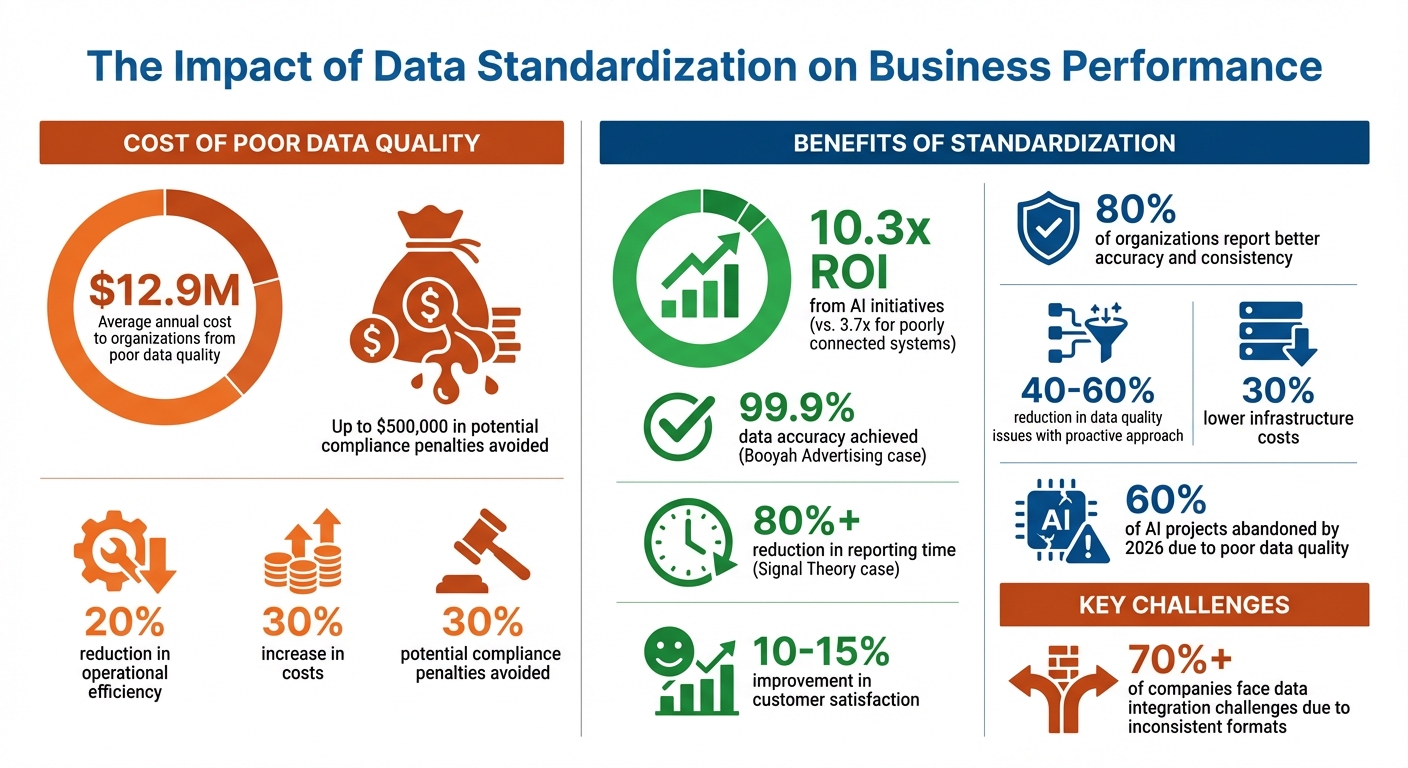
Data Standardization Benefits: Key Statistics and ROI Impact
What Is Data Standardization?
sbb-itb-d1a6c90
What Is Data Standardization?
Data standardization is all about transforming data from various sources into a consistent format based on established rules. Think of it as creating a single, uniform way to represent information. For example, terms like "California", "Calif.", and "CA" are all converted into one standardized version.
This process eliminates inconsistencies in how data is recorded, ensuring a solid foundation for tasks like reporting, automation, and decision-making. In fact, over 70% of companies face challenges integrating data due to inconsistent formats and lack of standardization. Let’s explore how this process works and why it’s so crucial.
The Basics of Data Standardization
Standardization tackles inconsistencies by focusing on three key areas: format alignment, unit harmonization, and structural uniformity.
- Format alignment: This ensures consistency in text case, date formats, and abbreviations. For instance, all street abbreviations like "St." are expanded to "Street", dates are standardized to MM/DD/YYYY, and phone numbers are formatted according to the E.164 international standard.
- Unit harmonization: Measurements are converted into a common standard. For example, weights might be converted to pounds, distances to miles, and currencies to U.S. dollars.
- Structural uniformity: This involves mapping different representations of the same data to a single "golden record." For instance, if one system uses "USA", another uses "United States", and a third uses "US", standardization ensures all systems use the same version.
The benefits of standardization are massive. Companies with well-integrated data systems see a 10.3x ROI from AI initiatives, compared to only 3.7x for those with poorly connected systems. As data governance expert Emily Winks puts it:
Standardization is the prerequisite for trustworthy AI at scale.
By creating a consistent structure, standardization paves the way for better analytics and smarter decisions.
Data Standardization vs. Data Cleansing
It’s easy to confuse these two concepts, but they serve different purposes in improving data quality. While data standardization focuses on creating consistent formats, data cleansing deals with identifying and fixing errors or removing duplicates.
Here’s a quick comparison:
| Concept | Primary Goal | Example |
|---|---|---|
| Data Standardization | Ensure consistent formats across values | Converting "Calif." and "California" to "CA" |
| Data Cleansing | Remove errors and duplicate records | Fixing a typo in a name or deleting duplicates |
Even if your data is error-free and has no duplicates, inconsistencies in formats can still cause problems. For example, if half your team records dates as "03/23/2026" and the other half uses "March 23, 2026", standardization is necessary to make the data usable across systems.
Data Quality Problems That Standardization Solves
Common Data Inconsistencies
Inconsistent data is a challenge that businesses face all the time. For example, date formats often vary - one team might use 03/23/2026, while another uses 23-03-2026 - making it nearly impossible to sort or compare records accurately. Address formats are another culprit: "NY", "N.Y.", and "New York" could all refer to the same place, but systems treat them as separate entries.
Measurement units add another layer of confusion. One department might log distances in miles, while another uses kilometers. Similarly, weights might be recorded in pounds or kilograms, creating obstacles for comparisons. Even text casing - like "SMITH", "smith", and "Smith" - can lead to duplicate records. Phone numbers are another headache, appearing as (555) 123-4567 or 5551234567, making it harder to match customer records. These discrepancies don’t just create minor annoyances - they disrupt workflows and impact overall business efficiency.
How Poor Data Quality Affects Business
These inconsistencies come with a hefty price tag. Poor data quality can reduce operational efficiency by 20% and drive up costs by 30%. Beyond financial losses, teams waste valuable time debating which data is correct instead of making decisions. For instance, marketing and sales teams might struggle to align on basic metrics, like what qualifies as a lead.
Mismatched data wreaks havoc on dashboards, too. Revenue might be displayed in different currencies, or distances could mix imperial and metric units, leading to inaccurate insights and misguided strategies. Automation tools and AI models - reliant on structured, standardized data - are especially vulnerable. Without clean data, these systems fail. It’s estimated that 60% of AI projects will be abandoned by 2026 due to poor data quality.
There’s also a legal risk. Regulations like GDPR and CCPA require businesses to manage personal data carefully. Without standardized records, locating and managing this data becomes a nightmare, potentially leading to hefty fines.
Without a common standard, data is just a collection of conflicting opinions.
Ultimately, teams spend more time cleaning up messy data than analyzing it, delaying critical decisions and slowing progress.
Benefits of Data Standardization
Better Data Accuracy and Consistency
When data variations like "CA", "Calif.", and "California" are standardized, it ensures that all systems are aligned and speaking the same language. This process removes ambiguity and helps avoid costly errors.
Take Booyah Advertising as an example - they achieved 99.9% data accuracy through standardization. This highlights how consistent data practices not only improve accuracy but also significantly reduce mistakes. In fact, studies show that 8 out of 10 organizations report better accuracy and consistency after adopting standardized data practices.
Schema enforcement plays a critical role here, acting as a quality checkpoint to prevent errors like text being entered into numerical fields. This ensures databases maintain their structural integrity. Additionally, validation rules applied during data entry - whether through SDKs or APIs - catch errors early, stopping them from spreading across systems. Fixing errors at this stage is far less expensive than cleaning up messy data later.
These improvements in accuracy pave the way for smoother operations, which we’ll explore next.
Increased Operational Efficiency
Standardization eliminates the time-consuming "data janitor" tasks that drain resources. Instead of manually reconciling whether "NYC" and "New York" refer to the same place, teams can focus on more valuable activities like strategic analysis.
The time savings are substantial. For instance, Signal Theory Inc. reduced their reporting time by over 80% after implementing standardized workflows. Analyst Shayna Tyler shared:
Reports that used to take hours now only take about 30 minutes. We're reporting for significantly more clients, even though it is only being handled by a single person.
Uniform data also enables automation, allowing organizations to generate weekly reports and KPI dashboards with minimal human intervention. This reduces errors and frees up staff for higher-level projects. Companies with strong data integration see a 10.3x ROI on AI initiatives, compared to just 3.7x for those with poor connectivity. Additionally, active metadata platforms can cut manual standardization efforts by 40% to 60%, thanks to automation.
Meeting Compliance Requirements
Beyond operational benefits, standardized data is essential for meeting regulatory requirements. Laws like GDPR, CCPA, and HIPAA demand precise data management, and standardization provides the structural consistency needed to comply with these regulations. For example, standardized personal information allows for faster processing of "Right to be Forgotten" requests and transforms audit preparation from a weeks-long headache into a task that can be completed in just hours.
Clear data lineage and strong compliance protocols also enable organizations to meet transparency requirements demanded by regulatory bodies. The financial impact of these efforts is notable - businesses can avoid up to $500,000 in compliance penalties by implementing proper standardization practices.
Boeing is a great example of this in action. By using ISO 10303 standards to standardize supplier data across its global supply chain, Boeing reduced specification errors, improved delivery timelines, and achieved rapid ROI through better supplier collaboration. In industries like healthcare and finance, where regulatory scrutiny is intense, standardization becomes the backbone of effective risk management.
How to Implement Data Standardization
Step 1: Review Your Data Sources
Start by mapping out all the systems that house critical information. This includes tools like CRMs, marketing platforms, ERPs, spreadsheets, manual logs, and even unstructured sources such as social media, PDFs, and news sites.
Once you’ve identified these sources, profile the data to uncover issues like inconsistent formats, conflicting names, missing values, and duplicate entries across APIs, SDKs, and databases. Focus on key data elements - like customer records, product codes, banking and financial tools, or campaign names - since these are most critical to your operations. This audit will pinpoint exactly where your data quality issues lie, helping you prioritize the areas that need the most immediate attention.
With a full understanding of your data landscape, you can move on to defining rules for standardization.
Step 2: Create Standardization Rules
Establish clear rules for how data should be formatted. For example, use ISO 8601 for dates, E.164 for phone numbers, and ISO 4217 for currencies. Decide on consistent naming conventions, such as snake_case or camelCase, and document everything in a centralized data dictionary.
Involve stakeholders from departments like marketing, sales, and finance early in the process. Their input ensures the rules align with cross-departmental needs and helps secure organizational support. This data dictionary will act as the definitive guide for how data should look across the company.
Once the rules are set, it’s time to clean and transform your data to align with these standards.
Step 3: Clean and Transform Your Data
Before transforming data, address basic issues like duplicates and errors - correcting typos in city names, for instance. Then, use ETL (Extract, Transform, Load) tools to standardize variations. For example, convert entries like "Calif." or "California" into the uniform code "CA."
Apply these rules at the point of data collection to prevent inconsistencies from entering your systems in the first place. This proactive approach, often called a "shift-left" strategy, can reduce data quality issues by 40% to 60%. Begin with a pilot project in a high-impact area, such as customer contact information, to demonstrate success before scaling standardization efforts across the organization.
Ongoing testing and monitoring are essential to maintaining data quality after transformation.
Step 4: Test and Monitor Data Quality
To ensure accuracy, compare samples of your standardized data against the original records. Use automated checks to validate data against predefined lists, such as verifying state codes are valid two-letter abbreviations.
Set up continuous profiling to catch issues like data drift, schema changes, or anomalies before they impact production systems. Automated alerts can notify data stewards when non-standard data or unusual patterns are detected. Instead of immediately deleting non-conforming data, quarantine it for manual review. Assign responsibility to dedicated data stewards who will oversee compliance and ensure these standards are upheld over time.
Through consistent monitoring and clear ownership, you can maintain the quality of your standardized data.
Using Data Standardization in Your Business
Now that we've covered how data standardization tackles inconsistencies and enhances efficiency, let’s dive into how it plays out in real-world business operations.
Real Applications for Standardized Data
Standardized data brings immediate advantages to various business areas. For instance, marketing teams can easily measure campaign performance across platforms when consistent naming conventions are used. A format like Date_Channel_CampaignType_Region allows seamless comparisons between Google Ads, Facebook, and LinkedIn campaigns, enabling precise cross-channel ROI analysis. These benefits extend beyond marketing, improving customer insights and streamlining financial reporting.
By integrating data from CRMs, email platforms, and web analytics, businesses can create a unified customer profile. This comprehensive view of the customer journey helps sales and support teams pinpoint where a customer stands in the pipeline. For example, Signal Theory Inc. reported a dramatic improvement in efficiency, cutting report preparation time by more than 80% through standardized workflows. Analyst Shayna Tyler shared:
Reports that used to take hours now only take about 30 minutes. We're reporting for significantly more clients, even though it is only being handled by a single person.
Financial reporting also benefits from standardization. Converting measurements (like pounds to kilograms) and currencies (such as Euros to USD) ensures financial data is consistent and comparable across regions. When businesses undergo acquisitions, harmonizing product SKUs and categories prevents inventory errors and simplifies order fulfillment by establishing a master product catalog. Additionally, standardized data makes it easier to locate, manage, and delete personal information, helping companies comply with GDPR and CCPA regulations.
Finding Data Tools on BizBot
BizBot’s directory is a valuable resource for finding tools to implement and maintain data standardization. It offers a curated selection of accounting software, management tools, and solutions tailored for small businesses and growing companies. BizBot focuses on simplifying operations with user-friendly tools that support data management, automated workflows, and CRM systems. These tools ensure data remains consistent and reliable throughout the customer journey. With BizBot, your business is equipped to uphold high data quality standards while reaping the benefits of standardization.
Conclusion
Standardizing data is critical for generating meaningful business insights. It removes errors and inefficiencies that, on average, cost businesses $12.9 million annually. By ensuring data reliability, companies can make quicker, more informed decisions, turning raw information into a dependable resource for strategy and operations.
This approach leads to tangible results. Businesses with effective data integration see a 10.3x return on investment (ROI) from AI, experience 10–15% improvements in customer satisfaction, and report that 80% of their data is more accurate.
To get started, target a high-impact area like customer contact details or campaign naming conventions. Define clear rules and implement automated validation at the point of entry. This proactive strategy can reduce data quality issues by 40–60% and lower infrastructure costs by around 30%.
Lastly, having the right tools makes all the difference. Explore BizBot's directory for carefully selected, easy-to-use solutions tailored for accounting, management, and data workflows. These tools simplify standardization efforts, even without a dedicated data team, ensuring your business operates with clean, reliable data.
FAQs
What data should I standardize first?
Start by focusing on standardizing essential data that plays a key role in your operations. This includes customer information - like addresses, names, and contact details - as well as key business metrics. Prioritize data that is shared often, used frequently, or prone to inconsistencies. Tackling issues such as mismatched formats or inconsistent naming conventions early on can ensure uniformity across systems, enhance analytics, and lead to more informed decision-making. By doing this, you lay a solid groundwork for expanding your data standardization efforts.
How is standardization different from cleansing?
Data standardization and cleansing serve different purposes but work hand in hand. Standardization involves converting data from multiple sources into a consistent format, making it easier to analyze and compare. Cleansing, however, is about spotting and fixing errors - like typos or incorrect details - to boost the accuracy of the data. Simply put, cleansing addresses errors, while standardization ensures a uniform structure for seamless usage and sharing.
How do I keep data standardized over time?
To keep data consistent and reliable, it's crucial to set clear data standards and governance policies. These guidelines should be applied consistently across all systems. Regular data cleaning and validation are also essential for catching and fixing errors or duplicates. Collaboration between teams plays a key role in maintaining these standards and ensuring consistency over the long term. By adopting continuous data governance practices, any discrepancies can be quickly resolved, helping to maintain the quality, accuracy, and dependability of your data over time.