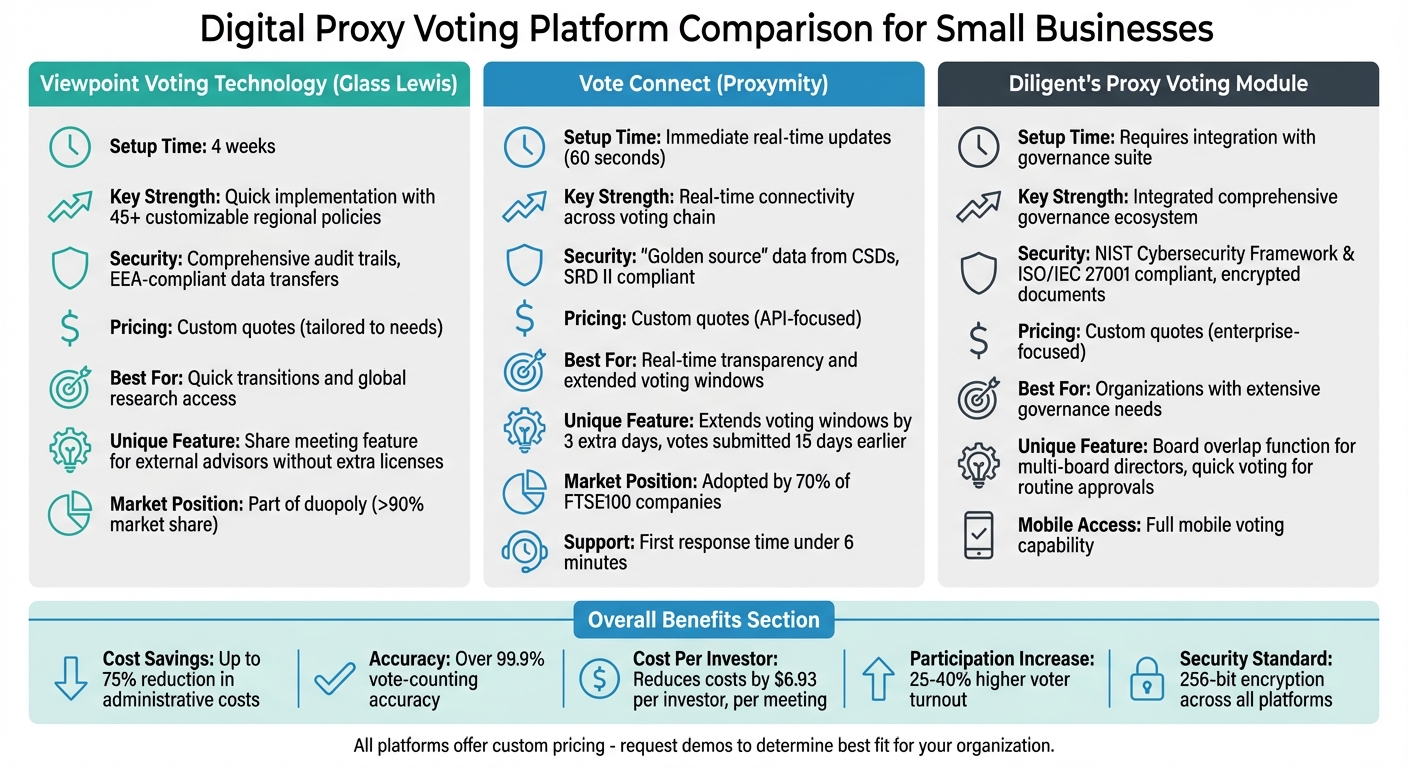
Digital proxy voting simplifies the way small businesses manage shareholder votes, replacing outdated paper-based systems with secure, online platforms. It reduces costs by approximately $6.93 per investor, per meeting, and increases participation rates by offering features like e-signatures, real-time tracking, and robust security measures such as 256-bit encryption.
Key platforms include:
- Viewpoint Voting Technology by Glass Lewis: Offers quick 4-week setup, customizable features, and strong security compliance.
- Vote Connect by Proxymity: Provides real-time updates in 60 seconds, extended voting windows, and global market access.
- Diligent's Proxy Voting Module: integrates with comprehensive board management solutions, offering mobile access and automated notifications.
These platforms address common challenges like lost votes, logistical inefficiencies, and manual errors, while catering to the digital preferences of Millennial and Gen Z leaders. By switching to digital solutions, businesses save up to 75% on administrative costs and achieve over 99.9% vote-counting accuracy, ensuring smoother governance processes.
Quick Comparison
| Feature | Viewpoint (Glass Lewis) | Vote Connect (Proxymity) | Diligent Proxy Module |
|---|---|---|---|
| Setup Time | 4 weeks | Immediate real-time updates | Requires integration with suite |
| Pricing | Custom quotes | Custom quotes | Custom quotes |
| Security | Comprehensive audit trails | "Golden source" data compliance | Encrypted documents |
| Best For | Quick implementation, research | Real-time voting, global access | Integrated governance needs |
For small businesses, digital proxy voting offers a modern, efficient, and secure way to improve governance while reducing costs and increasing participation.
Digital Proxy Voting Platforms Comparison for Small Businesses
Proxymity - Changing the way proxy voting works
sbb-itb-d1a6c90
1. Viewpoint Voting Technology by Glass Lewis
Viewpoint Voting Technology tackles challenges faced by small businesses with its adaptable pricing, quick setup, and strong security measures.
Pricing Accessibility
Glass Lewis doesn't list fixed prices for Viewpoint. Instead, pricing is tailored to each client, requiring a demo and a custom quote. While this approach may leave some questions initially, it allows small organizations to choose only the features they need, avoiding the costs of unnecessary extras typically required by larger investors.
Setup Time
One standout feature of Viewpoint is its quick implementation process. Businesses can start using the platform in as little as four weeks. For companies looking to modernize swiftly, this is a significant advantage over platforms that take months to deploy.
Security Features
The platform prioritizes data protection with advanced safeguards. Every action in the proxy voting process is logged, creating a comprehensive audit trail for compliance officers and stakeholders. For data transfers from the European Economic Area (EEA), Glass Lewis adheres to European Commission-approved standard contractual clauses. Additionally, the platform actively monitors for security incidents, helping to detect and prevent fraud.
Integration Ease
Viewpoint simplifies data management with customizable data feeds and various export options. This makes it easy to integrate with existing board management or shareholder tracking systems. Plus, Viewpoint works seamlessly with other Glass Lewis tools like N-PX Reporting and Vote Disclosure services. John Wieck, Glass Lewis' Chief Operating Officer, highlighted the company's focus on innovation:
Our partnership with Proxymity demonstrates our commitment to improving the timeliness, accuracy and transparency of the proxy voting process through the use of modern technologies and streamlined solutions.
These integration features are particularly helpful for small businesses that need efficient, connected solutions.
SMB-Specific Benefits
Viewpoint includes features tailored to smaller teams. For example, the "share meeting" feature lets businesses temporarily grant access to external consultants, legal advisors, or board members for voting or commenting - without requiring additional user licenses. This is especially valuable for small businesses that depend on external expertise during key decisions. Additionally, the platform provides access to Glass Lewis' governance research and vote recommendations, typically available 20 days before annual general meetings. This research support is a practical resource for small teams without dedicated research capabilities.
| Feature | SMB Benefit |
|---|---|
| Share Meeting | Collaborate with external advisors without needing full user licenses |
| Customizable Filters | Quickly focus on the most important votes |
| N-PX Reporting | Reduces the administrative workload of regulatory compliance |
| Real-time APIs | Ensures accurate, up-to-date voting entitlements and extended deadlines |
2. Vote Connect by Proxymity
Vote Connect by Proxymity focuses on real-time connectivity across the entire proxy voting chain. By linking issuers, intermediaries, and investors through a cloud-based system, the platform delivers meeting updates in just 60 seconds to connected parties. This rapid communication helps cut down processes that once dragged on for weeks, making governance more efficient for small businesses.
Pricing Accessibility
Proxymity doesn't publicly share standard pricing tiers, but its focus is on efficient data transmission via its API. Clients have praised it for providing "genuine transparency and value for their money". Instead of paying for unnecessary extras, small businesses benefit from streamlined operations tailored to their needs.
Security Features
The platform pulls "golden source" data directly from issuers and Central Securities Depositories (CSDs). It also updates voted share amounts in real time, reducing errors caused by manual processing. Jonathan Smalley, Proxymity's COO and Co-founder, highlighted this focus:
"The launch of Vote Connect Total... realizes Proxymity's long-held ambition to deliver unique value and choice to our customers... ensuring maximum privacy and security of shareholder information".
Vote Connect complies with global regulations, including the Shareholder Rights Directive (SRD II), reinforcing its commitment to secure and transparent operations.
Integration Ease
Vote Connect supports multiple communication methods - SWIFT, APIs, and trusted third-party tools - allowing businesses to customize their notification and voting workflows. For small businesses already using tools like board management or shareholder tracking systems, the platform integrates smoothly without requiring major overhauls. Processes like ballot generation, which used to take weeks, now happen in minutes. Additionally, intermediaries gain access to a dedicated portal with real-time updates and tailored reports.
SMB-Specific Benefits
The platform’s efficiency translates into clear advantages for smaller teams. Vote Connect extends voting windows by an average of three extra days, giving small businesses more flexibility to make informed decisions. Votes can also be submitted up to 15 days earlier than with traditional methods. For teams without dedicated governance staff, automating data handling reduces costs and lowers the risk of errors. Customer support is another strong point, with a first response time of under 6 minutes - critical during fast-paced voting periods.
| Feature | Small Business Impact |
|---|---|
| Real-Time Updates | Meeting updates delivered in 60 seconds |
| Extended Deadlines | Gain 5 extra days for investment decisions |
| Digital Confirmation | Proof that votes were received and recorded |
| Global Coverage | Access over 100 markets through one platform |
Next, we’ll delve into Diligent's Proxy Voting Module for a more comprehensive comparison.
3. Diligent's Proxy Voting Module
Diligent's Proxy Voting Module works seamlessly within a comprehensive boards ecosystem. Unlike standalone tools, this module integrates directly into a centralized dashboard that board members already use to manage documents and governance tasks. This setup not only enhances security - meeting the NIST Cybersecurity Framework and ISO/IEC 27001 standards - but also simplifies governance processes, offering a streamlined and cost-conscious digital proxy solution. Tammy Welcome from American Water Works highlighted its impact:
Our meetings are running fluidly. We had an uptick in conversations with our directors.
Security Features
The module ensures sensitive documents are encrypted both before and after signing. It also provides granular permissions, letting administrators control who can access documents, receive notifications, and cast votes. For confidential matters, it supports both transparent and anonymous voting, safeguarding director privacy. Real-time vote tallying creates an instant audit trail, while directors can securely vote from any device. Additionally, secure electronic signature workflows uphold the integrity of crucial regulatory filings like 10-K and SEC documents.
Integration Ease
Because the voting module is built into the Diligent Boards platform, existing users can integrate it effortlessly without needing third-party tools. A standout feature, the "board overlap function", allows directors serving on multiple boards to use their profiles and electronic signatures across different logins without re-entering details. However, advanced features may require extra setup, which some small businesses find less intuitive compared to simpler tools. G2 reviews from July 2024 note that competitors may offer easier setup for smaller organizations.
SMB-Specific Benefits
For small businesses, the module includes a "quick voting" feature, ideal for routine approvals like meeting minutes or unanimous consents. Mobile access makes it easy for leaders without dedicated administrative staff to coordinate votes remotely, eliminating the need for formal in-person sessions. Automated notifications reduce the burden of manual follow-ups, and the platform scales with organizational growth. Administrators can also customize vote types - whether yes/no, for/against/abstain, or signature-based - to align with specific governance requirements.
Pricing Accessibility
Diligent does not provide standard pricing details; businesses must request a quote or demo to understand costs. Its positioning as an enterprise-grade solution reflects its advanced capabilities, which may exceed the needs of smaller organizations. General online voting software for small businesses typically costs between $5 and $10 per user, but additional features can influence pricing. Small businesses should carefully assess whether Diligent's extensive feature set aligns with their governance needs before committing.
Pros and Cons
For small businesses looking for affordable and efficient digital proxy voting solutions, each platform comes with its own set of benefits and challenges.
Viewpoint Voting Technology (from Glass Lewis) stands out with its quick 4-week setup and access to over 45 customizable regional policies. However, being part of a duopoly controlling more than 90% of the proxy advisory market, it risks adopting a generalized approach. There’s also the potential for conflicts of interest if Glass Lewis offers consulting services alongside its voting platform.
Vote Connect by Proxymity excels with real-time updates delivered in just 60 seconds and extends voting windows by up to three days. By using "golden source" data, it eliminates manual errors, making the process smoother. That said, it relies heavily on internet connectivity and runs the risk of reducing voting to a mere formality, as some investors might not engage deeply with the process.
Diligent's Proxy Voting Module integrates proxy voting into a larger governance system, making it a comprehensive tool for organizations with broader needs. However, its complex implementation process and lack of transparent pricing can be a hurdle for small businesses. With typical online voting system costs ranging between $5 and $10 per user, Diligent’s pricing may stretch beyond smaller budgets.
Digital proxy voting, in general, offers substantial advantages: it can increase voter turnout by 25% to 40% and cut administrative costs by 60% to 75% compared to traditional paper-based methods. Automation also improves vote-counting accuracy to over 99.9%, solving long-standing issues like the 75% of issuers reporting "lost" votes in the past.
Here’s a quick comparison of the key features for these platforms:
| Feature | Viewpoint (Glass Lewis) | Vote Connect (Proxymity) | Diligent Proxy Module |
|---|---|---|---|
| Primary Strength | 45+ regional policies; 4‑week setup | Real‑time updates; 60‑second data delivery | Integrated governance suite |
| Market Position | Part of a duopoly (>90% market share) | Adopted by 70% of FTSE100 companies | Enterprise‑focused |
| Key Limitation | Potential conflicts of interest | Internet dependency; risk of box‑ticking | High cost and complex implementation |
| Pricing Transparency | Custom quotes | Custom quotes | Details available upon inquiry |
| Best For | Quick transitions; global research | Real‑time transparency; extended voting windows | Organizations with extensive governance needs |
Recommendations and Additional Resources
To make the best choice for your small business, start by reviewing your organizational bylaws. Confirm that digital proxy voting is allowed and check for any specific rules about who can serve as a proxy. This initial step can save you from compliance issues later on.
Next, align your budget with your voting needs. If your voting events are infrequent - like annual general meetings or quarterly board elections - pay-per-election pricing (typically $19–$29 per event) might be the most cost-effective option. On the other hand, if you need frequent voting, monthly subscription plans ranging from $50 to $500 could be a better fit. Platforms like Simply Voting even offer a free basic version, which can complement the pricing strategies discussed earlier.
When comparing platforms, focus on security and usability. Look for features like 256-bit encryption and two-factor authentication to keep your voting process secure. If your organization uses weighted voting to reflect shareholder equity, ensure the platform supports this functionality. Additionally, the system should be simple enough for non-technical shareholders to use, encouraging higher participation rates. Before committing to a platform, always request a live demo or free trial to test features like the setup wizard and ballot designer. This hands-on experience can confirm whether the platform integrates easily and meets your needs.
For those interested in exploring additional tools, BizBot's directory is a great resource. It offers curated solutions tailored to small businesses, freelancers, and growing companies, covering everything from ownership management to board administration.
Beth B., CFO of a privately held company, shared her experience:
Amazing client onboarding program – the implementation team relieved the burden and guided us every step of the way... No other solution included product for small to midsized privately held corporations.
This level of support can make the transition from paper-based to digital voting much smoother. By following these steps, you’ll be well-prepared for a seamless shift to digital proxy voting.
Conclusion
Switching to digital proxy voting offers small businesses a modern way to improve governance with efficient tools. Moving away from paper-based systems can reduce administrative costs by up to 75% and increase voter turnout by as much as 40%. These changes fundamentally reshape how small businesses connect with their stakeholders.
Take the example of Asplundh Tree Expert Company. In early 2023, they replaced physical mailings with digital proxy voting. General Counsel Ann Hook highlighted how the company not only saw a sharp rise in proxy participation but also created a comprehensive digital record, eliminating the need for physical storage. This isn’t an isolated case - digital solutions are transforming governance challenges across the board.
But the benefits go beyond just saving money. Digital platforms tackle persistent issues in traditional systems. For instance, 75% of issuers reportedly lose votes in legacy processes, and 61% fail to notify institutional shareholders about meetings. Modern platforms, however, offer 99.9%+ vote counting accuracy and real-time dashboards, delivering the transparency stakeholders now demand. This is particularly relevant as 85% of investors factor ESG considerations into their decisions.
The generational shift in leadership also plays a role. Millennials and Gen Z leaders prefer mobile-first, paperless solutions, aligning perfectly with digital proxy voting. Dean Little, Co-founder and CEO of Proxymity, summed it up well:
The digital age has ushered in a new era of shareholder democracy where all shareholders, regardless of size, have access to regular information about company affairs.
For small businesses ready to embrace this change, the process is straightforward. First, ensure your bylaws permit digital voting. Next, pick a pricing model that suits your voting needs. Finally, choose platforms with strong security features like 256-bit encryption and two-factor authentication. As shown earlier, selecting secure and efficient platforms is key to success. Digital proxy voting paves the way for a more engaged and transparent organization.
FAQs
Is digital proxy voting legally valid for my company?
Digital proxy voting is acceptable for U.S. companies as long as it aligns with laws and SEC regulations. This means following procedural rules, providing clear disclosures, and using secure platforms that meet compliance standards. To stay on the right side of the law, companies should stick to the latest SEC guidance and work with legal professionals to navigate any changes in regulations.
How do I choose the right pricing model for my voting needs?
When choosing the right pricing model for digital proxy voting, it's important to weigh factors like your organization's size, how often you hold votes, and the features you need. For smaller organizations with straightforward requirements, flat-rate or pay-per-election plans might be the most practical. On the other hand, if your organization conducts frequent or large-scale voting, a subscription-based model could offer better value.
Make sure the pricing aligns with your budget while covering key features like voter registration and secure ballot collection. At the same time, strike a balance between affordability, ease of use, and security to ensure a smooth voting process.
What security features should I require before switching?
Before transitioning to a digital proxy voting system, it's crucial to prioritize strong security measures. Features like secure data encryption, reliable user authentication, and comprehensive audit trails are essential to safeguard the integrity of the voting process. Additionally, make sure the system offers transparent procedures, secure delivery of electronic ballots, and adheres to all necessary regulations. These elements are key to protecting shareholder information, ensuring vote confidentiality, and providing a clear audit trail for future verification. Such safeguards are vital for maintaining trust and upholding the legal credibility of the process.