Data Loss Prevention (DLP) isn’t just for large corporations. Small and medium-sized businesses (SMBs) are increasingly using these tools to protect critical data, meet compliance standards, and avoid costly breaches. Here’s how three SMBs tackled their data protection challenges:
- Engineering Firm: Secured intellectual property using a cloud-based DLP solution, reducing costs and meeting compliance deadlines in under 90 days.
- Healthcare Provider: Adopted blockchain-based DLP to protect patient data, cut breaches, and simplify compliance.
- Retail Business: Leveraged Microsoft 365’s built-in DLP features and external monitoring to reduce cybersecurity costs and improve data visibility.
With 46% of cyberattacks targeting SMBs, the risks are high. But modern DLP solutions - like cloud platforms, blockchain, and built-in tools - offer affordable and effective ways to safeguard sensitive information. SMBs can start by prioritizing high-risk data, rolling out DLP in phases, and using automated tools to reduce manual effort.
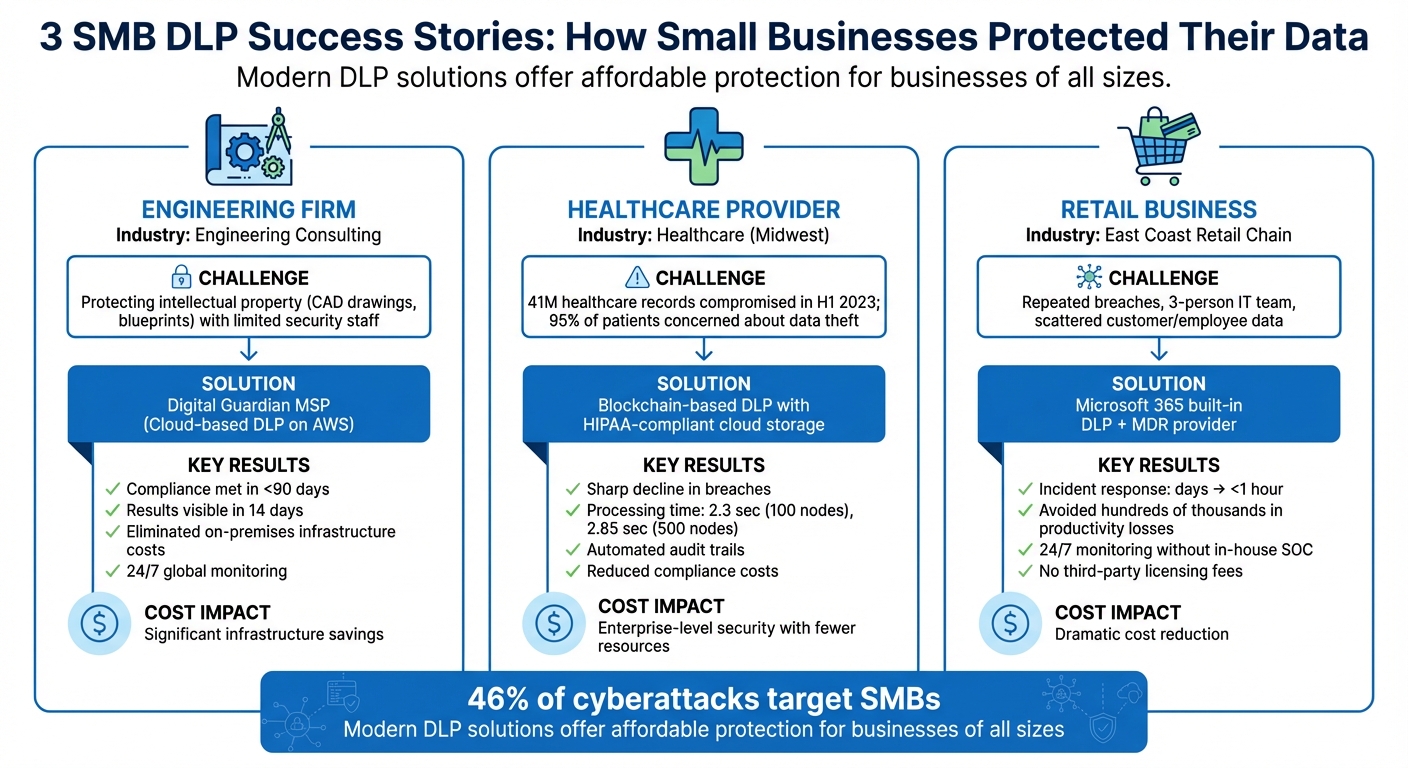
3 SMB DLP Success Stories: Challenges, Solutions & Results Comparison
Case Study 1: Engineering Firm Protects Trade Secrets with Digital Guardian MSP
io Consulting's experience highlights how a focused Data Loss Prevention (DLP) strategy can address the unique challenges faced by small and medium-sized businesses (SMBs).
Challenges Faced
The firm needed to safeguard its growing repository of intellectual property - like design specifications, CAD drawings, and blueprints - from sophisticated cyber threats. Compounding the issue, they were grappling with a shortage of skilled security personnel and tight compliance deadlines. These factors made finding a robust, cloud-based DLP solution a pressing priority.
Solution Implemented
To tackle these challenges, io Consulting turned to Digital Guardian's Managed Security Program (MSP), a cloud platform hosted on AWS. This solution filled their security talent gap by providing access to skilled InfoSec analysts, customized data protection policies tailored to safeguard sensitive data like PCI, PII, and PHI, and round-the-clock global monitoring to counter both insider and external threats.
Results Achieved
The results were swift and impactful. Within just 14 days, io Consulting began seeing tangible outcomes, and they successfully met their compliance deadlines in under 90 days. By adopting this cloud-based solution, they eliminated the need for expensive on-premises infrastructure, significantly cutting costs. This shift also allowed internal teams to focus on strategic initiatives, enhancing client trust and satisfaction.
"With Fortra Managed Security Program, we can be completely transparent with our clients about how we handle their data, giving them peace of mind that their sensitive data is fully protected."
- John Barton, Chief Information Officer, io Consulting
On top of cost savings and compliance, the firm gained unparalleled visibility into how data moved across endpoints, networks, and the cloud. This newfound clarity enabled them to monitor and control data exposure without disrupting daily operations.
Case Study 2: Healthcare SMB Cuts Breaches with Blockchain-Based DLP
A small healthcare provider in the Midwest faced a wake-up call after 41 million healthcare records were compromised in the first half of 2023. Their limited security team struggled with outdated, manual processes and lacked a clear picture of how patient data moved through their systems. These gaps highlighted an urgent need for a better data protection strategy.
Challenges Faced
The practice faced significant hurdles due to limited resources and an understaffed compliance team, making it difficult to monitor access to Protected Health Information (PHI) or manage complex security tools. On top of that, 95% of their patients expressed concerns about data theft or leaks. Breaches involving stolen credentials were particularly alarming, with an average of 292 days needed to detect and contain them.
Solution Implemented
To address these vulnerabilities, the provider adopted a blockchain-based cloud Data Loss Prevention (DLP) system. This innovative approach distributed data across a decentralized network, eliminating single points of failure. Instead of storing PHI directly on the blockchain, they used HIPAA-compliant cloud storage providers for the actual data, while cryptographic hashes were recorded on the blockchain. This setup ensured compliance with HIPAA's "Right to Amend" requirements.
Smart contracts played a key role by automating permissions. Only authorized personnel, such as doctors and staff, could access patient records using unique IDs and private keys.
"Blockchain's immutability provides a secure environment for patient data, relieving concerns and restoring trust."
- Scott Doughman, Chief Business Officer, Seal Storage Technology
Results Achieved
The results were striking. The practice experienced a sharp decline in breaches and reduced their compliance costs. Blockchain's tamper-proof ledger automatically generated an audit trail for every access event, simplifying regulatory compliance. Performance testing showed impressive scalability, with processing times of 2.3 seconds for 100 nodes and 2.85 seconds for 500 nodes. This allowed the provider to achieve enterprise-level security, all while operating with far fewer resources than larger hospitals.
Case Study 3: Retail SMB Cuts Cybersecurity Costs with Targeted DLP
A small retail chain on the East Coast was grappling with increasing cybersecurity threats while operating on a tight budget. Without the resources for a full-time Security Operations Center (SOC) and relying on outdated antivirus software, the business suffered repeated security breaches. These incidents forced its small IT team to abandon key strategic projects, resulting in productivity losses worth hundreds of thousands of dollars.
Challenges Faced
The retailer faced significant hurdles in managing its data. Customer payment information, employee records, and inventory details were scattered across multiple platforms, making it difficult to classify and protect sensitive data. With only three IT staff members, the team lacked the expertise to handle complex alerts or operate advanced Data Loss Prevention (DLP) tools effectively. Adding to the challenge, the hybrid work setup and unauthorized SaaS tools created visibility gaps, further straining their limited budget.
Solution Implemented
To address these issues, the retailer leveraged the built-in DLP features available in their Microsoft 365 Business Premium subscription, avoiding the need for costly third-party licensing fees while securing their critical data assets. They also partnered with a Managed Detection and Response (MDR) provider, ensuring 24/7 monitoring and incident remediation without the financial burden of maintaining an in-house SOC.
Results Achieved
The retailer saw a dramatic reduction in cybersecurity costs and a significant improvement in incident response times, cutting resolution windows from days to less than an hour. With automated threat responses in place, the IT team was able to refocus on strategic projects, preventing further productivity losses worth hundreds of thousands of dollars. This case highlights how targeted DLP strategies can be a game-changer for small and medium-sized businesses.
sbb-itb-d1a6c90
Lessons and Best Practices for SMBs Using DLP
Drawing from the case studies, small and medium-sized businesses (SMBs) often face similar challenges when implementing Data Loss Prevention (DLP) solutions. However, these challenges can be addressed with focused strategies.
Common Challenges
The examples above underscore several hurdles SMBs encounter with DLP.
One major obstacle is budget. With the average cost of a data breach reaching $4.35 million and enterprise DLP tools priced at over $10,000 annually (not including management costs), many SMBs find it difficult to allocate sufficient funds for business administration tools. Resource limitations make matters worse. While 72% of organizations rely on two or more DLP solutions, 29% report difficulties in managing them effectively. Many SMBs also lack dedicated IT security staff, leading to frequent false alerts and unnecessary fatigue . The rise of hybrid work has further complicated matters. Employees using personal, unsecured devices to access company data have created visibility gaps, leaving businesses vulnerable to breaches.
Implementation Strategies
SMBs can overcome these challenges by adopting targeted strategies for DLP implementation.
Start with a data audit to classify information into risk levels - high (e.g., personally identifiable information or intellectual property), medium (e.g., internal guides), and low (e.g., public data). This helps prioritize which data needs the most protection. Next, roll out DLP in phases. Begin with a pilot program focusing on high-risk departments like Finance or HR to test and refine rules before scaling up across the organization . Initially, focus on securing data in motion - for example, by blocking unauthorized uploads to personal cloud storage or USB devices. Implement adaptive policies that adjust based on user behavior and risk levels to reduce disruptions to daily workflows. Lastly, use solutions that provide real-time nudges to employees when they violate policies. This proactive approach turns security into a collaborative effort rather than a hindrance .
Results Comparison Table
| Metric | Engineering Firm | Healthcare SMB |
|---|---|---|
| Primary Challenge | Industrial espionage costing $100,000 per lost customer | Partner compliance mandate within 18 months |
| Solution Approach | DLP monitoring of communication channels | Managed Security Program with Fortra DLP |
| Key Result | Identified insider threat, recovered customers, competitor closed | Compliance achieved ahead of schedule; security team became a business partner |
| Cost Impact | Prevented ongoing $100,000 losses per customer | Avoided hiring additional personnel |
| Cultural Shift | Improved employee security mindfulness | Shifted from a restrictive approach to being an enabler |
Conclusion
The three case studies highlight an important shift: Data Loss Prevention (DLP) isn't just for large enterprises anymore. Small and medium-sized businesses (SMBs) can now protect sensitive data, meet compliance requirements, and reduce security expenses and utilize smarter business banking tools - even with tight budgets and lean teams.
Each case study showcases a tailored approach for a specific industry. For instance, an engineering firm avoided ongoing financial losses by detecting insider threats early through precise DLP monitoring. A healthcare analytics company achieved compliance ahead of schedule without needing to expand its workforce by using a Managed Security Program. Meanwhile, a retail SMB significantly cut cybersecurity costs by adopting a focused DLP strategy. These examples prove that the right DLP solution can pay for itself by preventing breaches that would otherwise harm an SMB’s finances and reputation.
The urgency for SMBs to adopt DLP is clear. With 46% of cyberattacks targeting SMBs and 77% of organizations experiencing insider-driven data loss, the risk is too great to ignore. Fortunately, modern DLP tools offer scalable options for every budget. SMBs can make use of built-in tools in platforms like Microsoft 365, collaborate with managed security providers to keep costs down, or implement AI-driven solutions that automate up to 80% of security tasks.
The best place to start? Focus on what matters most. Conduct a data inventory to pinpoint your highest-risk information, address common leak points like email and cloud storage, and roll out policies in manageable phases. As one healthcare security director wisely stated, "Getting budget for security solutions was simple compared to getting budget for additional personnel".
Whether you're safeguarding trade secrets, patient data, or customer payment information, these real-world examples show that SMBs can turn security challenges into opportunities. By adopting the right strategies, businesses can protect their assets while gaining a competitive edge. These lessons offer a practical roadmap for SMBs aiming to build robust DLP practices.
FAQs
How can small and medium businesses (SMBs) select the best DLP solution for their needs?
To select the right Data Loss Prevention (DLP) solution, small and medium-sized businesses (SMBs) should begin by identifying and organizing their sensitive data. This includes customer details, financial documents, or intellectual property, and determining where this data resides - whether in cloud applications, servers, or employee devices. Additionally, make sure to account for any industry-specific regulations like HIPAA or GDPR that your business must comply with.
When evaluating DLP providers, focus on factors like compatibility, scalability, and budget. Prioritize solutions that integrate smoothly with your current tools (such as Microsoft 365 or Google Workspace), provide robust data monitoring and protection, and are simple to manage without requiring a large IT team. Cloud-based DLP solutions are often a practical and budget-friendly option for SMBs, offering the flexibility to start small and grow as your needs evolve.
Lastly, consider conducting a pilot program to test the solution in action. Pay attention to key metrics like accuracy, user-friendliness, and how effectively it meets your security requirements. The right DLP system will protect your data while keeping your operations straightforward and manageable.
What are some budget-friendly ways for SMBs to implement data loss prevention (DLP)?
Small and medium businesses (SMBs) don’t need to break the bank to implement data loss prevention (DLP) strategies. Many popular cloud platforms, like Microsoft 365 or Google Workspace, already come with built-in security features. These can help detect, block, or encrypt sensitive data without requiring extra licenses. Combine these tools with lightweight mobile device management (MDM) software to extend protection across laptops, tablets, and phones - all managed from a single platform. This approach eliminates the need for costly standalone DLP solutions.
To get started, prioritize critical data such as customer details, payment records, or intellectual property. Use simple classification tools to label this data and enforce strict security measures only on these high-risk assets. This targeted approach reduces the load on your DLP system and keeps expenses in check. Another effective yet affordable step is employee training. Teaching your team how to properly handle sensitive information can significantly enhance security without requiring major investments.
For a more budget-conscious approach, consider rolling out your DLP strategy in phases. Start with a pilot program focused on one department or a specific type of data. Evaluate its performance and expand gradually. Opting for subscription-based pricing models that grow with your business can also help manage costs. If you’re looking for affordable DLP tools, BizBot’s directory of business solutions is a great resource for finding options tailored to SMB budgets.
How can blockchain-based DLP systems improve data security for healthcare organizations?
Blockchain-based data loss prevention (DLP) systems bring a new level of security to healthcare organizations. They create an unchangeable ledger where access-control policies and audit logs are stored. This means every change and access attempt is recorded in a way that’s both transparent and resistant to tampering.
These systems also rely on decentralized, encrypted, role-based permissions to control who can access sensitive health information. This ensures that only authorized individuals can view or share protected data, safeguarding confidentiality and minimizing the chances of breaches. By blending transparency with strong encryption, blockchain DLP solutions provide a secure and reliable way to manage healthcare data.