Anti-Money Laundering (AML) training is mandatory for financial institutions, but how do you measure its success? Tracking the right metrics ensures your training is effective, aligns with compliance goals, and helps avoid costly fines. Here are the top 10 metrics to evaluate AML training outcomes:
- Completion Rates: Measures participation but doesn’t guarantee knowledge retention.
- Assessment Scores: Tests understanding and practical application of AML concepts.
- Number of Cases Identified: Tracks how well employees detect suspicious activities.
- Suspicious Activity Reports (SARs) Filed: Reflects timely and accurate reporting.
- Employee Engagement Levels: Shows how actively employees interact with training.
- Participant Feedback Scores: Gauges clarity and relevance of training content.
- Time Spent on Training Modules: Indicates engagement and potential content issues.
- Pre- and Post-Training Knowledge Improvement: Measures learning progress.
- Behavioral Changes in Compliance Adherence: Observes real-world application of training.
- Training Relevance Ratings: Assesses how useful the content is for employees’ roles.
These metrics go beyond completion rates, providing actionable insights into training effectiveness. For example, combining SAR filing data with assessment results can highlight gaps and improve compliance efforts. With $22.6 billion in AML-related fines recorded from 2013–2020, tracking these metrics isn’t just helpful - it’s critical to mitigating risks and meeting regulatory requirements.
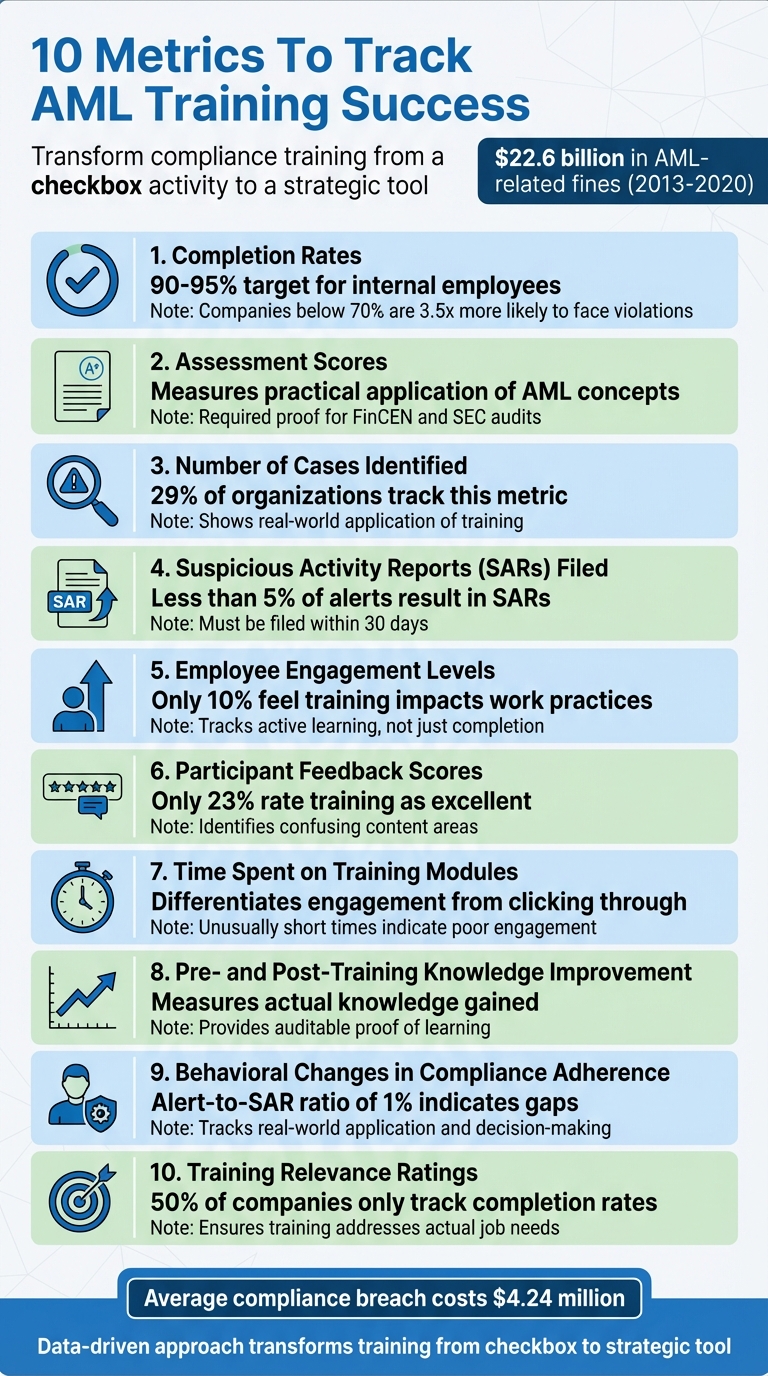
10 Key Metrics to Track AML Training Success
Significance of AML Data Accuracy & Its Alignment with Training Requirement (Webinar series)
1. Completion Rates
Completion rates represent the percentage of employees who finish AML training. This metric acts as an initial gauge of your training program's health, offering a glimpse into how engaged employees are and whether the content resonates with them. Interestingly, 50% of companies rely on completion rates as their primary measure of training effectiveness, making it a widely used starting point. However, it's essential to dig deeper to understand how these rates translate into meaningful outcomes.
Effectiveness in Measuring Training Outcomes
While completion rates are a quick way to measure participation, they don’t tell the whole story. They fail to show whether employees are retaining the information or applying it in real-world scenarios. In fact, only 10% of employees feel that compliance training significantly impacts their work practices. So, while these rates provide a baseline, they need to be paired with other metrics to truly assess the training's effectiveness.
Relevance to AML Compliance Goals
For AML compliance, keeping detailed records of completion rates is essential, especially during regulatory audits. Falling short in this area can have serious consequences - companies with completion rates below 70% are 3.5 times more likely to face regulatory violations. To mitigate such risks, top-performing organizations aim for completion rates of 90–95% for internal employees and 80–90% for external contractors or partners. There’s a financial incentive too: one company that boosted its completion rate from 85% to 95% saved $3.7 million by avoiding non-compliance fines.
Ease of Tracking and Reporting
Modern LMS platforms make tracking and reporting completion rates much simpler. For example, in 2024, BlackSky moved from manually tracking data in Excel to using automated LMS tools and achieved a 100% completion rate in just two weeks. Features like single sign-on (SSO), automated email reminders, and mobile-friendly modules make it easier for employees to complete training during their downtime.
Impact on Overall Compliance Performance
Higher completion rates often lead to broader organizational improvements. Companies with rates above 80% report 34% higher employee engagement scores. However, completion rates alone don’t guarantee compliance success. As Fizza Nabeel from DRIDER explains:
Quantifying compliance training effectiveness is not a luxury; it's a necessity for businesses operating in a regulated environment.
To get a full picture of training impact, completion rates should be combined with other metrics like assessment results and observed behavioral changes. Together, these metrics provide a more thorough understanding of how effective your AML training program truly is.
2. Assessment Scores
Ensuring employees not only complete AML training but also truly grasp its concepts is essential. Assessment scores serve as a clear indicator of how well employees understand AML principles. Low scores can highlight gaps in knowledge or reveal areas where the training materials might need improvement.
Effectiveness in Measuring Training Outcomes
Assessment scores go beyond testing memory - they evaluate how well employees can apply AML knowledge in practical scenarios. For example, scenario-based questions might ask employees to identify red flags in transactions or decide when to file a Suspicious Activity Report. These real-world simulations help measure how employees perform under realistic conditions. Using a mix of question formats, like interactive hotspots or open-ended responses, adds depth to the evaluation process.
Relevance to AML Compliance Goals
Regulators, such as FinCEN and the SEC, require organizations to demonstrate the effectiveness of their training programs. Assessment scores provide measurable proof of the knowledge employees gain through training.
This becomes even more critical as regulatory requirements evolve. For instance, starting January 1, 2028, U.S. Registered Investment Advisers must comply fully with the Bank Secrecy Act. This includes mandatory staff training and independent testing, making assessment scores a key piece of evidence during audits.
Ease of Tracking and Reporting
Modern Learning Management Systems (LMS) make it simple to track metrics like average scores, pass rates, attempts per module, and time spent on training. These platforms provide real-time data, allowing compliance officers to pinpoint teams or individuals who may need additional support.
Impact on Overall Compliance Performance
Strong assessment scores confirm that employees are equipped to spot suspicious activities and fulfill reporting duties. Given that traditional AML monitoring systems often generate false-positive rates as high as 93% to 99.5%, well-trained staff play a crucial role in identifying actual threats. Tying assessment results to performance reviews can also encourage active participation. Regularly updating quizzes to align with changes in AML regulations - like new sanctions or beneficial ownership rules - ensures that training stays relevant and effective.
3. Number of Cases Identified
The number of cases identified serves as a clear indicator of whether employees are applying their training to detect suspicious activities effectively.
Effectiveness in Measuring Training Outcomes
This metric highlights how well training translates into actionable results. When employees spot and report suspicious transactions, it demonstrates their ability to apply what they've learned to real-world scenarios. According to a PricewaterhouseCoopers study, 29% of organizations evaluate AML training effectiveness by tracking AML-related Suspicious Activity Reports (SARs) filed after training sessions.
"equip employees with the knowledge and skills to identify and report suspicious activities accurately." - Financial Crime Academy
A higher number of reported cases - provided they are mostly valid - signals that the training is working. However, it's not just about quantity; the quality of these reports matters too. If most cases are false positives, it may indicate the need for more focused training to help employees better differentiate between genuine threats and routine activities. This metric bridges the gap between theoretical knowledge and practical application.
Relevance to AML Compliance Goals
From 2013 to 2020, the United States incurred $22.6 billion in AML-related fines, with insufficient training being a leading factor. Tracking the number of identified cases helps organizations avoid costly compliance failures. When employees consistently recognize and report suspicious activities, it demonstrates to regulators that the organization’s training program delivers measurable outcomes - not just participation certificates.
Ease of Tracking and Reporting
Modern case management systems make it easier to monitor this metric. These systems connect transaction monitoring alerts directly to case creation, providing detailed audit trails. You can see which employees identified specific cases, when they flagged them, and how each case was resolved. Organizations can also categorize cases by the type of AML issue, compare identification rates before and after training, and evaluate how many identified cases lead to filed SARs. Integrating these tools with compliance dashboards ensures training metrics are used strategically across the organization.
Impact on Overall Compliance Performance
Tracking this metric not only measures training success but also helps pinpoint areas for improvement. For instance, if employees consistently miss red flags like structuring patterns or unusual wire transfers, targeted training can address these gaps before they lead to significant compliance risks. Combining case identification data with participant feedback and assessment results provides a well-rounded view of the training program’s strengths and areas needing refinement.
4. Suspicious Activity Reports (SARs) Filed
The number of SARs filed reflects not just how well employees identify potential issues, but also how consistently they report them. This metric shows whether your training program leads to actionable compliance results, rather than just raising general awareness.
While identifying suspicious activities is the first step, SAR filings confirm that employees are following through in line with regulatory requirements.
Effectiveness in Measuring Training Outcomes
SAR filings offer tangible proof that employees can apply their training when it matters most. The SAR conversion rate (SARs filed compared to alerts generated) highlights how effectively staff distinguish real concerns from false positives. In the financial industry, where false-positive rates often range from 93% to 99.5%, fewer than 5% of alerts typically result in a SAR filing.
"An increase in the number of SARs filed may suggest an improved ability to identify and report suspicious activities, indicating that the training has successfully enhanced employees' awareness and vigilance." - KyrosAML
Tracking increases in SAR filings can help measure the immediate impact of training efforts. However, if the SAR conversion rate is as low as 0.1%, it may signal the need for more focused training on specific red flags.
Relevance to AML Compliance Goals
Regulatory bodies like FinCEN and the SEC require AML programs to show measurable effectiveness, which includes using data-driven metrics to demonstrate that your controls are functioning. SARs must generally be filed within 30 calendar days of detecting suspicious activity, and timely reporting is a key indicator of program success.
"Regulators view timely reporting as a core indicator of program effectiveness." - Joseph Ibitola, Flagright
To stay ahead of deadlines, many organizations set internal goals, such as filing SARs within 20 days. This buffer not only ensures compliance but also demonstrates operational efficiency. It can also help avoid hefty fines tied to delayed or insufficient reporting. Meeting these expectations requires robust tracking systems, which are explored further in the section on modern case management tools.
Ease of Tracking and Reporting
Modern systems now make it easier to monitor SAR workflows. Centralized dashboards can track filing timeliness, conversion rates, and alert patterns, allowing organizations to compare performance against historical data and industry benchmarks.
Impact on Overall Compliance Performance
The ratio of alerts to SARs filed is a critical indicator of whether employees are focusing on the right issues. A low-quality ratio may suggest that staff are flagging too many false positives while overlooking genuine risks. When combined with metrics like training assessment scores and observed behavioral changes, SAR filing data provides a comprehensive view of where your compliance training excels and where adjustments are needed.
5. Employee Engagement Levels
Employee engagement goes beyond simply completing training modules - it reflects how actively employees are learning and applying what they’ve been taught. While completion rates tell you who finished the course, engagement metrics reveal who is truly absorbing and using the material in their daily responsibilities.
Effectiveness in Measuring Training Outcomes
Engagement can be assessed using both quantitative data (like time spent on modules or voluntary enrollments) and qualitative feedback (such as surveys). For example, if employees breeze through modules unusually quickly, it’s often a sign they’re just clicking through without really engaging. This is a red flag, especially when only 10% of employees say compliance training genuinely impacts their work practices. Additionally, fewer than 23% of employees rate their organization’s compliance training as "excellent". These numbers highlight the need for strategies that encourage deeper engagement and learning.
Relevance to AML Compliance Goals
Engaged employees are essential for maintaining compliance in everyday operations. When employees are more engaged, they’re better equipped to understand and apply complex Anti-Money Laundering (AML) regulations, particularly when identifying suspicious activities. Encouraging a sense of personal responsibility among staff helps build a stronger compliance culture and supports the fight against financial crime.
"Engaged employees are more likely to actively participate in the training, retain information, and apply it effectively in their day-to-day roles." - Financial Crime Academy
Regulators, including FINRA and FinCEN, increasingly require proof that training is not only delivered but also comprehended. Voluntary participation in advanced, non-mandatory modules is a clear sign of employees’ commitment to compliance.
Ease of Tracking and Reporting
Modern Learning Management Systems (LMS) make it easier to monitor engagement. They track metrics such as time spent on pages, completion rates, and responses to interactive content, helping to identify rushed completions or low scores. Features like gamified challenges and scenario-based simulations provide additional insights into how well employees are engaging with the material.
Impact on Overall Compliance Performance
Higher engagement directly improves the quality of compliance efforts, particularly in the accuracy of suspicious activity reporting. Employees who are engaged are better at differentiating genuine threats from false alarms. By linking engagement data to outcomes like reduced false alerts, organizations can demonstrate the value of their training programs. These insights also help identify departments with low engagement, which may indicate higher operational risks.
sbb-itb-d1a6c90
6. Participant Feedback Scores
Effectiveness in Measuring Training Outcomes
Participant feedback scores offer valuable insight into how well training content resonates with employees. They reveal whether the material is clear, relevant, and applicable to daily tasks. Interestingly, only 10% of employees feel that compliance training significantly impacts their job practices.
"Post-training surveys that capture what employees learned and how they apply it offer a more precise measure of training effectiveness." - Traliant
These surveys are particularly useful for identifying confusing areas, such as Customer Due Diligence procedures. By addressing these issues promptly, compliance officers can update training materials in real time, ensuring the program stays relevant to emerging money laundering threats.
Relevance to AML Compliance Goals
Feedback plays a crucial role in aligning training with an organization's specific financial crime risks. It not only helps improve course content but also fosters a workplace focused on risk awareness. For example, participants can rate how well the training prepares them for tasks like identifying suspicious transactions, filing SARs, or conducting KYC procedures. Questions about the usefulness of real-world scenarios and case studies further assess whether employees can apply what they've learned to identify red flags in their roles.
Ease of Tracking and Reporting
Modern Learning Management Systems simplify the process of gathering and analyzing feedback through automated surveys and real-time dashboards. Collecting anonymous feedback at different stages - right after training to measure satisfaction and weeks later to evaluate retention - offers a comprehensive view of the program's effectiveness. This approach encourages candid responses while reducing the fear of negative consequences.
"Honest feedback highlights improvement opportunities... gather anonymous feedback at multiple stages to identify recurring issues and refine training." - Fizza Nabeel, Content Head, DRIDER
When combined with other metrics, these insights can significantly enhance your AML training efforts.
Impact on Overall Compliance Performance
Participant feedback, when paired with completion and engagement data, creates a well-rounded picture of your training program's impact. Acting on this feedback turns training into a dynamic process that evolves over time. Employees who see their suggestions influencing future modules are more likely to stay engaged and committed to fostering a compliance-focused culture. This cycle of continuous improvement not only enhances training but also strengthens the organization’s ability to detect and report suspicious activities.
7. Time Spent on Training Modules
Time spent on training modules is a key metric that builds on earlier measures like engagement and assessments. It offers a deeper look into how effectively employees are interacting with the material. If a 30-minute module is completed in just 2 minutes, it’s a clear sign of poor engagement. On the other hand, if learners take much longer than expected - say, twice the anticipated time - it might indicate that the content is too complex or confusing .
"If the staff is completing the course in a very short amount of time, chances are they are not engaging with the content and won't retain much of the information." – Kim Morrison, eLearning Industry
It’s also essential to differentiate between active engagement and simply having the training open in the background. For instance, someone might leave the module running while multitasking, leading to inflated duration numbers. Tracking time at the module level, rather than just looking at overall course completion, can help identify specific points where learners might be struggling. This level of detail not only informs better training design but also supports compliance audits.
Relevance to AML Compliance Goals
For Anti-Money Laundering (AML) programs, demonstrating that employees have received adequate training is critical. Regulators expect proof that staff have engaged with high-risk topics, such as filing Suspicious Activity Reports or performing Customer Due Diligence, to ensure a strong compliance framework . Time-based metrics provide tangible, auditable evidence that training was substantive, not just a box-ticking exercise. For example, correlating time spent on modules with assessment scores can highlight inconsistencies, like unusually short completion times paired with high scores, which might point to answer sharing.
Ease of Tracking and Reporting
Modern learning management systems (LMS) make it simple to track and report time-based metrics. These platforms automatically log how long employees spend on each module, offering dashboards that highlight departments or individuals with unusual engagement patterns. Establishing clear time benchmarks for each module makes it easier to spot when content needs adjustments, whether due to pacing issues or overly complex material .
Impact on Overall Compliance Performance
"Completion isn't the same as comprehension, and it rarely translates to better decisions or safer behavior." – Absorb LMS
This quote underscores the importance of focusing on meaningful engagement rather than just ticking off completed modules. Time metrics, when paired with other data like assessment results, can help ensure that training not only meets compliance requirements but also leads to better decision-making and safer practices.
8. Pre- and Post-Training Knowledge Improvement
Pre- and post-training assessments are a straightforward way to evaluate the impact of learning. A pre-training test sets a baseline, while a post-training test measures how much knowledge has been gained, helping to identify and close specific gaps.
Effectiveness in Measuring Training Outcomes
These assessments go beyond surface-level evaluations - they confirm real understanding. They provide clear evidence that employees can spot red flags, follow reporting protocols, and apply AML (Anti-Money Laundering) principles effectively, even under pressure.
By analyzing score changes in specific topics, organizations can pinpoint strengths and weaknesses in their training programs. For instance, if employees score well on Customer Due Diligence but struggle with filing Suspicious Activity Reports, you know exactly where to focus future efforts. This level of detail allows for more tailored training, moving away from generic sessions toward addressing actual needs. Such measurable improvements also support regulatory compliance and help refine future training strategies.
Relevance to AML Compliance Goals
Tracking knowledge growth does more than validate training quality - it reinforces AML compliance efforts.
"Conducting pre- and post-training assessments allows organizations to measure the improvement in employees' knowledge and understanding of AML principles." – Financial Crime Academy
For AML programs, showing measurable knowledge improvement isn’t optional - it’s often required by law. Assessment results act as auditable proof that your organization is actively educating employees on key topics like suspicious activity detection, risk-based onboarding, and internal reporting processes. In jurisdictions such as the UAE, where Federal Decree-Law No. 20 of 2018 mandates AML-specific training, these assessments are critical for meeting legal obligations.
Ease of Tracking and Reporting
Today’s LMS (Learning Management Systems) make tracking and reporting easier than ever. These platforms automatically collect data and generate real-time dashboards, enabling organizations to monitor individual module scores, compare performance across departments, and identify underperforming teams. Anonymous surveys paired with these assessments can also gauge whether employees find the training useful and applicable, creating a safe space for honest feedback.
Impact on Overall Compliance Performance
The true value of these assessments comes when they’re tied to real-world compliance outcomes. For example, linking assessment scores to the quality of Suspicious Activity Reports or a reduction in false-positive alerts provides concrete proof of a return on your training investment. Reinforcing these assessments with tools like microlearning quizzes or scenario-based exercises ensures that employees retain and apply their knowledge over time.
9. Behavioral Changes in Compliance Adherence
Completing a test or scoring well on assessments doesn’t necessarily mean employees will apply their knowledge effectively in real-world situations. True success in compliance training is reflected in behavioral changes - like recognizing red flags, following protocols, and making informed compliance decisions during daily operations.
Effectiveness in Measuring Training Outcomes
Behavioral metrics go beyond completion rates and quiz scores, offering a clearer picture of how training impacts job performance. According to iTacit, tracking behavioral changes is crucial. Front-line managers play a key role here, observing how employees respond to compliance challenges, handle suspicious transactions, and conduct customer due diligence. Tools like scenario-based assessments and mock audits provide practical ways to evaluate how well employees apply Anti-Money Laundering (AML) knowledge in realistic situations.
Another way to gauge behavioral trends is by monitoring incidents and near-miss events. For instance, an Alert-to-SAR (Suspicious Activity Report) ratio of just 1% could highlight gaps in training effectiveness.
Relevance to AML Compliance Goals
Behavioral metrics are directly tied to the success of a compliance program. They measure whether employees are filing high-quality SARs, conducting thorough customer due diligence, and minimizing false alerts. This focus is vital given that only 10% of employees feel compliance training has changed their work habits, and fewer than 23% rate their organization’s training as excellent.
Ease of Tracking and Reporting
Measuring behavioral change isn’t straightforward - it requires pulling insights from various sources, such as manager observations, incident reports, peer feedback, and near-miss tracking. Encouraging employees to report close calls without fear of punishment can reveal risky behaviors that might otherwise go unnoticed. Manager debriefs, where training content is tied to real team challenges, also provide valuable qualitative insights that numbers alone can’t capture. By combining these methods, organizations can link training outcomes to real compliance improvements.
Impact on Overall Compliance Performance
When behavioral changes take root, the results are evident: fewer policy violations, better-quality SARs, and a reduction in false positives all point to effective training. A comprehensive view emerges by blending quantitative data - like SAR filing rates - with qualitative feedback from interviews and focus groups. Together, these insights create a fuller picture of how training drives compliance performance.
10. Training Relevance Ratings
Training relevance ratings focus on how well training content supports employees in their daily compliance tasks. Unlike test scores, which show what employees know, these ratings reveal whether that knowledge is useful in real-world compliance scenarios. Interestingly, employee feedback often highlights that training's practical impact is limited.
Effectiveness in Measuring Training Outcomes
Relevance ratings shed light on whether training aligns with employees' specific roles and the AML risks they face. This helps organizations evaluate whether the content equips employees with the skills they need to handle money laundering risks effectively. As the Financial Crime Academy puts it:
Evaluating the relevance and effectiveness of the AML training program involves assessing its ability to equip participants with the knowledge and skills necessary to identify and mitigate money laundering risks.
Relevance to AML Compliance Goals
Training that's highly relevant to employees' roles often leads to positive behavioral changes. When employees see the training as applicable, they’re more likely to embrace a compliance mindset and accurately report suspicious activities. Despite this, 50% of companies still use completion rates as their primary measure of training success - a metric that doesn’t necessarily reflect how well employees can apply what they've learned. Relevance ratings, on the other hand, help determine whether training addresses critical AML compliance needs or merely serves as a "check-the-box" exercise. These ratings also complement tracking systems that monitor engagement data more comprehensively.
Ease of Tracking and Reporting
Modern Learning Management Systems simplify the collection of relevance ratings through surveys and dashboards. These tools can include targeted questions about how clear and useful the training content is for employees' specific roles. Gathering feedback right after training, as well as after employees have returned to their regular tasks, provides a fuller picture. Anonymous surveys encourage honest responses, helping organizations assess whether training effectively prepares employees for real-world compliance challenges. Additionally, analyzing relevance data by role or department can reveal gaps where training may not fully address operational risks.
Impact on Overall Compliance Performance
Relevant training empowers employees to identify suspicious activities that align with their firm’s specific customer base and transaction types. Organizations that refine their training based on employee feedback can prevent knowledge gaps and focus resources on areas with the most impact. With 95% of organizations aiming to build a shared culture of compliance, ensuring training relevance is critical for reducing risks of negligence that could lead to financial, reputational, or operational harm.
Conclusion
Tracking these metrics transforms AML training from a routine task into a powerful tool for organizational success. By analyzing completion rates, assessment scores, and behavioral changes, companies can uncover knowledge gaps and allocate resources where they’ll have the most impact. Between 2013 and 2020, the U.S. recorded a staggering $22.6 billion in AML-related fines - largely due to insufficient training - making it clear that measuring training effectiveness is vital to protecting your firm from both financial penalties and reputational damage.
Using data analysis makes compliance efforts proactive instead of reactive. When training engagement correlates with outcomes like identified cases and SAR accuracy, it provides the auditable evidence that regulators like FINRA and FinCEN demand.
"By adopting a data-driven approach, compliance training transforms from a checkbox activity to a strategic tool for business success." – Fizza Nabeel, Content Head, DRIDER
This approach ensures training investments deliver measurable returns, which is critical given the average compliance breach costs $4.24 million.
However, training gaps still pose challenges. Only 10% of employees report meaningful changes in their work practices, and fewer than 23% rate their organization’s training as excellent. To address these shortcomings, organizations need to go beyond tracking completion rates. Focusing on behavioral shifts and knowledge retention can close these gaps before they lead to violations. Tailoring training by role, conducting mock audits, and analyzing near-misses are practical steps to prevent regulatory issues while fostering a stronger culture of compliance.
FAQs
What’s the best mix of metrics to prove AML training works?
To effectively evaluate the success of AML training, it's important to focus on a combination of metrics. These include training completions, which show participation levels; knowledge retention, to assess how well the material is understood; behavioral changes, which indicate how employees apply what they’ve learned; incident mitigation, reflecting the program's role in reducing risks; and compliance outcomes, which measure adherence to regulatory standards. By tracking these areas together, you can gauge understanding, practical application, and the broader impact of your training efforts.
How do I link training results to SAR quality and timeliness?
To link AML training outcomes to the quality and timeliness of SARs (Suspicious Activity Reports), it's crucial to assess how training impacts both the precision and speed of SAR submissions. Metrics like the clarity and accuracy of SAR narratives, as well as the time taken from identifying suspicious activity to filing the report, are invaluable here. Conducting regular evaluations - such as comparing pre- and post-training performance - can highlight progress and confirm whether the training equips staff to better detect and report suspicious activities.
How can I measure real behavior change after AML training?
To gauge the effectiveness of AML training in driving behavior change, focus on how employees translate their knowledge into actions, decision-making, and adherence to compliance standards. Track key indicators such as a decrease in incidents and measurable performance improvements. These metrics can help reveal the training's influence on day-to-day behavior and overall compliance efforts.