Winning customer loyalty is harder than ever, especially with 4.65 billion social media users expecting fast, personalized interactions. Yet, many businesses struggle because customer data is scattered across emails, calls, and social media platforms. This disconnect leads to slow responses, frustrated customers, and lost opportunities.
Integrating social media into CRM systems solves this by centralizing all interactions - tweets, DMs, comments - into one dashboard. Businesses using this approach report up to a 26% increase in customer retention and a 91% higher leads-to-close rate. By combining social data with traditional CRM tools, companies can respond faster, personalize interactions, and build stronger customer relationships.
Key takeaways:
- Centralized data: Combine all customer interactions into one system.
- Faster responses: Meet social media expectations for quick replies.
- Stronger loyalty: Personalized experiences boost retention and sales.
Social media-integrated CRMs are no longer optional - they’re essential for keeping customers engaged and loyal.
Top 5 Reasons to Integrate Your CRM with Social Media
Customer Retention Challenges in the Digital Age
Keeping customers loyal has become a challenge rooted in fragmented data. Imagine this: a customer tweets a complaint, but that tweet exists in isolation from their previous emails or calls. Each interaction feels like starting from scratch. This lack of connection doesn’t just slow down resolution - it frustrates customers and pushes them away. In fact, 88% of business leaders recognize the importance of social media insights for customer retention. Yet, many companies lack the integrated systems to effectively act on this wealth of information.
Disjointed data doesn’t just hamper understanding; it also delays meaningful engagement.
Scattered Data Across Multiple Channels
Customers interact with brands across a dizzying array of platforms - Instagram DMs, Facebook comments, Twitter mentions, emails, phone calls, and support tickets. But without integration, these channels operate in silos. For example, your sales team might see a customer’s purchase history in the CRM but remain unaware of the frustrated tweet they sent this morning. Meanwhile, a support agent on the phone might ask questions the customer already answered in a Facebook message yesterday.
This lack of connection creates major blind spots. Social media, in particular, generates enormous amounts of unstructured data - likes, comments, shares, and sentiment - that traditional CRM systems struggle to process. The result? Customers are forced to repeat themselves as they move between channels, creating friction that drives them toward competitors. Considering that retaining an existing customer costs 5 to 7 times less than acquiring a new one, these fragmented experiences can quickly become costly.
Disconnected data doesn’t just slow things down - it leads to responses that feel impersonal and sluggish.
Slow or Generic Customer Interactions
Speed is everything on social media, where complaints play out in public. 72% of people who complain to a brand on Twitter expect a response within one hour. Fail to meet that expectation, and you risk not only losing a customer but also damaging your reputation in front of a wider audience.
Yet, about 40% of customer tweets directed at brands never receive a response. That’s thousands of missed chances to build loyalty. And when responses do come, they’re often generic because agents don’t have the context they need. Take the example of a leading wireless carrier: by analyzing social media complaints and proactively reaching out with tailored solutions, they managed to cut their churn rate in half within a single quarter. Their secret? They stopped treating social media as a separate channel and integrated it with their broader customer data.
Without this kind of integration, teams are left in the dark. They can’t identify sentiment trends, prioritize urgent issues, or deliver the personalized responses that turn dissatisfied customers into loyal supporters. With 30% of social media users now preferring "social care" over traditional phone support, failing to connect the dots isn’t just inconvenient - it’s a serious disadvantage. Unified data is the key to faster, more personalized interactions, which are essential for keeping customers happy and loyal.
How Social Media Integration Improves CRM Systems
Integrating social media with CRM systems turns them into dynamic hubs for managing relationships rather than just static databases. Instead of viewing social platforms as isolated channels, this integration brings tweets, comments, DMs, likes, and reviews directly into customer records. The result? A unified interaction history where every conversation - whether it’s on Instagram, X (formerly Twitter), LinkedIn, or Facebook - is stored in one place. This eliminates repetitive questions and gives teams a complete view of customer interactions, setting the stage for deeper engagement strategies that we’ll explore further.
Social integration captures both structured data and behavioral insights. While traditional CRMs focus on basic transaction data, like purchase history and email threads, social CRMs go a step further by collecting behavioral data. This includes insights into customer frustrations with competitors, the brands they follow, and the types of content they engage with. Such context allows teams to qualify leads more effectively and personalize outreach based on actual interests - not assumptions. However, only 10% of marketers currently sync social data with their CRM systems, leaving many businesses without access to these valuable insights.
"Traditional CRM manages data, while social CRM engages people." - Brandwatch
Building Complete Customer Profiles with Social Data
Social media integration doesn’t just centralize interaction history - it also enriches customer profiles. When someone comments on your Facebook post or mentions your brand on X, that interaction is logged in real-time within their CRM record. This data reveals details like which competitors they follow, pain points they’ve shared publicly, and whether their sentiment toward your brand has been positive or negative. Platforms like LinkedIn are especially useful for B2B profile enrichment, while Instagram and TikTok provide insights into younger audiences.
This enriched data gives sales teams a competitive edge. Instead of relying solely on job titles for outreach, they can address specific complaints about a competitor’s slow service and offer a tailored solution. Marketing teams can also identify brand advocates - those who actively praise or defend your company online - and turn them into informal ambassadors. By combining this data, businesses achieve a 360-degree view that unites sales, marketing, and support teams around a shared understanding of each customer.
Real-Time Engagement and Response
On social media, speed is everything. Complaints often unfold publicly, and a slow response can escalate into a PR crisis. Integration allows businesses to respond within minutes, directly addressing customer retention challenges. For example, JetBlue Airways uses X as a key customer service channel, maintaining an average response time of 15 minutes and achieving an 85% customer satisfaction score for social interactions. Today, about 20% of their total customer service interactions happen through X.
Real-time alerts notify teams the moment someone mentions your brand or uses keywords like "help" or "price". This enables proactive support, where teams can step into conversations before formal tickets are even created. Coca-Cola exemplifies this approach by managing a global community of 108 million Facebook followers. Through their efforts, they achieved a 4% engagement rate on campaign posts and boosted brand recognition by 12%. When customers see your team resolving issues publicly, it builds trust - not just with the individual but with everyone watching. Research shows that customers spend 20% to 40% more with companies that respond to service requests on social media.
sbb-itb-d1a6c90
Benefits of Social Media-Integrated CRMs for Retention
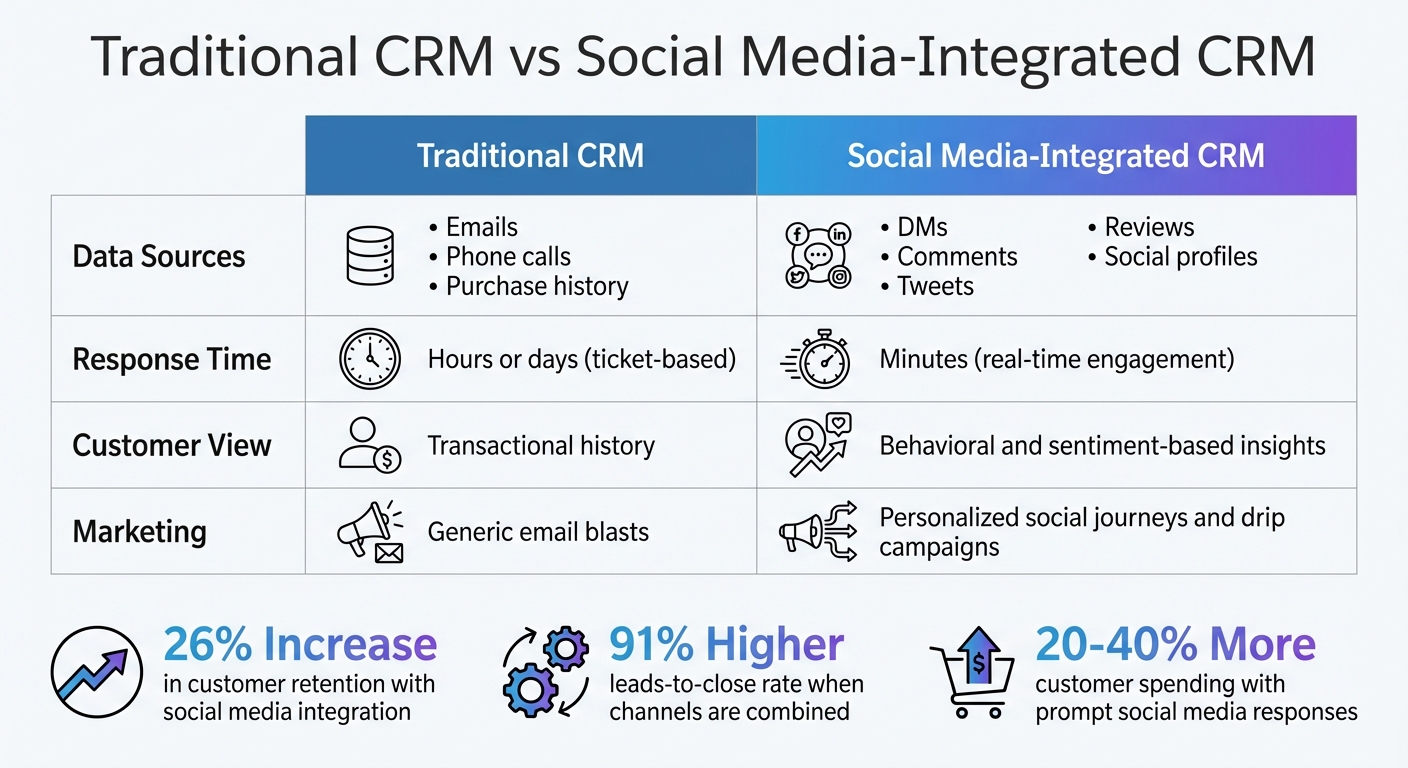
Traditional CRM vs Social Media-Integrated CRM Comparison
Social media-integrated CRMs can increase retention rates by as much as 26%. Considering that retaining existing customers costs five times less than acquiring new ones, and a modest 5% boost in retention can drive profits up by 75%, it’s clear why businesses are turning to this approach.
Let’s break down why these tools outperform traditional CRMs:
| Feature | Traditional CRM | Social Media-Integrated CRM |
|---|---|---|
| Data Sources | Emails, phone calls, purchase history | DMs, comments, tweets, reviews, social profiles |
| Response Time | Hours or days (ticket-based) | Minutes (real-time engagement) |
| Customer View | Transactional history | Behavioral and sentiment-based insights |
| Marketing | Generic email blasts | Personalized social journeys and drip campaigns |
By pulling in data from social interactions and providing real-time engagement, these integrations allow businesses to craft highly personalized experiences that go far beyond generic outreach.
Building Customer Loyalty Through Personalization
Social data is a game-changer for creating tailored customer experiences. For example, Walmart leverages AI-driven personalization to analyze browsing habits, purchase history, and seasonal trends. This approach has led to a 20% increase in sales. Similarly, Michael Kors implemented an AI-powered chatbot integrated with its CRM across platforms like WhatsApp, email, and social media. The results? An 83% reduction in response times, a 95% customer satisfaction rate, and a 20% rise in conversions.
"Personalization is no longer a nice-to-have; it's an expectation for consumers. Brands must deliver tailored experiences at every touchpoint to stay competitive." – Austin Wright, Head of Strategy & Analytics, Tandem Theory
The impact of personalization is staggering - it’s estimated to drive between $1.7 trillion and $3 trillion in value across global industries. Additionally, 53% of consumers say that timely responses to their comments and questions are a top factor when deciding to follow a brand. On the flip side, ignoring negative comments leads 28% of consumers to unfollow, and 32% will leave if a brand fails to engage with its community.
While personalization builds loyalty, automation ensures efficiency.
Improving Efficiency with Automation
Automation simplifies managing customer interactions across multiple platforms. It automates tasks like lead capture, ticket creation, and personalized follow-ups, cutting manual data entry by up to 70% and boosting ROI by 20%. This speed isn’t just an operational win - it directly impacts customer retention.
Quick responses matter. Customers are willing to spend 20% to 40% more with companies that respond promptly to their service requests on social media. By combining automation with social media integration, businesses can deliver seamless and timely interactions that keep customers coming back.
Steps to Implement Social Media Integration in CRMs
Integrating social media into your CRM can streamline operations and enhance customer retention by enabling fast, personalized communication. The process involves selecting the right CRM and ensuring your team is well-trained for effective implementation.
Selecting a CRM with Social Media Features
CRMs come with varying levels of social media capabilities, so it's crucial to choose one that aligns with your needs. Features like social listening - which tracks brand mentions across platforms like Facebook, Twitter, and Instagram - help monitor customer sentiment and spot emerging trends .
A strong CRM should offer unified customer profiles, combining social media data (likes, shares, and interests) with traditional customer details like email and purchase history. This creates a full 360-degree view of each customer, allowing for more personalized interactions . Real-time engagement tools are equally important, enabling you to respond to customer questions or concerns directly from the CRM interface.
Automation and AI features can save time and improve efficiency. Look for tools like automated lead generation from social mentions, AI-driven chatbots for instant responses, and social-triggered drip campaigns to engage users without manual effort. Additionally, robust analytics and reporting dashboards are essential for tracking engagement metrics, conversion rates, and ROI.
When it comes to integration, consider your method carefully:
- Native integrations: These are built into the CRM and work seamlessly with platforms like Facebook or Instagram.
- Third-party connectors: Tools like Zapier can bridge gaps for less common platforms.
- API-based integrations: Ideal for larger enterprises with unique workflows or legacy systems, though these require more setup time.
Native integrations are often the quickest to set up, while third-party and API-based methods may take longer, depending on complexity. Once you've selected your CRM, the next step is configuring it and preparing your team.
Setting Up Integration and Training Teams
After choosing a CRM, focus on technical setup to ensure smooth data flow. Data mapping is key - it aligns data fields between your social platforms and CRM so that details like social handles, activities, and lead information sync properly . Securely authorize CRM access to social accounts using encrypted connections, and ensure compliance with standards like GDPR and CCPA to protect customer data.
Start small by integrating one or two key social channels, testing them thoroughly before expanding. Set up automated lead scoring rules to prioritize high-quality leads based on factors like job title or engagement level. This can reduce manual data entry by as much as 60% to 70%, freeing up your team to focus on meaningful customer interactions.
Training is a critical part of the process. Introduce new social channels gradually to allow your team to master them before adding more. Teach agents to maintain a professional tone, as social media responses are public.
"You must train agents to keep in mind that they should never write anything that could damage the brand if it went viral and beyond a single interaction." – Alex Bullen, Chief Product Officer, Playvox
Equip your team to recognize customer sentiment - whether positive, negative, or neutral - and prioritize interactions that are critical to retention. While automation can handle routine tasks, complex issues require a personal touch to build loyalty. Since social media users often expect quick replies, even outside regular business hours, establish clear availability guidelines for your team.
Finally, schedule regular feedback sessions - monthly or bi-monthly - to review performance metrics like click-through and open rates. These meetings can help refine your approach over time. Creating a brand voice guide for all social platforms will also ensure consistent messaging and help build trust with your audience.
Conclusion
Customer retention in 2025 hinges on meeting customers where they spend their time - and more often than not, that’s on social media. With 67% of customers now turning to social platforms to interact with businesses, it’s crucial to bring tweets, DMs, and comments under one roof. By integrating social media into CRMs, businesses can unify customer interactions into detailed profiles, breaking down silos and creating a seamless experience.
The benefits of this approach are clear. For instance, integrating social data into CRMs can improve retention rates by up to 26%. Companies that respond promptly on social platforms see customers spending 20% to 40% more. And when email, social media, and phone support are combined into a single system, the leads-to-close rate improves by an impressive 91% compared to using these channels separately.
Real-time engagement, personalized communication, and smooth omnichannel experiences aren’t just nice-to-haves - they’re the foundation of customer loyalty in today’s landscape.
"Social CRM helps businesses make customer engagement a two-way street. Instead of a passive audience, customers become active participants in the story of a brand." – Salesforce
Yet, despite these benefits, only 10% of marketers currently sync their social data with CRM systems. This gap presents an enormous opportunity for forward-thinking businesses. By reimagining how they capture, analyze, and act on customer interactions, companies can turn retention challenges into opportunities for long-lasting relationships. Social CRM isn’t just a tool - it’s a game-changer for driving growth and loyalty.
FAQs
How can integrating social media with a CRM help improve customer retention?
Integrating social media with a CRM brings all customer interactions together in one place, giving businesses a real-time, unified view. This makes it easier for teams to respond quickly, handle concerns efficiently, and connect with customers on a more personal level.
Social media insights also help businesses spot trends, predict what customers might need next, and customize their communication. These personalized interactions strengthen relationships and encourage loyalty, increasing the chances that customers will stick with your brand.
What are the benefits of using CRMs with social media integration for customer retention?
CRMs that integrate with social media bring together data from platforms like Facebook, Instagram, and Twitter alongside traditional CRM tools. This combination gives businesses a complete picture of customer interactions, making it easier to deliver quicker, more tailored customer service. The result? Happier customers and stronger loyalty.
On top of that, these integrations provide key insights into customer behavior and preferences, helping businesses craft smarter marketing strategies. By connecting with customers in real time on the platforms they use most, companies can enhance brand visibility, build stronger relationships, and improve customer retention.
How can businesses effectively integrate social media with their CRM systems?
To effectively combine social media with your CRM, the first step is to define your objectives. Are you aiming to boost customer retention, gather more detailed lead information, or speed up response times? Once you’re clear on your goals, select a CRM that integrates seamlessly with the social platforms you use most - whether that’s Facebook, Instagram, LinkedIn, or Twitter. Make sure the system can sync essential data like profile information, engagement stats, and message histories.
After integration, set up social-listening tools to track mentions, comments, and hashtags. These insights can then be directed to the right teams for action. Train your team on the new workflows, establish clear expectations for response times, and use CRM dashboards to keep an eye on key metrics like customer sentiment, response rates, and conversion rates.
It’s essential to regularly evaluate the integration to maintain accurate data, ensure compliance, and track overall performance. Leverage your CRM’s segmentation features to design personalized campaigns based on social interactions, keeping your audience engaged and fostering loyalty. If you’re looking for customized solutions, BizBot offers a directory of business tools to help you match the right CRM and social media platforms to your specific needs.