Localization in mobile app payments isn't just about translating text - it’s about creating a user-friendly, compliant, and secure checkout experience tailored to regional preferences using the best business administration tools. With cross-border ecommerce projected to hit $7.9 trillion by 2030, apps that don’t prioritize localization risk losing users and revenue. Here’s what you need to know:
- Why Localization Matters: It reduces cart abandonment by offering familiar payment methods, currencies, and interfaces.
- Key Features to Look For:
- Top Tools:
- Crowdin: Developer-focused, offers Over-the-Air (OTA) updates and robust integration.
- Lokalise: Great for collaboration and compliance; trusted by fintech apps.
- Phrase: Enterprise-grade solution with automation and security certifications.
- Smartcat: Combines AI translation with freelance marketplace access.
- OneSky: Context-aware AI for accurate, cost-effective translations.
Quick Tip: Start by identifying regions with high traffic but low conversions. Then, choose a tool that supports local currencies, payment methods, and compliance requirements.
Quick Comparison
| Tool | Best For | Key Features | Starting Price | G2 Rating |
|---|---|---|---|---|
| Crowdin | Developers | OTA updates, API/SDK integration | $45/month | 4.4/5 |
| Lokalise | Collaboration | Compliance, Figma integration, fast updates | $144/month | 4.7/5 |
| Phrase | Enterprises | Enterprise automation, PCI DSS compliance | $1,045/month | 4.5/5 |
| Smartcat | Budget-friendly | AI + human translation, freelancer marketplace | $99/month | Not listed |
| OneSky | Small teams | Context-aware AI, pay-as-you-go pricing | $0.005/word | Not listed |
Localization is no longer optional - choose the right tool to make your app payments feel local, secure, and user-friendly.
What to Look for in Payment Localization Tools
Picking the right localization tool for mobile app payments goes beyond just translating text. It’s about ensuring compliance, safeguarding security, and keeping up with your growing user base. A poor choice can lead to compliance headaches, payment failures, or abandoned carts. Here’s what you should focus on.
API and Integration Options
Your localization tool needs to integrate seamlessly with your payment gateways and development workflows. Look for platforms that offer strong SDKs and APIs, allowing easy connection to your existing systems. The best tools work directly with code repositories like GitHub, GitLab, and Bitbucket, automatically syncing translations whenever your source code changes. This eliminates the tedious manual export-import process, speeding up your release cycles.
Over-the-Air (OTA) updates are another must-have. These updates let you fix translation errors or update payment-related text instantly, without needing to resubmit your app to the App Store or Google Play. Studies show that 65% of companies see a return on investment of three times or more from localized content, while AI-driven workflows can cut time-to-market by nearly 30%.
On top of integration, ensure your tool meets regional compliance standards and supports local currencies.
Regional Compliance and Currency Support
Compliance is non-negotiable. Your payment localization tool must adhere to regional regulations like PCI DSS, PSD2, GDPR, and Strong Customer Authentication (SCA). Embedding features like 3D Secure authentication is crucial to avoid disruptive redirects that lead to cart abandonment.
Currency support is equally vital. For example, platforms like Stripe handle payments in over 135 currencies, letting you display prices in formats familiar to your customers - whether it’s $1,234.56 in the U.S. or €1.234,56 in Germany. Go beyond basic currency conversion by choosing tools with FX risk management features that lock in exchange rates, protecting you from market fluctuations. Additionally, the tool should support local payment methods such as iDEAL in the Netherlands, Pix in Brazil, or Alipay in China, as digital wallets continue to dominate mobile transactions.
"A truly localized checkout can make customers more comfortable, minimize drop-offs, and help your business feel like it belongs in that market." - Stripe
Scalability and Automation
As your app expands, automation becomes a game-changer. The best tools leverage AI for translation, automated quality checks, and duplicate string detection, all while keeping costs manageable. Real-time visual previews are especially helpful, allowing translators to see how text fits within the app’s interface and reducing errors.
Look for tools that support continuous localization through CLI, API, or webhooks. This keeps translations aligned with your development pipeline, ensuring your localization process scales effortlessly as you grow.
Best Localization Tools for Mobile App Payments
Here’s a look at some platforms that simplify payment localization for mobile apps, catering to different needs and budgets.
Crowdin
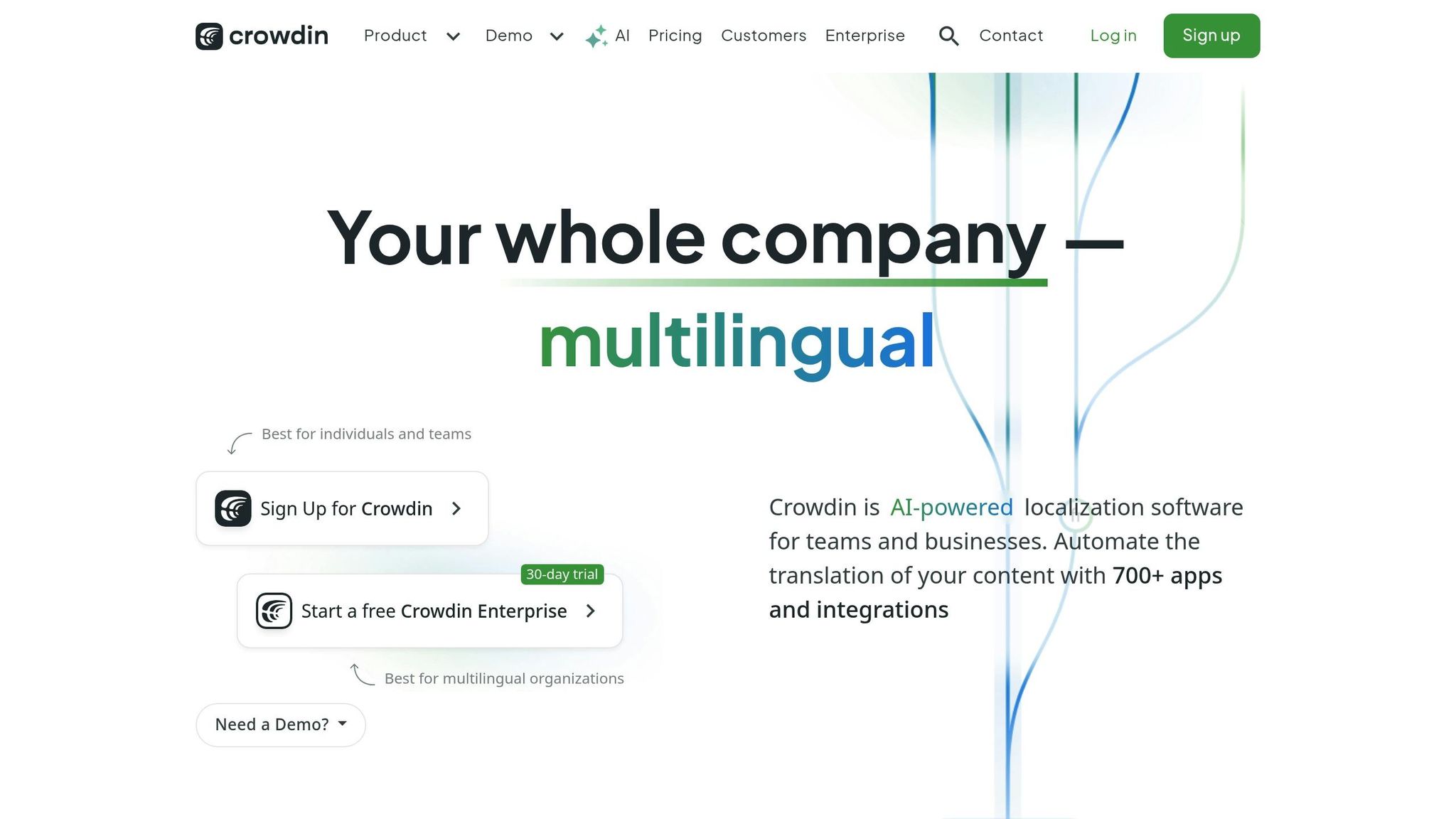
Crowdin focuses on continuous localization with automated content synchronization, ensuring your payment interface text stays updated with your codebase. One standout feature is its Over-the-Air (OTA) SDK, which allows you to push translation updates directly to users' devices without waiting for App Store or Google Play approvals. This comes in handy for fixing critical payment errors or quickly updating currency formats.
Pricing starts at $45/month for the Pro plan and $134/month for the Team plan (billed annually). Crowdin has a 4.4/5 rating on G2, with users highlighting its robust integration ecosystem.
"I18n can be scary for any company, but Crowdin made it incredibly easy to onboard and offboard both translators and proofreaders. Without Crowdin's generous open source plan, we would likely not be supporting over 35 languages in our Cal.com app."
– Peer Richelsen, Co-founder, Cal.com
Next up, Lokalise offers advanced collaboration tools and strong compliance features.
Lokalise
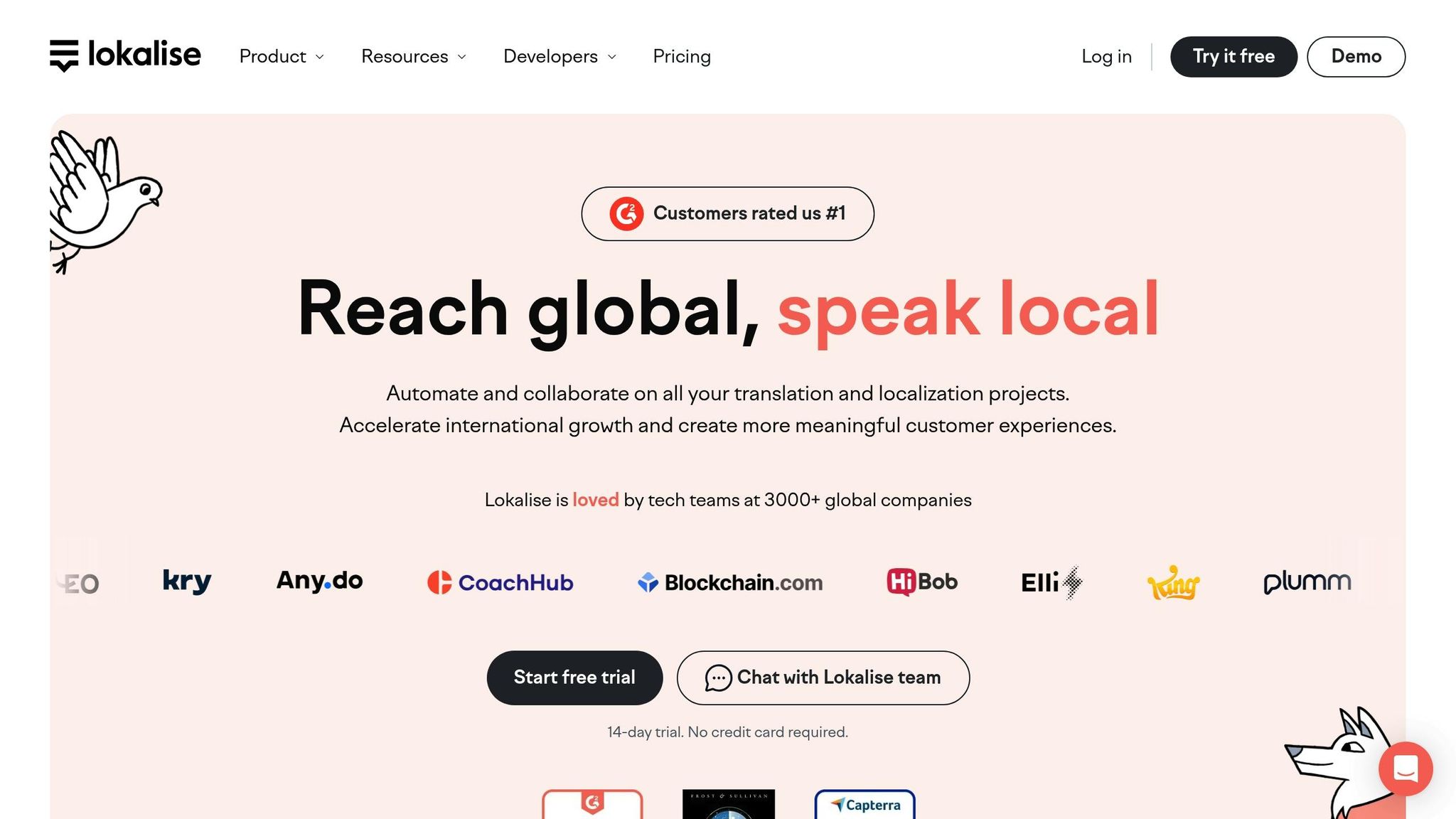
Lokalise provides real-time collaboration through its translation dashboard and version control system. It’s particularly well-suited for fintech and banking apps, boasting ISO 27001/27017 certifications and SOC 2 Type II compliance. The platform includes 10 pre-built SDKs for iOS and Android, enabling fast deployment of updates to payment-related text.
In November 2025, Revolut used Lokalise to expand localization across 20+ languages and 30+ markets. By processing 60,000 words daily with a 1–3-day turnaround, Revolut saved over 100 hours of manual work each week. Pricing starts at $144/month for the Explorer plan, with Growth at $499/month and Advanced at $999/month (billed annually). Lokalise holds a 4.7/5 G2 rating, with 95% of users praising its role in their localization journey.
"With Lokalise's Figma integration, I've eliminated my operational workload and can now focus on performance to improve the overall experience for our customers."
– Romain Dahan, Product Manager, Withings
For enterprise-level requirements, Phrase offers advanced compliance and automation.
Phrase
Phrase is tailored for enterprise payment systems, offering PCI DSS compliance. It automates the transfer of content from design and development environments, enabling real-time deployment of localized content.
In the Forrester Wave™: Enterprise Translation Management Solutions, Q3 2025, Phrase scored top marks in 21 out of 26 criteria. Its drag-and-drop workflow builder, Phrase Orchestrator, simplifies localization processes. Pricing starts at $1,045/month for the Team plan, with custom pricing options for Business and Enterprise plans. The platform guarantees 99.9% uptime and is certified for ISO 27001, PCI DSS, and GDPR compliance. Users rate it 4.5/5 on G2, often highlighting its scalability and AI-driven automation.
"Deliveroo wouldn't have a localization process without Phrase. Investing in the Phrase Localization Platform, we have managed to centralize the process and ensure consistency with all types of content."
– Cristina Marín, Senior Localization Manager, Deliveroo
If flexibility and access to freelance translators are priorities, Smartcat offers a comprehensive solution.
Smartcat
Smartcat combines localization technology with a freelance marketplace, making it easy to scale translations across multiple languages. This is especially helpful for teams without in-house translators. The platform features automated AI translation and integrates seamlessly with Android and iOS repositories.
Starting at $99/month, it’s one of the more budget-friendly enterprise options. Smartcat also simplifies payments to freelancers with its integrated invoicing system, reducing administrative tasks. Its AI tools help cut translation errors by 50%, ensuring consistent terminology in payment-related interfaces.
Lastly, OneSky provides precise translations through its context-aware AI.
OneSky
OneSky uses a context-aware AI system to deliver accurate translations for payment interfaces. It includes automated quality checks to catch errors before they go live and integrates directly into development pipelines for continuous localization at scale.
OneSky operates on a service-based pricing model, with project quotes and translations starting at $0.005 per word. This pay-as-you-go approach can be a cost-effective choice for teams with varying localization needs. Its context-aware system ensures accurate translation of terms like "Save" versus "Save File", depending on their placement in the UI.
Each of these tools brings unique features to ensure your app’s payment interfaces feel seamless and localized for every market.
sbb-itb-d1a6c90
Payment Localization Tools Compared
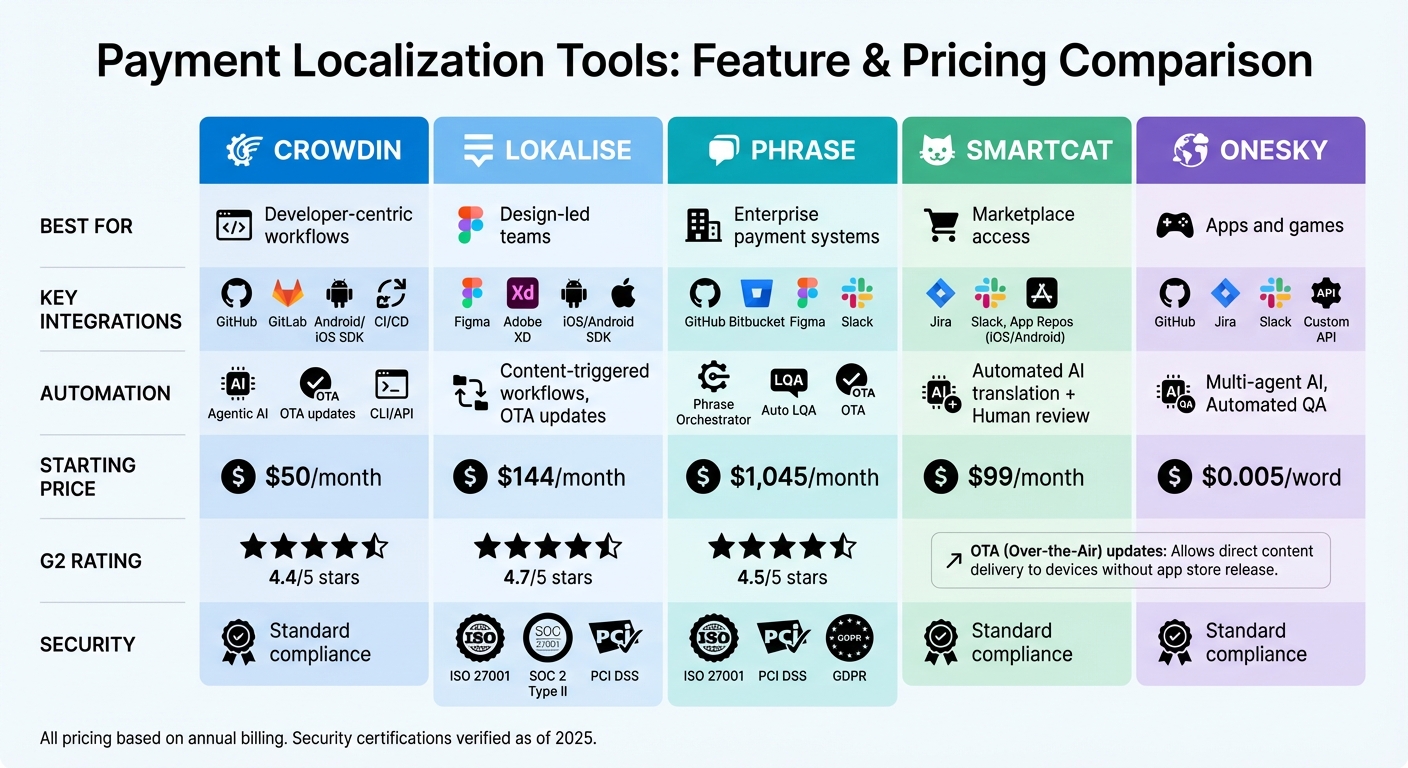
Mobile App Payment Localization Tools Comparison: Features, Pricing & Ratings
Here's a breakdown of how various payment localization tools perform in key areas like integration capabilities, automation, pricing, enterprise support, and language coverage for mobile payment apps.
| Tool | Best For | Key Mobile Integrations | Automation Features | Starting Price | G2 Rating | Security Certifications |
|---|---|---|---|---|---|---|
| Crowdin | Developer-centric workflows | GitHub, GitLab, Android/iOS SDK, CI/CD | Agentic AI, OTA updates, CLI/API | $50/month | 4.4/5 | Standard compliance |
| Lokalise | Design-led teams | Figma, Adobe XD, iOS/Android SDK | Content-triggered workflows, OTA updates | $144/month | 4.7/5 | ISO 27001, SOC 2 Type II, PCI DSS |
| Phrase | Enterprise payment systems | GitHub, Bitbucket, Figma, Slack | Phrase Orchestrator, Auto LQA, OTA | $1,045/month | 4.5/5 | ISO 27001, PCI DSS, GDPR |
| Smartcat | Marketplace access | Jira, Slack, App Repos (iOS/Android) | Automated AI translation + Human review | $99/month | Not specified | Standard compliance |
| OneSky | Apps and games | GitHub, Jira, Slack, Custom API | Multi-agent AI, Automated QA | $0.005/word | Not specified | Standard compliance |
This table highlights the core features of each tool, while the following details provide deeper insights into how these platforms meet specific needs.
Crowdin and Phrase are particularly popular with engineering-focused teams. Their powerful CLI tools and reliance on string keys simplify translation management for labels like "checkout_button" or "pay_now" across multiple languages. This makes them ideal for teams aiming to streamline complex workflows.
For teams prioritizing seamless collaboration between design and development, Lokalise is a standout choice. Its integration with tools like Figma ensures that payment buttons and currency symbols fit perfectly within UI constraints, a critical feature for maintaining a polished user experience.
When it comes to security, Lokalise and Phrase excel. Lokalise is trusted by fintech giants like Mastercard and Revolut, while Phrase is used by companies such as Uber and KuCoin. Both tools meet stringent security standards, including ISO 27001 and PCI DSS certifications, ensuring sensitive payment data remains protected.
For teams without in-house translators, Smartcat offers a unique solution by combining automated AI translation with human review. This hybrid approach is particularly useful for organizations looking to balance speed with accuracy. Meanwhile, OneSky provides a cost-effective pay-as-you-go model at $0.005 per word, making it a great option for apps and games that require context-aware translations.
Additionally, Crowdin, Lokalise, and Phrase support OTA (over-the-air) updates, which allow for quick fixes and updates. This feature is invaluable when addressing issues in payment interfaces or adapting to local currency changes on the fly.
How to Choose the Right Localization Tool
Start by identifying regions where you see plenty of traffic but low conversion rates. This is often a sign that payment localization could be the missing link. For context, the global cross-border ecommerce market is expected to hit $7.9 trillion by 2030, making it a massive opportunity to tap into.
When selecting a tool, look for smarter business banking tools that simplify the process. Ideally, it should support over 135 currencies and local payment methods through a single integration, saving you from the hassle of custom coding. For example, WooCommerce managed to launch payments in 17 countries within just three months using a team of fewer than 20 people. As you scale, ensure the platform includes strong security measures to protect your transactions.
Security and compliance are non-negotiable. Your tool must automatically handle PCI DSS compliance, tokenization, and region-specific requirements like Strong Customer Authentication (SCA) and PSD2.
"Scalability and security are two key areas of focus in operating all of our solutions. That is why we chose Stripe. We saw Stripe as the most secure provider".
Another critical factor is developer experience and integration flexibility. Before going live, test the tool's sandbox environment to simulate scenarios like declined charges, expired cards, and fraud attempts. Check for clear documentation, reliable SDKs, and webhook support to keep your backend running smoothly. A user-friendly API can significantly speed up your launch and reduce the burden on your engineering team.
Once integration and security are sorted, focus on payment methods that deliver global and regional impact. Start with global digital wallets like Apple Pay and Google Pay - they’re easy to implement and work across multiple markets. Afterward, dive into region-specific options like iDEAL in the Netherlands or Pix in Brazil, tailoring your strategy to regions with the highest potential return based on your data.
FAQs
How does localization help reduce cart abandonment in mobile app payments?
Localization plays a key role in reducing cart abandonment by showing prices in the shopper's local currency and providing familiar, trusted payment options. This approach helps avoid confusion, prevents surprise fees, and ensures a more seamless checkout process.
Research indicates that about 13% of shoppers abandon their carts when prices are displayed in foreign currencies. Tackling this issue through localization not only boosts user confidence but also motivates them to finalize their purchase.
What security standards should a localization tool follow for safe mobile app payments?
To keep mobile app payments secure, it's crucial to use a localization tool that aligns with established security standards such as ISO 27001, ISO 27017, and SOC 2 Type II. These certifications highlight strong data protection measures, secure cloud management, and strict privacy practices.
By choosing tools that adhere to these standards, you can protect sensitive payment information, boost user confidence, and meet global security requirements.
Why are over-the-air updates essential for localizing mobile app payments?
Over-the-air updates play a crucial role in keeping apps current and functional. They let developers roll out changes - like security patches, tax rate modifications, or currency updates - without forcing users to manually download updates. This approach keeps payment systems aligned with local laws and ensures users enjoy a secure, hassle-free experience no matter where they are.
With real-time updates, businesses can stay responsive to regional requirements while delivering a consistent and dependable payment process for their customers.