Securing company data is more critical than ever, especially with remote and hybrid work dominating the professional landscape. Business VPNs provide encrypted, secure access to corporate networks, protecting sensitive information like passwords and files from cyber threats.
Key Takeaways:
- Purpose: Business VPNs secure remote access to company data, unlike consumer VPNs, which focus on anonymity.
- Centralized Management: IT teams can control user accounts, permissions, and credentials through a single dashboard.
- Security Features: Look for AES-256 encryption, kill switches, multi-factor authentication, and Zero Trust Network Access (ZTNA).
- Scalability: Modern solutions support hundreds of users, with features like split tunneling and cloud-based infrastructure for better performance.
- Compliance: Essential for meeting standards like HIPAA, GDPR, or SOC 2.
Quick Comparison: Business vs. Personal VPNs
| Feature | Personal VPN | Business VPN |
|---|---|---|
| Primary Goal | Anonymity, unblocking | Secure corporate access |
| Management | Individual settings | Centralized admin control |
| IP Type | Shared dynamic IP | Dedicated/static IP |
| Connections | Limited devices | Scalable for teams |
| Billing | Individual plans | Corporate billing |
Pro Tip: Choose a VPN tailored to your business size. Small businesses should prioritize affordability and ease of use, while larger companies require advanced security and compliance features.
Why Companies Need a Business VPN in 2025 to Secure Remote Work & Protect Access
sbb-itb-d1a6c90
Key Features to Look for in a Business VPN
When evaluating a business VPN, it's crucial to focus on security features, scalability and performance, and ease of management. These elements work together to protect sensitive data while ensuring smooth operations with efficient tools.
Security Features
Strong security is the backbone of any reliable VPN. Look for key features like AES 256-bit encryption, a kill switch to protect data during dropped connections, multi-factor authentication (MFA), and safeguards such as DNS and IP leak protection. Advanced options like Zero Trust Network Access (ZTNA) and post-quantum cryptography (PQC) are also worth considering, especially for businesses handling sensitive information.
MFA is particularly important. With 68% of data breaches involving human error, requiring two-factor authentication at the admin level can block unauthorized access, even if passwords are compromised.
ZTNA takes security a step further by verifying every connection and limiting access to only what's necessary. For businesses with high-stakes data, providers offering PQC can help protect against emerging threats.
Privacy-focused features are becoming essential. RAM-only servers, which erase all data upon reboot, and no-logs policies verified through third-party audits, are now standard for organizations with strict security needs. If your industry requires compliance with regulations like HIPAA, GDPR, or SOC 2, ensure your VPN provider meets these standards.
Once security is locked in, it's time to consider how the VPN handles speed and scalability.
Scalability and Performance
A VPN that significantly slows down your connection can hinder productivity. Ideally, a high-quality VPN should limit speed loss to 20% or less of your baseline internet speed. To maintain performance, look for providers with a global network of servers, particularly near your employees' locations, to minimize latency.
Features like dedicated IPs and split tunneling can also improve performance. Split tunneling allows only sensitive business traffic to pass through the VPN, while less critical activities (like video calls or streaming) bypass the encrypted tunnel. This reduces bandwidth usage without sacrificing security.
Some enterprise-grade servers now support bandwidths of up to 20Gbps, ensuring smooth operations for data-heavy tasks. Cloud-based VPNs can further reduce bottlenecks by directing only necessary traffic to your local network.
For businesses requiring high uptime, look for solutions with active-active clustering for load balancing and network availability of 99.9% or higher. Modern protocols like WireGuard or proprietary options like NordLynx also provide faster speeds and lower latency compared to older protocols like PPTP or OpenVPN.
But even the most secure and high-performing VPN needs to be easy to manage.
Ease of Management
A well-designed VPN should simplify administration. A centralized management dashboard is invaluable, allowing IT teams to control user accounts, set permissions, and manage credentials all in one place - minimizing human error.
Integration with Single Sign-On (SSO) providers like Google Workspace, Okta, Azure AD, or AWS can streamline access, while Mobile Device Management (MDM) support ensures secure remote device management.
An always-on VPN feature ensures that devices automatically connect whenever they access the internet, reducing the risk of unsecured data transmission. Additionally, role-based access control (RBAC) allows administrators to assign permissions based on employees' roles, ensuring users only access what they need.
Automated onboarding and offboarding tools are another must-have. They eliminate the risk of lingering accounts, which can become security vulnerabilities. For smaller IT teams, managed solutions - like those provided by NordLayer - handle backend maintenance and configuration, reducing setup errors. Plus, 24/7 technical support ensures quick troubleshooting when needed.
Choosing the Right Business VPN for Your Company
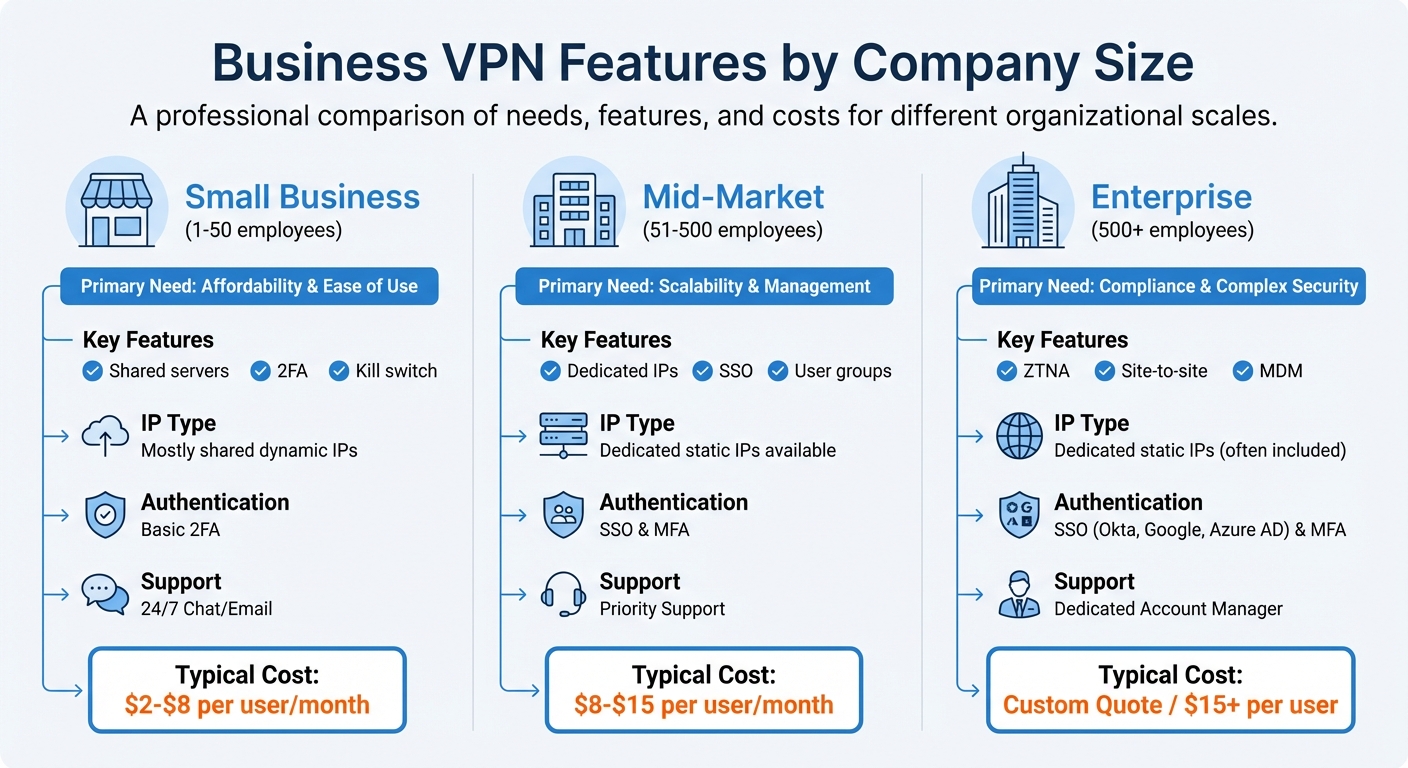
Business VPN Features Comparison by Company Size 2025
When selecting a VPN for your business, it's essential to match the solution to your company's size, technical capabilities, and operational needs. Paying for advanced features you don’t need can waste resources, while skimping on security could leave sensitive data exposed. Below, we break down VPN options tailored to different business sizes.
VPN Solutions for Small Businesses
For small businesses (1–50 employees), affordability and simplicity are key. Many small businesses lack dedicated IT teams, so it’s best to choose VPNs that are straightforward to set up and manage.
Look for providers offering low entry costs and no minimum user requirements. Features like centralized dashboards, strong encryption, kill switches, and multi-factor authentication (MFA) are must-haves. Some providers also bundle antivirus tools, adding extra protection without the need for separate subscriptions.
"A VPN is a low-cost preventative measure that could spare you from future headaches." – Justyn Newman, Senior Writer, PCMag
Shared servers are usually sufficient for small businesses. Unless you specifically need static IPs for tasks like whitelisting, there’s no need to pay extra for dedicated servers.
VPN Options for Mid-Market and Enterprise Companies
Mid-market companies (51–500 employees) and enterprises (500+ employees) have more complex needs, including scalability, compliance, and robust security measures. These organizations often manage intricate infrastructures, so VPNs should integrate seamlessly with existing centralized management systems.
For larger companies, Zero Trust Network Access (ZTNA) is becoming a standard. This approach verifies every connection individually, ensuring no user or device is automatically trusted. It’s especially critical for organizations with multiple office locations or those handling regulated data.
Key features for larger businesses include site-to-site connectivity to link office branches, single sign-on (SSO) integration with tools like Okta or Azure AD, and role-based access control (RBAC). Compliance with regulations like HIPAA, SOC 2, or GDPR is non-negotiable. Given that 46% of data breaches involve customer PII, choosing a VPN provider with independently audited no-logs policies is crucial.
Modern enterprise VPNs also support high bandwidths - some reaching up to 20Gbps - to handle data-intensive tasks. Additionally, cloud-based VPNs can reduce network congestion by splitting traffic intelligently, avoiding the bottlenecks associated with traditional on-premises servers.
Comparison Table: VPN Features by Business Size
| Feature | Small Business (1–50 employees) | Mid-Market (51–500 employees) | Enterprise (500+ employees) |
|---|---|---|---|
| Primary Need | Affordability & Ease of Use | Scalability & Management | Compliance & Complex Security |
| Key Features | Shared servers, 2FA, Kill switch | Dedicated IPs, SSO, User groups | ZTNA, Site-to-site, MDM |
| IP Type | Mostly shared dynamic IPs | Dedicated static IPs available | Dedicated static IPs (often included) |
| Authentication | Basic 2FA | SSO & MFA | SSO (Okta, Google, Azure AD) & MFA |
| Support | 24/7 Chat/Email | Priority Support | Dedicated Account Manager |
| Typical Cost | $2–$8 per user/month | $8–$15 per user/month | Custom Quote / $15+ per user |
Take advantage of trial periods - typically 14 to 30 days with money-back guarantees - to evaluate how a VPN performs within your network. Pay close attention to upload and download speeds, as some services can reduce upload speeds by up to 50%, which could be a problem for teams regularly uploading large files to cloud storage.
Deployment and Best Practices for Business VPNs
Implementation Strategies
Start by evaluating your security needs - consider factors like the number of users, the types of devices they use, and their locations. This will help you decide between remote-access and site-to-site VPNs. With nearly 45% of American employees working remotely at least part-time, remote-access VPNs are often the go-to solution for businesses.
Before rolling out your VPN, remove outdated software to avoid compatibility issues. Also, ensure your current routers work with the new VPN provider. Many modern business VPNs boast deployment times as quick as 10 minutes.
When choosing a protocol, match it to your specific needs: WireGuard for speed, OpenVPN for robust security, or IKEv2/IPsec for mobile users who switch between Wi-Fi and cellular networks. Install the VPN software on all employee devices - whether they use Windows, macOS, Linux, iOS, or Android. For company-owned hardware, pre-install the VPN client, enable multi-factor authentication (MFA), and activate a Kill Switch to block traffic if the connection fails.
Once your VPN is up and running, shift your focus to managing and fine-tuning it for optimal security and performance.
Management and Optimization
After deployment, it's crucial to configure your VPN to strike the right balance between security and usability. Use network segmentation to enforce least privilege access, allowing employees to reach only the applications they need rather than the entire network. This approach, inspired by Zero Trust Network Access (ZTNA) principles, not only enhances security but also boosts performance.
To reduce strain on your network, consider split tunneling. This allows less sensitive traffic, like video calls, to bypass the VPN while keeping critical data secure. However, improper configuration of split tunneling can open security gaps, so proceed carefully. Regularly update your VPN software to patch vulnerabilities, and provide employees with training on secure login methods and basic troubleshooting. This not only minimizes accidental data leaks but also cuts down on IT support requests.
Compliance and Security Considerations
Strengthen your VPN setup by integrating compliance and advanced security measures. Use strong encryption, such as AES-256, to safeguard data in transit from being intercepted or altered. Opt for VPN providers with independently verified no-logs policies to ensure privacy and meet data protection regulations. For industries like healthcare and finance, compliance with standards such as HIPAA and SOC 2 is non-negotiable.
"As employees continue working from home, CIOs, CISOs, and CTOs of distributed workforces have a requirement to protect their business from cybersecurity threats." – Subbu Sthanu, Chief Commercial Officer, IPVanish VPN
If your business operates internationally, be aware of geopolitical restrictions. Some countries, including Russia, China, and Pakistan, have strict VPN regulations. For instance, Russia banned non-approved VPN services in March 2024, while in China, only VPNs with government backdoor access are allowed - making them unsuitable for secure business use. To ensure compliance and security, plan alternative access methods for employees in these regions.
Conclusion: Investing in the Right VPN for 2025
Key Points Recap
Selecting the right VPN for your business boils down to three main factors: security, scalability, and ease of management. Focus on providers that offer AES-256 encryption, modern protocols like WireGuard or OpenVPN, and no-logs policies verified by independent audits. Additionally, features like dedicated IPs, centralized management dashboards, and multi-factor authentication are vital to protect against unauthorized access.
Scalability is another critical consideration. Opt for providers with extensive global server networks and the ability to easily add users as your business expands. If your industry has strict compliance requirements - such as healthcare or finance - make sure the VPN adheres to standards like HIPAA, SOC 2, or ISO 27001. A well-secured VPN can be a strong line of defense against breaches that could have severe financial and reputational consequences.
Performance and reliability are equally important. A poorly performing VPN can create bottlenecks that disrupt operations. Managed solutions with "always-on" features are particularly helpful for businesses without dedicated IT teams, ensuring employees stay connected without needing constant reminders.
Next Steps
Armed with these insights, begin by auditing your current and future security requirements. Consider whether your workforce will remain hybrid, fully remote, or on-site, as this will influence whether you need a simple app-based VPN or a more advanced site-to-site solution. Take advantage of risk-free trials to test various services before committing to any long-term contracts .
Make sure to verify provider claims through independent third-party audits . This thoughtful, step-by-step approach ensures your business is well-prepared to stay secure in 2025. For additional tools to streamline your operations, check out directories like BizBot (https://bizbot.com), where you can find curated resources for accounting, HR, and management tailored to small businesses and growing companies.
FAQs
How do business VPNs help meet compliance requirements like HIPAA and GDPR?
Business VPNs play a crucial role in meeting compliance standards by providing strong security measures to safeguard sensitive information. Features like AES-256 encryption, strict no-logs policies, and regular security audits work together to keep confidential data safe and private. These measures also show a company’s dedication to protecting data and adhering to regulatory demands.
By encrypting internet traffic and securing communications, business VPNs significantly lower the risk of data breaches. This helps companies stay compliant with regulations like HIPAA and GDPR, ensuring both legal alignment and data security.
What makes a business VPN different from a personal VPN?
A business VPN caters specifically to the needs of organizations. It includes features like centralized management, advanced security protocols, and user access controls, all designed to support teams and protect sensitive data. Businesses also benefit from tools such as audit logs and enterprise-level encryption, making it a solid choice for handling confidential information.
On the other hand, a personal VPN is geared toward individual users. Its primary focus is on privacy, secure browsing, and bypassing content restrictions. While both types of VPNs encrypt internet traffic, a business VPN is optimized for multi-user environments and operational workflows, whereas a personal VPN prioritizes ease of use for a single user.
What features should I look for in a VPN to suit my business needs?
Choosing the right VPN features for your business comes down to understanding your size, operations, and security requirements. Start by focusing on business-oriented features that support growth and efficiency, such as dedicated IP addresses, centralized management tools, secure remote access, and user role management. These tools help streamline operations as your team expands.
When it comes to security, it’s non-negotiable. Opt for top-tier encryption like AES-256, trusted protocols such as WireGuard or OpenVPN, and additional protections like kill switches, DNS leak prevention, and multi-factor authentication. If your industry is subject to strict regulations, ensure the VPN complies with standards like GDPR or HIPAA.
Smaller businesses might prioritize simplicity and cost-effectiveness, while larger organizations often require advanced management tools, faster connections, and solutions that can scale with their needs. Take a close look at your operational demands and test different options to strike the ideal balance between security, usability, and scalability.