Non-compliance with mobile messaging regulations can cost businesses millions in fines and damage consumer trust. Here's what you need to know to stay compliant:
- Key Rules: Regulations like the TCPA (U.S.), GDPR (EU), and CASL (Canada) govern how businesses send SMS, MMS, and RCS messages. They mandate strict consent requirements, opt-out handling, and timing restrictions.
- Penalties: Violations can result in fines up to $1,500 per message under TCPA, €20 million under GDPR, or $10 million under CASL. Carriers like T-Mobile may also impose surcharges or block non-compliant traffic.
- Consent Management: Businesses must secure clear, documented consent and honor opt-out requests immediately. Double opt-ins and detailed record-keeping are essential.
- Carrier Registration: The 10DLC system requires businesses to register brands and campaigns to avoid message blocking or reduced throughput.
- International Rules: GDPR emphasizes explicit consent and data protection, CCPA focuses on transparency and user rights, and CASL requires express consent for marketing.
Compliance tools like AI-powered software can automate opt-out handling, consent tracking, and carrier registration, simplifying the process for businesses. Staying compliant ensures high deliverability, protects your reputation, and maintains consumer trust.
SMS Marketing Compliance: 4 Expert Tips for Staying Legal
sbb-itb-d1a6c90
U.S. Regulations for Mobile Messaging
In the U.S., business text messaging is subject to two primary regulatory frameworks: the TCPA (Telephone Consumer Protection Act), overseen by the FCC, and the 10DLC registration system, managed by The Campaign Registry.
TCPA: Telephone Consumer Protection Act
Enacted in 1991, the TCPA treats text messages as "calls" and regulates how businesses can communicate with consumers. For marketing messages, businesses must secure prior express written consent - a signed agreement. Transactional messages, on the other hand, require prior express consent.
"The underlying purpose of both the U.S. regulatory and telecommunication industry rules... is to ensure that people do not receive SMS communications that they do not want to receive." - Twilio
Here are key TCPA rules businesses need to follow:
- Timing Restrictions: Marketing texts can only be sent between 8:00 a.m. and 9:00 p.m. (local time).
- Opt-Out Handling: Opt-out requests using keywords like STOP, QUIT, or UNSUBSCRIBE must be processed immediately.
- Revoking Consent: Starting April 11, 2025, consumers can withdraw consent "in any reasonable manner", and businesses must process these requests within 10 business days.
- Do Not Call Registry: Check the National Do Not Call Registry every 31 days to avoid messaging numbers listed without prior written permission.
Additionally, businesses must maintain records of consent for at least five years. This includes timestamps, IP addresses for online opt-ins, and the exact language displayed during sign-up. Initial opt-in disclosures must clearly state the business name, message frequency, and inform users that "message and data rates may apply".
Next, let's look at the specific requirements of the 10DLC system.
10DLC: 10-Digit Long Code Messaging
While the TCPA focuses on consent, the 10DLC system governs registration and content standards for businesses using 10-digit local numbers for Application-to-Person (A2P) messaging. Starting February 2025, all businesses must register with The Campaign Registry (TCR) to use 10DLC numbers. This involves registering both your Brand (business identity) and Campaign (specific use case, like marketing or customer support). The process typically takes 1–5 business days and requires:
- A valid Employer Identification Number (EIN)
- Your legal business name
- A functioning website with a clear privacy policy
Here’s how 10DLC compares to Dedicated Short Codes:
| Feature | 10DLC (Long Code) | Dedicated Short Code |
|---|---|---|
| Setup Time | 1–5 business days | 8–12 weeks |
| Monthly Cost | $10–$50 | $500–$1,000 |
| Throughput | 1–30 messages per second | 100+ messages per second |
| Best For | Customer service, 2FA, local presence | High-volume marketing, alerts |
During registration, carriers assign a Trust Score (0–100) to your Brand, which determines your message throughput. A higher Trust Score can allow daily limits exceeding 200,000 messages. Unverified brands, however, may face caps as low as 2,000 messages per day. Costs include a one-time Brand registration fee of $4.00 to $15.00, a $15.00 campaign submission fee, and monthly campaign fees ranging from $1.50 to $30.00, depending on the use case.
To comply with 10DLC standards, businesses must avoid sending messages containing SHAFT content (Sex, Hate, Alcohol, Firearms, Tobacco) or any federally illegal substances, such as marijuana - even in states where it is legal. Additionally, purchasing or trading lead lists is prohibited; businesses must obtain explicit, informed opt-in consent directly from recipients. Sending unregistered messages can result in penalty surcharges between $0.006 and $0.017 per segment, and carriers may block non-compliant traffic altogether.
International Compliance Requirements
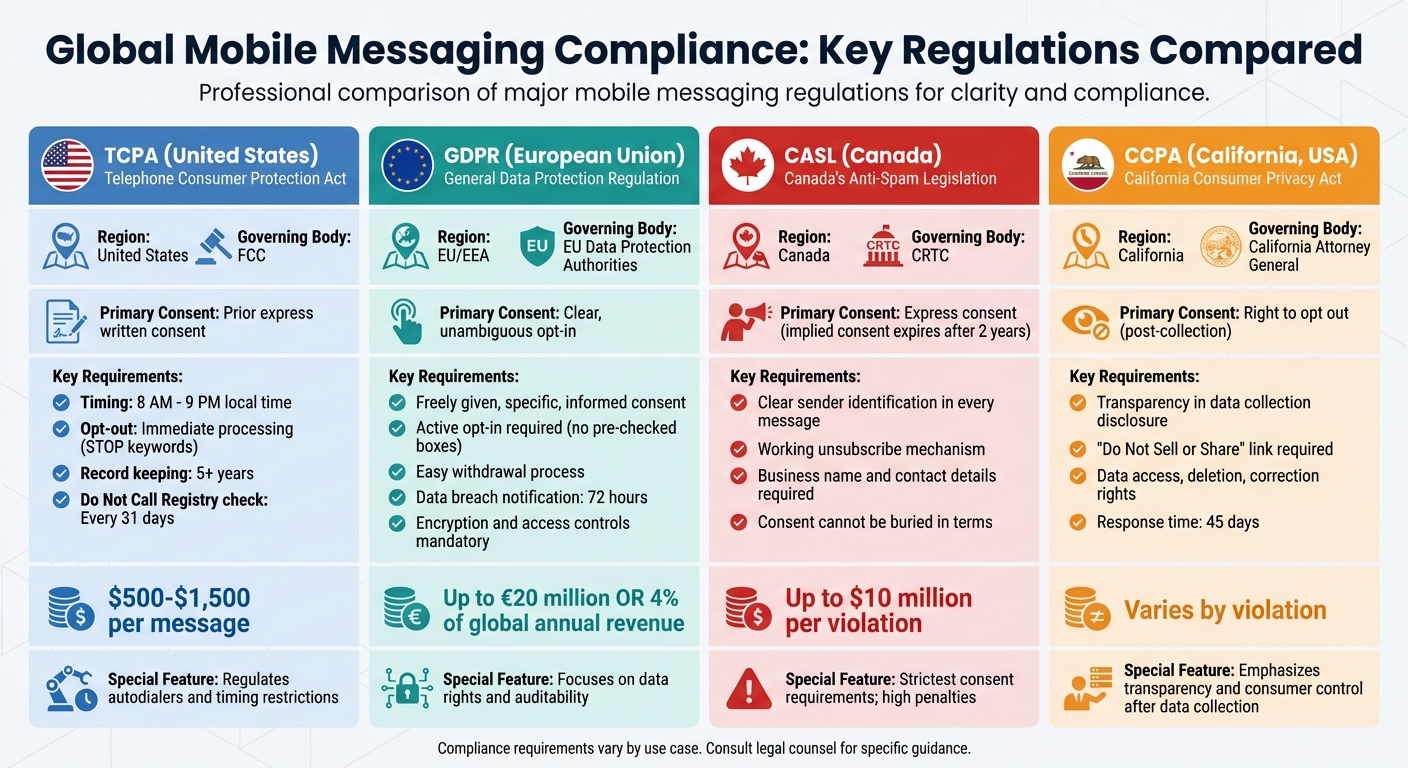
Mobile Messaging Compliance Regulations Comparison: TCPA, GDPR, CASL, and CCPA
Navigating international mobile messaging compliance means understanding regulations like GDPR, CCPA, and CASL. These frameworks - set by the European Union, California, and Canada - shape how businesses handle consent, data storage, and opt-out processes.
GDPR: General Data Protection Regulation
GDPR governs personal data use for individuals in the EU and EEA, including phone numbers for mobile messaging. To send messages, you need a lawful basis, and for marketing, explicit consent is typically required rather than relying on "legitimate interest".
"Consent must be freely given, specific, informed, and unambiguous." – Klaviyo
This means consent must come from a clear, affirmative action. Pre-checked boxes, silence, or inactivity don’t count. Users must actively opt in, and withdrawing consent must be just as easy.
Key GDPR consent requirements include:
| GDPR Requirement | Practical Implementation for Messaging |
|---|---|
| Freely Given | Consent isn’t tied to service conditions and is separate from terms and conditions. |
| Specific | Separate opt-ins for different purposes or channels. |
| Informed | Clearly disclose who is sending the message, how often, and opt-out instructions. |
| Unambiguous | Users actively opt in, such as by checking a box or replying with a keyword. |
| Withdrawable | "STOP" commands or unsubscribe links must be processed immediately. |
GDPR also enforces strict data use rules. You can’t repurpose data collected for one reason without separate consent. Additionally, businesses must respond to requests like data access or deletion within one month.
Security is crucial under GDPR. Personal data must be safeguarded with measures like encryption and access controls. If a breach occurs, authorities must be notified within 72 hours. Companies also need a Data Processing Agreement (DPA) with their messaging providers to define security responsibilities.
Non-compliance can lead to fines of up to €20 million or 4% of global annual revenue, whichever is higher. To comply, use double opt-in to confirm ownership of the phone number, log consent details, and include an easy opt-out option like "Reply STOP" in every message.
While GDPR emphasizes consent and data minimization, California’s CCPA takes a different approach, focusing on consumer rights over personal data.
CCPA: California Consumer Privacy Act
The CCPA empowers California residents to control their personal data. If you send messages to California-based customers, you must disclose what personal information you collect (e.g., phone numbers, message content) and how it’s used.
Under CCPA, consumers can opt out of the sale or sharing of their data. You’ll need to provide a "Do Not Sell or Share My Personal Information" link in your privacy policy and honor opt-out requests promptly. Consumers also have the right to access, delete, or correct their data.
Unlike GDPR’s upfront consent focus, CCPA emphasizes transparency and user control after data is collected. Businesses must disclose what data is collected, why, and whether it’s shared with third parties.
"6 in 10 consumers surveyed by Twilio say protecting their data is the top way to build their trust." – Twilio
To meet CCPA requirements, ensure your privacy policy explains your messaging practices, provide an easy opt-out mechanism, and respond to data requests within 45 days. Keeping detailed records of consent, including timestamps and sources, can help demonstrate compliance.
Next, let’s look at Canada’s CASL, which takes a stricter stance on marketing consent.
CASL: Canada's Anti-Spam Legislation
CASL regulates commercial messages sent to Canadian numbers. It requires three key elements: valid consent, clear sender identification, and a working unsubscribe option.
Unlike U.S. laws, CASL demands express consent for marketing messages. Implied consent, such as from a purchase, isn’t enough - it must be explicitly documented and not buried in lengthy terms.
Each message must identify your business and include contact details. Additionally, opt-out options must be easy to use and processed promptly. Implied consent expires after two years, so you’ll need express consent for continued messaging.
Failure to comply can result in fines up to $10 million per violation. To stay compliant, use double opt-in, include your business name and contact info in every message, and automate opt-out processes for quick handling. Keep detailed records of how and when consent was obtained.
Here’s how these regulations stack up:
| Regulation | Region | Primary Consent Requirement | Key Feature |
|---|---|---|---|
| GDPR | European Union | Clear, unambiguous opt-in | Focuses on data rights and auditability |
| CASL | Canada | Express consent (implied consent expires) | Requires sender ID and unsubscribe option; high penalties |
| CCPA | U.S. (California) | Right to opt out | Emphasizes transparency and consumer control |
| TCPA | United States | Prior express written consent | Regulates timing (8 a.m.–9 p.m.) and use of autodialers |
To succeed globally, tailor your messaging to each region’s rules. For example, GDPR requires clear opt-ins for EU users, while CASL mandates express consent and sender identification for Canadian recipients.
How to Stay Compliant with Mobile Messaging Rules
Staying compliant with mobile messaging regulations involves more than just understanding the rules - it requires a proactive approach to managing consent, controlling content, and ensuring carrier registration. Skipping these steps could lead to hefty fines, ranging from $500 to $1,500 per message under the TCPA, or up to $10,000 per violation for non-compliant 10DLC messaging.
Managing Consent and Keeping Records
At the heart of compliance is express written consent. This can’t be assumed from a purchase or hidden in fine print. You need to document every opt-in, including the timestamp, source, method, and exact consent language.
Your call-to-action should clearly spell out your brand name, the type of content you’ll send (like alerts or promotions), how often messages will be sent, and a note that "message and data rates may apply." Include links to your terms and privacy policy. Once someone opts in, send a confirmation text that reiterates your brand identity, the message frequency, and opt-out instructions.
For extra security, use a double opt-in process. After the initial sign-up, send a follow-up text requesting the user to reply "YES" to confirm their subscription. This step ensures the phone number belongs to the user and provides a stronger record of consent.
If someone opts out using keywords like STOP, UNSUBSCRIBE, or CANCEL, honor the request immediately and send a final confirmation message. Keep these records for at least five to seven years to safeguard against audits or legal challenges.
To maintain a clean contact list, check the National Do Not Call Registry every 31 days and use reassigned number lookup services to avoid contacting new owners of recycled numbers. For example, in 2023, Hearsay, a financial services platform, collaborated with Twilio to create a compliant SMS program for over 200,000 financial advisors. By automating consent workflows and using proxied phone numbers, they boosted client engagement sevenfold and increased new business conversions by 37%, all while adhering to strict regulations.
"Complex regulatory requirements meant that most of our customers did not previously have an enterprise SMS program in place. Working with Twilio allowed us to quickly deliver this channel." – Steven Latow, Platform Team Lead, Hearsay
Once consent is managed, the next step is ensuring your content and message timing meet compliance standards.
Content Rules and Message Timing
Certain types of content are strictly off-limits. Carriers prohibit SHAFT content - Sex, Hate, Alcohol, Firearms, and Tobacco. Even industries like CBD or cannabis, while legal in some areas, may face restrictions due to federal regulations. If you’re in these industries, you’ll need advanced carrier vetting and strict age-gating on your website.
Timing is equally important. Marketing messages should only be sent between 8:00 AM and 9:00 PM (local time for the recipient). Some states, like Florida and Oklahoma, have even stricter rules. Automated scheduling tools that adjust for time zones can help you stay compliant.
Every message must clearly identify your brand so recipients know who’s contacting them. Avoid generic URL shorteners and instead use branded domains tied to your business. Also, remember that separate consent is required for different types of messages - opting in for transactional alerts doesn’t automatically allow promotional messaging.
With content and timing under control, the final step is ensuring proper carrier registration.
Carrier Registration and Verification
For businesses using 10-digit long codes (10DLC) for messaging, registration is mandatory. Keeping your 10DLC registration up to date is critical to maintaining message throughput. Failing to register could result in your messages being flagged as spam and steep carrier penalties.
Your website plays a role in this process too. It must be active, feature a clear privacy policy, and include age-gating if your content falls under SHAFT categories. Proper registration ensures compliance and helps you avoid disruptions in your messaging campaigns.
Tools for Managing Compliance
Trying to manage compliance manually at scale is like chasing shadows - it’s just not practical. Rules differ across states, phone numbers constantly get reassigned, and opt-out requests can pop up unpredictably. That’s where compliance monitoring software steps in. These tools use AI and machine learning to catch potential issues before messages are sent.
Compliance Monitoring Software
Compliance tools are designed to automate essential tasks that ensure adherence to regulations. The best tools rely on AI-powered detection to scan and classify messages for violations. For example, they can differentiate between critical messages like fraud alerts, two-factor authentication codes, and shipping updates, versus non-critical ones like promotions or event invites. Why does this matter? Essential messages can bypass quiet hour restrictions, while marketing texts must comply with timeframes like 8:00 AM to 9:00 PM - or even stricter rules in states like Florida and Oklahoma.
Another key feature is the ability to verify phone numbers against the FCC’s reassigned number database every 30 days. This ensures that the person receiving your messages is still the one who originally gave consent. Automated opt-out management is equally critical, handling keywords such as STOP, UNSUBSCRIBE, or CANCEL. Many platforms also provide consent management APIs to keep user preferences updated across various systems.
Real-time dashboards are a game-changer, offering error logging to quickly identify problems. Additionally, tools that enforce geographic accuracy - using ZIP codes rather than just area codes - ensure quiet hours are based on the recipient’s actual location.
Consider the case of Olo Engage, a restaurant marketing platform, which implemented Twilio’s AI-powered Compliance Toolkit in September 2025. This rollout, completed in a single day, automated tasks like state-specific quiet hours and reassigned number checks. Ray Gallagher, VP and GM of Olo Engage, described the complexity of managing compliance at scale:
"Managing compliance takes a lot of overhead. The rules can differ by state, people change numbers, opt-ins and opt-outs are sporadic, and every detail matters when you're sending tens-of-millions of messages annually."
With the TCPA imposing fines of up to $1,500 per violation and SMS messages achieving a 98% open rate, it’s easy to see how non-compliance can harm both your wallet and your brand.
If you’re looking for an all-in-one solution, specialized platforms can simplify the process of choosing the right tools.
BizBot: Finding the Right Compliance Tools
This is where BizBot comes in. Think of it as your one-stop shop for finding compliance tools. BizBot (https://bizbot.com) offers a curated directory of business administration tools, including ones focused on compliance. Whether you need software for managing records or systems that integrate seamlessly with your existing CRM, BizBot helps you compare options tailored to your company’s size and needs. Plus, its subscription management feature tracks expenses across multiple tools, helping you keep costs under control.
Common Compliance Mistakes and How to Avoid Them
To safeguard your business from hefty fines and reputational harm, it’s critical to steer clear of common compliance mistakes. Here’s a breakdown of some frequent errors and how to address them effectively.
Sending Messages Without Proper Consent
Reaching out to recipients without their documented, prior express written consent is a direct violation of TCPA regulations. This can lead to fines ranging from $500 to $1,500 per message.
The rules became even stricter on January 27, 2025, with the FCC’s introduction of the "one-to-one consent" rule. This means consent obtained through shared lead generation forms is no longer valid. Each business must now independently secure and verify consent directly from consumers. Using purchased or inherited contact lists without re-verifying consent is a major risk.
Poor recordkeeping compounds the problem. To protect yourself, maintain timestamped logs of opt-ins for at least 4 to 7 years. Without these records, defending your case in litigation becomes nearly impossible.
A practical solution? Implement a double opt-in process. This ensures you have clear, timestamped evidence of user consent, making your compliance airtight.
Breaking Timing and Content Rules
Timing and content missteps can derail your messaging campaigns and invite legal trouble. Messages should only be sent during permitted hours, typically 8:00 AM to 9:00 PM local time, based on accurate, geo-based timing. Sending messages outside of these hours can result in carrier filtering or legal action.
State-specific rules add another layer of complexity. For example, Florida and Oklahoma have stricter regulations. Florida even limits campaigns to no more than three messages within a 24-hour period.
Content is another minefield. Avoid prohibited topics like SHAFT (Sex, Hate, Alcohol, Firearms, Tobacco) and sensitive subjects such as cannabis or CBD unless properly vetted. Mentioning these topics without clearance can lead to immediate channel blocking. Additionally, always use branded, custom short domains instead of generic URL shorteners to reduce the risk of your messages being flagged as spam.
Lastly, ensure you process STOP commands immediately. Update your suppression list permanently, and include clear opt-out instructions in every message, such as "Reply STOP to unsubscribe." Once a recipient opts out, their number must remain on the suppression list for all future campaigns unless new consent is explicitly obtained.
Conclusion
Staying on top of mobile messaging compliance is critical for maintaining an effective SMS strategy. Regulations like the TCPA, 10DLC, GDPR, and CCPA aren't just legal formalities - they protect your business from hefty fines ranging from $500 to $1,500 per message and the risk of class-action lawsuits. Beyond avoiding penalties, compliance directly impacts message deliverability and customer engagement. Carriers use trust scores and registration data to weed out spam, which means non-compliant messages may be throttled or outright blocked.
Following the rules also strengthens customer relationships. When you secure explicit consent, respect opt-out requests, and stick to approved messaging hours, you build trust. And trust pays off - SMS campaigns often see a staggering 98% open rate when customers have opted in willingly. As Twilio aptly puts it, "Customers want to feel safe and respected. Your commitment to compliance ensures that trust".
The regulatory environment is constantly changing, requiring businesses to meet higher consent standards, follow state-specific rules, and maintain records for up to seven years. Tackling these demands manually can be overwhelming, but compliance software simplifies the process. These tools handle everything from timestamped consent tracking and real-time opt-out processing to filtering prohibited SHAFT topics and managing 10DLC registration.
For businesses navigating these complexities, BizBot can help. Their directory of business administration tools includes compliance monitoring solutions that streamline carrier registration and content filtering. This lets you focus on connecting with your audience rather than worrying about regulatory red tape.
Investing in the right tools today ensures your messaging stays compliant and hassle-free.
FAQs
What counts as “written consent” for SMS marketing?
"Written consent" in SMS marketing means a consumer has signed an agreement explicitly allowing a business to send them telemarketing messages. This agreement must clearly spell out the program's terms and conditions, ensuring everything is transparent and follows legal regulations.
Do I need separate opt-ins for marketing vs. transactional texts?
Yes, separate opt-ins are necessary. For marketing texts, you need explicit, written consent before sending any messages. On the other hand, transactional texts typically don’t require prior opt-in, but they still need to comply with the relevant regulations. It’s crucial to stay aligned with applicable laws to avoid potential penalties.
What do I need to register for 10DLC in the U.S.?
To register for 10DLC in the U.S., you'll need to gather key business information, including:
- Company name and address
- EIN or Tax ID
- Industry details
- SMS use case
- Opt-in consent methods
- Privacy policy and terms of service
- Sample SMS messages
Once you have all this information ready, you can complete the registration process through platforms like The Campaign Registry or via your messaging provider.