Modern workplaces often struggle with leadership communication. Leaders think they’re updating teams effectively, but employees often feel left out. Remote and hybrid work environments make this worse, leading to miscommunication, disengagement, and even financial losses.
Key Takeaways:
- Miscommunication: 30% of employees feel frustrated by unclear messages from managers in remote settings.
- Emotional Disconnect: Text lacks tone and context, leaving employees feeling detached.
- Sensitive Topics: Emails often fail to convey empathy during tough discussions.
- Solution: Video messaging bridges these gaps by combining clarity, tone, and context.
Why Video Works:
- Clarity: Visual and verbal cues reduce misunderstandings, improving message retention by 95%.
- Engagement: Teams using video feel 75% more connected to leaders.
- Efficiency: Video saves time - 3 minutes of video can replace 20 minutes of typing.
Video messaging helps leaders communicate effectively, build trust, and improve team alignment. It’s a simple way to connect with employees, even across remote teams.
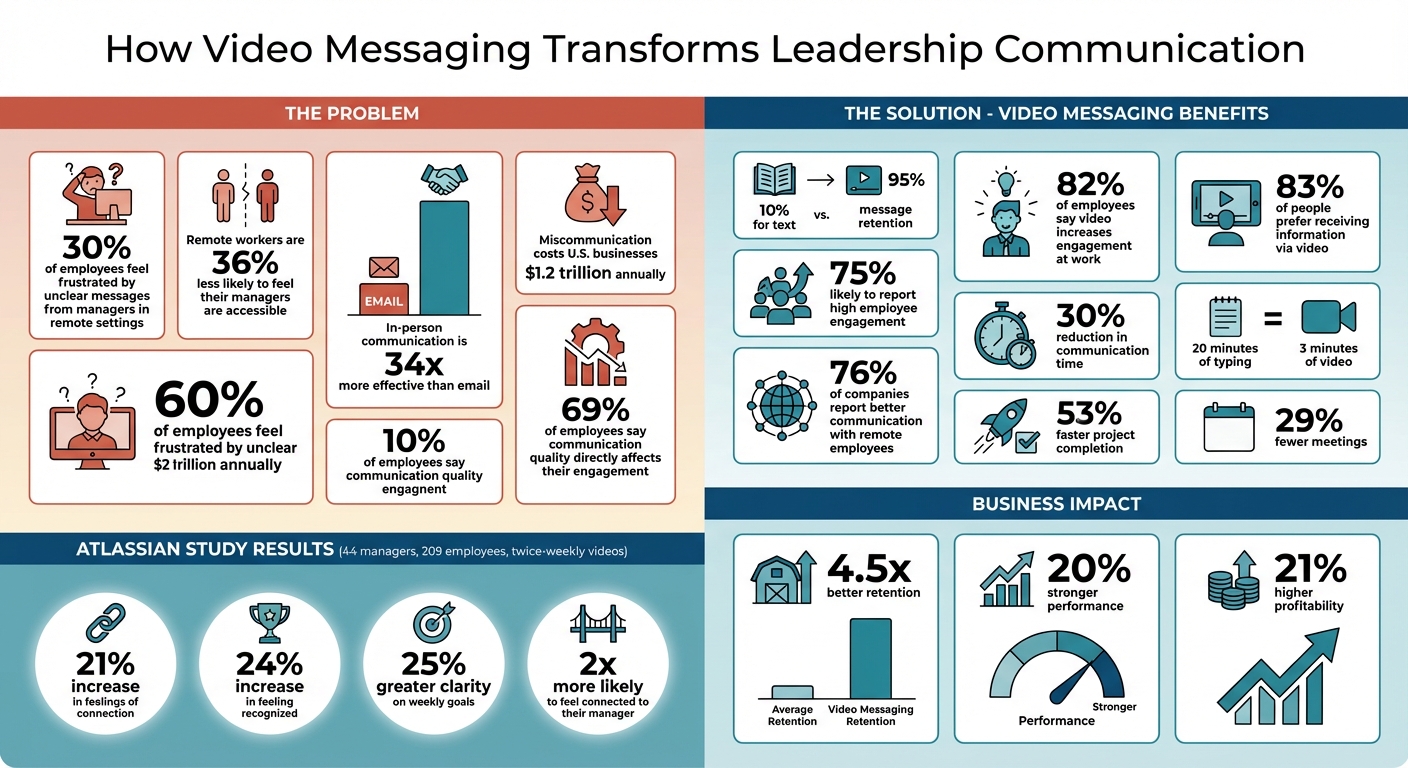
Video Messaging Impact on Leadership Communication: Key Statistics
The Leadership Communication Framework Every Manager Should Know
sbb-itb-d1a6c90
Common Leadership Communication Problems
Leaders today face several hurdles in effectively connecting with their teams. These challenges can lead to confusion, weaken trust, and negatively impact both productivity and morale.
Miscommunication in Remote and Hybrid Teams
When teams are scattered across different locations, even simple communication can become a source of frustration. Vague or conflicting messages sent through email or Slack often leave employees confused and unfocused, which ultimately drags down productivity. In fact, 30% of employees report feeling frustrated by unclear communication from their managers in remote settings.
Adding to the challenge, remote workers are 36% less likely than their in-office counterparts to feel their managers are accessible. Without the benefit of tone, body language, or facial expressions, messages can easily be misinterpreted. This problem is amplified in remote environments, where employees struggle to pick up on contextual cues that would be more apparent in face-to-face interactions.
Another issue is the rise of information silos in remote work settings, which makes cross-departmental knowledge sharing more difficult. On top of that, 33% of remote workers now spend more time reporting their progress than they did in the office. This so-called "visibility tax" forces employees to prioritize proving their productivity over actually getting work done.
These communication struggles not only disrupt clarity but also weaken the emotional bonds that are essential for fostering a cohesive team.
Loss of Emotional Connection
Emails and text messages often fail to deliver the emotional cues needed to build trust and engagement. Without facial expressions or vocal tones, sincerity and concern are harder to convey. This gap in connection can leave employees feeling detached from their organization’s goals.
Research highlights the difference: in-person communication is 34 times more effective than email for persuasion and clarity. As Panopto aptly put it:
"You can't beat text with more text".
Companies that embrace video communication see better results - workforces skilled in video are twice as likely to describe their collaboration as "excellent". The takeaway? Employees need more than words on a screen; they need to see and hear their leaders to feel truly connected.
Difficulty Communicating Sensitive or Complex Topics
When it comes to discussing sensitive issues, text-based communication often falls short. Whether it’s addressing layoffs, policy changes, or performance concerns, relying on email or chat can lead to misunderstandings or even conflict. Short messages may come across as cold or critical, and they lack the nuance needed to convey a leader’s true intent.
This communication gap can foster a culture of avoidance, where leaders shy away from addressing tough topics for fear of making things worse. Problems then go unresolved. Virtual settings also make it harder to detect subtle emotional cues, such as when employees outwardly agree but privately harbor doubts - a behavior sometimes called "courteous compliance."
As Sarah Rozenthuler, a coaching psychologist, points out:
"Difficult conversations require empathy, curiosity and courage - all profoundly human capacities".
Without these human elements, sensitive discussions can lose the empathy they require. Considering that 69% of employees say communication quality directly affects their engagement, the stakes for getting it right are incredibly high.
How Video Messaging Solves Communication Problems
Video messaging brings back the human element often missing in text-based communication, combining facts with emotion for clearer, more engaging exchanges. By addressing common challenges like miscommunication, emotional disconnect, and the difficulty of discussing sensitive topics, it equips leaders with a practical way to bridge communication gaps and grow your business fast with efficient tools. This approach also supports more effective visual delivery.
Improving Clarity Through Visual and Verbal Cues
Plain text can leave too much open to interpretation. Video messaging solves this by letting leaders use tone, pacing, and emphasis to make their points stand out. Screen recording tools add another layer, allowing them to visually guide teams through complex tasks or data. For instance, instead of drafting a long email about a new workflow, a leader could record their screen, highlight details with arrows or annotations, and explain each step in real time.
This approach isn’t just efficient; it’s preferred. A whopping 83% of people say they’d rather receive information via video, which can cut communication time by 30%. A study conducted in March 2024 by Atlassian's Team Anywhere Lab found that when 44 managers sent twice-weekly asynchronous video updates to 309 employees, feelings of connection rose by 21%, and perceptions of recognition increased by 24%. One manager, Ajit, shared:
"Creating a Loom helped me consider my audience and clarify my thought process better than how I might communicate when I shoot off a message via Slack."
Another advantage? Employees can pause, rewind, and revisit video messages whenever they need, making it easier to absorb and retain information compared to live meetings or lengthy email threads.
Building Trust and Authenticity
Video messaging doesn’t just improve clarity - it also strengthens trust. Unlike text, video captures nonverbal cues like facial expressions and body language, which convey sincerity and empathy. Interestingly, employees often respond better to unpolished videos from leaders. A leader stumbling over words while explaining a tough decision can come across as more relatable and trustworthy.
The numbers back this up: video-savvy teams are 75% more likely to report high employee engagement, and 76% of companies using video report better communication with remote employees. Alex L, an individual contributor at Atlassian, summed it up well:
"I felt a lot more seen and heard when updates on our goals and context behind big initiatives were presented by a human."
Leaders don’t need fancy equipment to make an impact. A simple setup with natural lighting and conversational talking points can create a sense of connection. Regular updates also build trust over time, while inconsistent communication can leave employees feeling uncertain.
Delivering Sensitive Messages with Empathy
When it comes to sensitive topics, video messaging offers a level of empathy that text just can’t match. Whether addressing layoffs, policy changes, or performance issues, leaders can use tone, pauses, and facial expressions to convey seriousness and compassion. Visual aids like slides or screen recordings can further clarify difficult decisions.
Asynchronous video is especially helpful in these situations. Leaders can take the time to carefully craft their message, while employees can absorb the information at their own pace. For maximum impact, keep regular updates short - around 2–3 minutes - and reserve 5–10 minutes for more complex topics. If a message runs longer, consider breaking it into segments. Adding captions and transcripts ensures accessibility for everyone, including those who might need to review the content multiple times or prefer reading along.
Business Benefits of Video Messaging for Leadership
Video messaging isn’t just about better clarity and trust - it also addresses some of the toughest challenges leaders face, delivering measurable business advantages. Stronger communication within teams can lead to 4.5× better retention, 20% stronger performance, and 21% higher profitability.
Better Engagement and Team Alignment
Video messaging has a unique ability to help employees feel more connected to leadership and their work. For example, 82% of employees say video increases their engagement at work, and 44% of companies believe it helps employees feel more connected to senior leaders.
A study by the Atlassian Team Anywhere Lab in March 2024, led by Dr. Molly Sands, highlighted how impactful video can be. In this study, 44 managers sent two brief video updates each week - one on Monday to set priorities and another on Friday to celebrate achievements. The results? Teams receiving these videos were twice as likely to feel connected to their manager compared to those receiving written updates. Additionally, 24% felt more recognized, and 25% reported greater clarity on their weekly goals - all without adding more meetings. Video adds a personal touch that written communication simply can’t replicate.
Higher Productivity and Lower Turnover
Clear communication through video can cut down on costly misunderstandings and disengagement. Miscommunication costs U.S. businesses a staggering $1.2 trillion annually, with $361 million lost each week just resolving these issues. On average, it takes 18 minutes to clear up a single misunderstanding. Video helps avoid these pitfalls by improving message retention - 95% of a message is remembered when delivered via video, compared to just 10% for text. This clarity leads to quicker decisions and better team outcomes.
Video messaging also boosts productivity by streamlining workflows. Employees complete projects 53% faster with video tools, and organizations see 29% fewer meetings on average. In fact, cutting meetings by 40% has been shown to increase productivity by 71%. These time savings allow employees to focus on meaningful work, making the entire organization more efficient.
Faster Communication Processes
Video messaging dramatically speeds up communication. Leaders can convey in just three minutes what might take 20 minutes to type, saving time while ensuring clarity.
It’s also a scalable solution. A single video - whether it’s an onboarding guide or a company-wide update - can be stored in a shared library for employees to access anytime. This eliminates the need to coordinate schedules across different time zones, enabling teams to stay informed and keep projects moving without delays. Video messaging ensures that critical information is always available, fostering smoother workflows and faster decision-making.
Conclusion: Improving Leadership Communication with Video Messaging
Modern workplaces often grapple with communication hurdles like misunderstandings and disengagement. Video messaging offers a powerful way to tackle these issues head-on. Unlike text, video captures the subtle cues - tone, facial expressions, body language - that help leaders convey their messages with clarity, sincerity, and a human touch. Whether you're leading a global remote team or reconnecting with employees who feel disconnected, video creates a bridge that text-based communication simply can't.
The numbers back this up. Video messaging can boost engagement by up to 75%, improve message retention to 95% (compared to just 10% for text), and save 30% of the time typically spent on communication tasks - all of which contribute to higher productivity. These aren't just statistics - they're results that translate into better leadership outcomes.
Take the example from the Atlassian study: managers who shared short, twice-weekly video updates saw their teams feel twice as connected. Additionally, 24% of employees reported feeling more recognized, and 25% gained clarity on weekly goals. The takeaway? You don’t need a high-budget production - just start with short, unscripted updates that focus on being genuine.
Ready to take the plunge? Consider exploring tools like the BizBot directory to find solutions that make video messaging easier and help streamline your leadership communication.
FAQs
When should leaders use video instead of email or chat?
Leaders should turn to video when they want to convey a sense of genuineness, strengthen trust, and foster a personal connection - especially in remote or hybrid work environments. Video brings an added layer of communication by showcasing facial expressions, tone, and body language, which makes messages more engaging and easier to interpret. It’s perfect for delivering concise, impactful updates, nurturing personal relationships, and ensuring clarity and energy that often get lost in text-based communication.
How do you keep leadership video updates short and effective?
To create leadership video updates that grab attention and deliver value, stick to a single, focused message and keep it brief - ideally under 10 minutes. For frontline teams, aim for even shorter clips, around 60 seconds. Start with the most important points right away, skip any extra details, and maintain a straightforward tone. Vertical videos without unnecessary filler often perform better, as they respect employees' time and keep them engaged.
What’s the best way to share sensitive news with video?
When sharing sensitive news through video, it's important to approach the message with transparency and empathy. This helps convey honesty and fosters trust. A recorded video message gives leaders the chance to communicate clearly and in a way that feels personal, which can be crucial for maintaining morale during challenging updates. By providing context and showing understanding, leaders can help employees grasp the situation and their role in it. Plus, recorded videos make it easier for remote or distributed teams to access the message, regardless of time zones.