Whistleblower software protects employees who report misconduct by ensuring anonymity, safeguarding data, and preventing retaliation. Retaliation can take many forms, from overt actions like firing to subtle forms like exclusion or mockery. Legal protections, such as the Sarbanes-Oxley and Dodd-Frank Acts, aim to shield whistleblowers, but businesses must also implement secure systems to handle reports effectively.
Key features of whistleblower software include:
- Anonymous reporting channels: Protects identity with unique identifiers and two-way communication.
- Data security: Uses advanced encryption (AES-256-CBC) and compliance with global standards like GDPR.
- Audit trails and case management: Tracks reports, escalates issues, and ensures transparency.
When paired with clear anti-retaliation policies and employee training, such tools reduce risks, improve reporting efficiency, and create safer workplaces. Companies using these systems report fewer lawsuits and lower settlement costs, proving their effectiveness in addressing workplace misconduct.
Whistleblower Software Impact: Key Statistics on Retaliation Prevention and ROI
Advancing Speak-Up by Improving Investigations Case Management
sbb-itb-d1a6c90
Legal Protections for Whistleblowers in the U.S.
Navigating whistleblower laws in the United States requires businesses to stay compliant with a mix of federal and state regulations. These laws create a framework to safeguard individuals who report misconduct, ensuring robust protections are in place.
Dodd-Frank Act and Sarbanes-Oxley Act
Two major federal laws - the Dodd-Frank Wall Street Reform and Consumer Protection Act and the Sarbanes-Oxley Act (SOX) - serve as the cornerstone of whistleblower protections in the U.S. Both prohibit retaliation against employees who report violations of securities laws.
The Sarbanes-Oxley Act offers protection to employees of publicly traded companies and their subsidiaries who report fraud involving mail, wire, banking, or securities, as well as breaches of SEC regulations. If an employee faces retaliation under SOX, they can seek remedies such as reinstatement to their position with seniority, back pay with interest, and compensation for damages, including expert witness fees. The Department of Labor's OSHA enforces these provisions, and employees typically have 180 days to file a retaliation complaint.
The Dodd-Frank Act expands these protections by empowering the SEC to take legal action against employers. Employees who successfully sue in federal court may receive double back pay with interest, reinstatement, and reimbursement for legal fees. However, to qualify for Dodd-Frank's anti-retaliation protections, whistleblowers must report their concerns to the SEC in writing before any retaliatory actions occur. Additionally, whistleblowers may be eligible for financial awards ranging from 10% to 30% of sanctions collected if their case results in penalties exceeding $1 million.
Both acts include strict rules preventing companies from obstructing whistleblowers. For instance, SEC Rule 21F-17(a) states:
No person may take any action to impede an individual from communicating directly with the Commission staff about a possible securities law violation, including enforcing, or threatening to enforce, a confidentiality agreement.
This ensures that tools like non-disclosure agreements or severance packages cannot be used to silence employees from reporting violations to regulators.
State-Level Whistleblower Protections
In addition to federal regulations, state laws provide further safeguards, addressing specific local compliance requirements. All 50 states have whistleblower protection laws. These laws often extend coverage to private-sector employees reporting violations of state laws, filling gaps left by federal statutes.
While federal laws like SOX focus on specific industries or misconduct, state laws often apply more broadly. Many states protect employees under a "public policy exception" to at-will employment, which prevents termination for reasons that violate established public policy. However, some states, such as Alabama, Florida, and Georgia, do not recognize this exception. States also have their own versions of the False Claims Act; for example, Texas and Washington limit their statutes to healthcare fraud, while California and New York address a wider range of issues.
For businesses operating across multiple states, compliance requires careful alignment with both federal and state laws. This includes creating whistleblower programs that meet the most stringent requirements, maintaining detailed records of reports, investigations, and employment decisions.
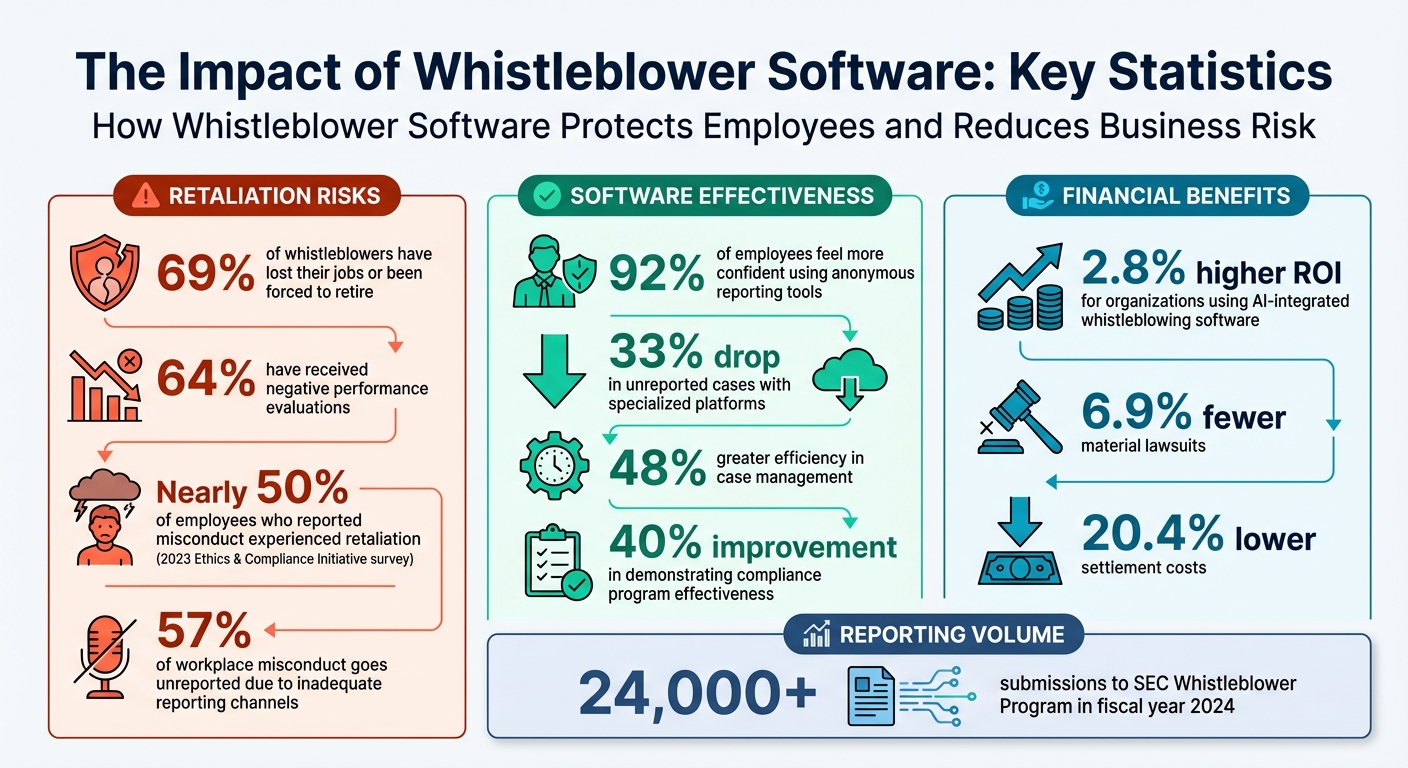
The importance of these protections is reflected in recent data. The SEC Whistleblower Program received over 24,000 submissions in fiscal year 2024, and a 2023 survey by the Ethics and Compliance Initiative revealed that nearly half of employees who reported misconduct experienced retaliation. These figures highlight the need for businesses to prioritize legal compliance while fostering a workplace culture that values ethical behavior and transparency.
Key Features of Whistleblower Software
Whistleblower software acts as a protective shield for employees who report misconduct, ensuring their identity remains hidden while safeguarding sensitive information. By replacing less secure methods like emails or face-to-face conversations with efficient digital tools, these tools are designed to prevent retaliation and maintain confidentiality.
Anonymous Reporting Channels
The foundation of any whistleblower system lies in its ability to protect the anonymity of those reporting. These platforms use unique identifiers, such as SafeKeys or PINs, while stripping away metadata like IP addresses and device details, ensuring no one can trace the report back to the individual. This setup allows whistleblowers to stay anonymous while still checking updates or responding to follow-up questions.
A standout feature is two-way anonymous communication, which provides a secure space for investigators and whistleblowers to exchange information. This means investigators can ask for clarification or additional evidence without compromising the whistleblower's identity. Resolver highlights this advantage:
Two-way anonymous communication ensures you can clarify facts, gather evidence, or provide status updates without betraying identity.
To further protect sensitive information, role-based access control (RBAC) ensures only authorized individuals - such as Compliance Officers, CEOs, or external legal counsel - can access specific reports. This minimizes the risk of retaliation by restricting who sees the details of a complaint. In fact, industry research shows that 90% of employees feel more confident about speaking up when anonymous reporting tools are available.
Once anonymity is secured, robust encryption measures ensure all communications remain protected.
Secure Communication and Data Protection
Whistleblower platforms use AES-256-CBC encryption to safeguard data both during transmission and while it’s stored, making it virtually unreadable even in the event of a security breach. Top-tier systems also hold certifications like ISO 27001 and SOC 2 Type II attestation, ensuring their security measures meet international standards such as GDPR and the EU Whistleblowing Directive.
Data is stored in Tier IV SSAE-16 compliant data centers, which feature redundant power systems, climate controls, and continuous monitoring to ensure reliability. Some platforms even offer data residency options, allowing organizations to choose where their data is stored to comply with local privacy regulations.
As Resolver puts it:
Confidentiality is the backbone of a trusted compliance program.
Organizations that adopt whistleblowing software, especially those integrated with AI tools, report tangible benefits - 2.8% higher ROI, 6.9% fewer material lawsuits, and 20.4% lower settlement costs on average. These results highlight the financial and operational advantages of a secure, well-implemented system.
Audit Trails and Case Management
In addition to secure communication, maintaining a transparent record of every report is crucial. Centralized case management systems create a permanent, time-stamped audit trail that logs who accessed a report, when they viewed it, and any changes made. This ensures a clear chain of custody, which is essential for regulatory audits or legal proceedings.
Automated triage features take things a step further by scanning reports for keywords like "retaliation" or "threat", flagging high-risk cases for immediate attention by senior leadership or legal teams. This quick response can significantly reduce the risk of retaliation. Resolver emphasizes the importance of controlled access:
If too many people see a sensitive report, or if the wrong person gets access, you put reporters at risk and compromise the defensibility of your process.
Dashboards provide leadership with valuable insights, such as trends in reporting volume and types of complaints by department or location. These tools help identify patterns - like repeated retaliation claims against a single manager - before they escalate into larger issues. Companies using case management software report 48% greater efficiency and a 40% improvement in demonstrating compliance program effectiveness.
Finally, remediation tracking links investigation findings to corrective actions, ensuring problems are addressed and resolved rather than ignored.
Integrating Anti-Retaliation Policies into Business Operations
Whistleblower software works best when it’s paired with well-defined policies, thorough training, and a structured approach to investigations. Let’s break down how businesses can create clear policies, educate their teams, and ensure transparency during investigations.
Creating Clear Non-Retaliation Policies
Anti-retaliation policies should leave no room for ambiguity. They need to clearly define what constitutes retaliation, covering both obvious actions like firing or demoting someone and more subtle behaviors like excluding employees from meetings, denying shift swaps, or even blacklisting them.
The Occupational Safety and Health Administration (OSHA) defines retaliation as:
"An adverse action is an action which would dissuade a reasonable employee from raising a concern about a possible violation or engaging in other related protected activity."
Policies should also address situations like constructive discharge, where working conditions become so unbearable that an employee feels they have no choice but to resign. To strengthen enforcement, companies should include specific examples of retaliation in employee handbooks and outline the consequences of violating these policies.
Whistleblower software can play a key role here by flagging reports that include terms like "retaliation", "threat", or "hostile environment", ensuring these issues are escalated promptly. Additionally, businesses must account for temporary workers, as both staffing agencies and host employers can share legal responsibility for retaliation.
Training Employees and Managers
Training is essential to help employees and managers understand their rights and responsibilities. It should cover what qualifies as protected activity, such as reporting safety hazards, financial misconduct, or environmental issues to management or the proper authorities. Federal laws protect employees who report concerns internally, emphasizing the importance of creating a safe space for internal reporting.
Managers, in particular, need to recognize that retaliation isn’t always deliberate. Even subtle actions can be perceived as retaliatory. Training should also explain the investigation process, stressing that investigators are neutral fact-finders rather than advocates for either side. This level of transparency fosters trust and encourages employees to come forward.
Another critical aspect of training is educating employees about the deadlines for filing retaliation complaints. These timelines vary by statute. For example, employees have 30 days to file under the OSH Act or Clean Air Act, but 180 days under laws like the Sarbanes-Oxley Act or the Affordable Care Act. Knowing these deadlines helps employees protect their legal rights.
| Statute | Filing Deadline | Primary Subject |
|---|---|---|
| OSH Act | 30 days | Workplace Safety & Health |
| Clean Air Act (CAA) | 30 days | Environmental Protection |
| Sarbanes-Oxley Act (SOX) | 180 days | Corporate Fraud & Financial |
| Affordable Care Act (ACA) | 180 days | Health Insurance/Healthcare |
| Food Safety Modernization Act (FSMA) | 180 days | Food Manufacturing/Distribution |
Transparent Investigation and Follow-Up Processes
For employees to trust the system, investigations must be transparent. Whistleblower software should securely collect all relevant evidence - emails, texts, logs, and personnel files - and produce a findings letter that outlines corrective actions. This mirrors OSHA’s approach, which allows both the complainant and the respondent to review and challenge the evidence.
Clear documentation shows that reports lead to real change, whether through updated policies, disciplinary actions, or additional training. If retaliation is confirmed, companies may be required to provide remedies such as back wages (with IRS-determined interest), reinstatement, or reimbursement for legal fees.
Keeping investigations on track also requires up-to-date contact information for everyone involved. Outdated details can delay or even derail the process. Whistleblower software can help by sending automated reminders to ensure contact information is regularly updated. By embedding these practices into their operations, businesses can resolve issues efficiently and reinforce a culture of accountability.
Using BizBot to Support Whistleblower Protection
Finding HR and Compliance Tools with BizBot
A strong whistleblower protection program relies on software that integrates smoothly with HR and compliance systems. That's where BizBot steps in, acting as a one-stop directory for businesses to find and evaluate whistleblower platforms that align with regulatory standards.
BizBot focuses on tools that include anti-retaliation features, ensuring whistleblowing processes stay connected to broader compliance efforts. It also highlights solutions designed to integrate seamlessly with existing HR systems, helping businesses maintain a unified compliance framework across operations.
The impact of using integrated whistleblowing platforms is clear. Companies utilizing these tools have seen a 33% drop in unreported cases and a 48% improvement in case management efficiency. Additionally, organizations with robust systems report 6.9% fewer material lawsuits and 20.4% lower settlement costs. Considering that 57% of workplace misconduct goes unreported due to inadequate reporting channels, investing in the right software can lead to meaningful change.
Managing Business Software with Subscription Management
Selecting the right compliance tools is just the beginning - maintaining them is equally important. Once the tools are in place, tracking licenses, usage, and costs becomes crucial. BizBot’s subscription management features simplify this process, helping businesses keep their software investments organized and ensuring compliance tools remain active and updated.
This centralized oversight is especially useful for uncovering hidden costs, like time lost to manual processes, employee burnout from managing disconnected systems, or the risks of letting licenses expire during organizational transitions. By streamlining subscription tracking, businesses can better understand cost-effectiveness and improve operational efficiency. For growing companies, this kind of visibility makes it easier to upgrade from basic software versions to more advanced tiers as compliance demands grow.
Conclusion
Whistleblower protection software plays a critical role in creating a safe and secure space for employees to report misconduct. When you consider that 69% of whistleblowers have lost their jobs or been forced to retire, and 64% have received negative performance evaluations, the risks of coming forward are undeniably high. Organizations that fail to address retaliation not only face regulatory consequences but also risk losing the trust that keeps their teams cohesive and effective.
Modern whistleblower systems go beyond damage control, offering tools that help prevent issues before they escalate. Features like anonymous reporting channels, secure two-way communication, and automated triage tackle the root causes that allow misconduct to thrive. As the National Whistleblower Center aptly states: "The best way to stop retaliation is to prevent it from happening".
Industry leaders echo these sentiments:
"Meeting whistleblowing regulations doesn't have to create friction. You can follow the rules, then use them as stepping stones to a more engaged, transparent work environment." - NAVEX
The numbers back up these claims. With 92% of employees feeling more confident using anonymous reporting tools and a 33% drop in unreported cases among organizations that implement specialized platforms, it’s clear that this technology addresses the silence that often enables misconduct. Features like role-based controls, audit trails, and real-time dashboards provide leadership with the oversight they need while maintaining the anonymity of whistleblowers.
FAQs
How does whistleblower software protect anonymity and prevent retaliation?
Whistleblower software ensures anonymity by employing advanced encryption techniques to safeguard all communications. Reports are transmitted through secure, encrypted channels that strip away or bypass the collection of identifying details, such as IP addresses. To further protect reporters, unique access keys are often provided, allowing them to monitor their submissions while keeping their identity hidden.
To combat retaliation, these systems restrict access to sensitive information, ensuring that only authorized personnel can view it. By protecting whistleblowers' identities and securing the reporting process, this software offers employees a safe way to voice concerns without the risk of facing negative consequences.
What protections do whistleblowers have under U.S. law?
In the United States, whistleblowers are safeguarded from retaliation by their employers. This means that whether you work for a federal agency, a contractor, or a private company, your employer cannot legally fire, demote, or discriminate against you for reporting misconduct or violations of the law. These protections cover disclosures made in good faith about issues such as fraud, safety violations, or other unlawful activities.
If a whistleblower faces retaliation, they have the right to file a complaint with agencies like the Department of Labor, OSHA, or the Department of Justice's Office of the Inspector General. Additional protections are outlined in laws such as the Sarbanes-Oxley Act and the Occupational Safety and Health Act (OSH Act). However, it’s crucial to act quickly - filing deadlines vary depending on the law, and missing them could jeopardize your ability to protect your rights.
How can companies integrate whistleblower software with their HR systems?
Integrating whistleblower software with your HR system can be a straightforward process if approached thoughtfully. First, check that the software is compatible with your HR platform. Map out key data fields - like employee IDs and department details - to ensure smooth data sharing. Using APIs or pre-built connectors can make this even easier by syncing updates, such as new hires or role changes, automatically.
To improve efficiency, set up automated workflows that route reports directly to the appropriate HR or compliance team members. Adding a simple "Report an Issue" button within your HR portal or intranet can encourage employees to voice concerns without hassle. And don’t forget: safeguarding anonymity and privacy is critical. Use encryption and strict access controls to keep sensitive information secure.