Contract collaboration software simplifies the way businesses manage agreements by addressing common challenges like slow approval cycles, scattered documents, and compliance issues. Instead of relying on outdated methods like email threads and manual signatures, these platforms centralize everything into one system. Here's what you need to know:
- Time Savings: Speeds up contract cycles by enabling real-time collaboration and automated approvals.
- Fewer Errors: Reduces mistakes with pre-approved templates and built-in checks.
- Improved Tracking: Centralized dashboards and audit trails ensure deadlines and compliance are never missed.
- Cost Efficiency: Cuts administrative costs, which can average $6,900 per contract with manual processes.
5 Hidden Benefits of Contract Management Software | ConvergePoint
sbb-itb-d1a6c90
Problems with Traditional Contract Management
Traditional contract management methods come with a host of inefficiencies and errors that can significantly hinder productivity. Below are some of the most common challenges businesses face when relying on outdated approaches.
Scattered Documents and Poor Tracking
When contracts are scattered across email threads, desktop folders, and shared drives, locating the right document can feel like a never-ending scavenger hunt. Teams often waste hours searching for the latest version, which can lead to version control issues. Imagine sending outdated terms to a client because legal hadn't approved the final draft yet - this not only causes delays but can also harm a company's reputation.
"If answering any of those questions requires digging through email threads, you don't have a contract management system. You have a filing cabinet made of hope." – Zignt
Without a centralized system, tracking becomes a nightmare. It’s hard to know which contracts are awaiting signatures, which ones are due for renewal, or even who made the last changes. This fragmented approach creates "tracking black holes", where critical deadlines are easily missed. The result? Reduced efficiency, more errors, and longer approval times.
Errors and Compliance Issues
Manual workflows are notoriously error-prone, with mistakes cropping up in 15%–20% of contract fields. Spreadsheets are particularly risky: a simple misstep like sorting a column incorrectly can break formulas, reformat dates, or disable renewal alerts. These errors may seem small, but they can have big consequences.
Another major issue is the lack of a clear audit trail. Traditional systems often fail to provide timestamped, tamper-proof records showing who signed a document, when it was signed, or from which device. This opens the door to legal risks and financial losses - businesses lose an average of 9% of their annual revenue due to poor contract management practices. The lack of compliance and accountability in manual processes often creates bottlenecks, slowing down approvals and increasing risks.
Slow Approval Cycles
Traditional contract management relies heavily on sequential workflows - Sales drafts the contract, Legal reviews it, and Finance approves it before it’s sent for signatures. This "baton-passing" process can drag total contract cycles out to an average of 5–8 business days. The administrative labor costs alone can add up to about $6,900 per contract.
Manual processes that involve printing, signing, scanning, and emailing create unnecessary friction. In fact, contracts requiring three or more manual steps see abandonment rates rise by 23%. For instance, before automating their workflows, Eversendai faced significant delays due to manual tracking. However, after integrating Microsoft SharePoint, they managed to complete 69% of contracts within just two days of initiation. This example highlights how outdated methods can slow down operations and how centralization can streamline processes effectively.
Benefits of Contract Collaboration Software
Modern contract collaboration software addresses the inefficiencies of traditional processes by bringing all aspects of contract management under one roof. Instead of juggling endless email threads and scattered files, teams can work together seamlessly in a centralized platform. This shift results in faster turnaround times, improved accuracy, and better oversight.
Shared Platform for Team Collaboration
A unified workspace eliminates the chaos of fragmented communication. Teams from legal, sales, and finance can work together in real time - drafting, redlining, and commenting simultaneously using a browser-based editor. This parallel workflow cuts out the delays caused by sequential reviews and ensures that everyone is always working on the latest version of the contract.
Role-based permissions add another layer of efficiency and security. Administrators can lock critical legal sections while allowing teams to customize client-specific details. For instance, a well-known hotel chain streamlined its contract processes across HR, IT, and Finance in February 2026, reducing monthly printouts by over 10,000 and cutting turnaround times from weeks to just days.
Standardized templates with built-in conditional logic further enhance productivity. These templates allow legal teams to pre-approve formats that automatically adjust clauses based on contract type or value.
Automated Workflows and Faster Approvals
Automation takes the hassle out of manual follow-ups. Documents are routed to the right approvers through predefined rules, whether based on contract value or specific clause changes. This automated process can speed up contract finalization by as much as 10 times compared to traditional methods.
Features like account-free signing simplify the process even further by generating unique signing links for instant completion. Companies using these automated workflows report significant time savings, with reductions in contract cycle times ranging from 20% to 50%.
Better Tracking and Compliance Management
One of the standout features of contract collaboration software is its ability to provide detailed visibility. Every change is logged with timestamps and contributor details, creating a tamper-proof audit trail. This ensures a clear record of who signed a document, when, and from which device - essential for compliance audits and legal accountability.
Automated reminders prevent costly mistakes by notifying teams of critical dates, such as renewals, terminations, or compliance deadlines. These features have led to a 73% increase in contract compliance rates and a 9.2% boost in annual revenue for organizations.
Centralized storage with advanced access controls ensures that contracts are both secure and easy to retrieve. Cloud-based repositories with encryption allow authorized users to locate agreements quickly without compromising sensitive information.
These features not only improve tracking and compliance but also highlight the stark differences between modern and traditional contract management methods, setting the stage for further comparison.
Traditional Methods vs. Contract Collaboration Software
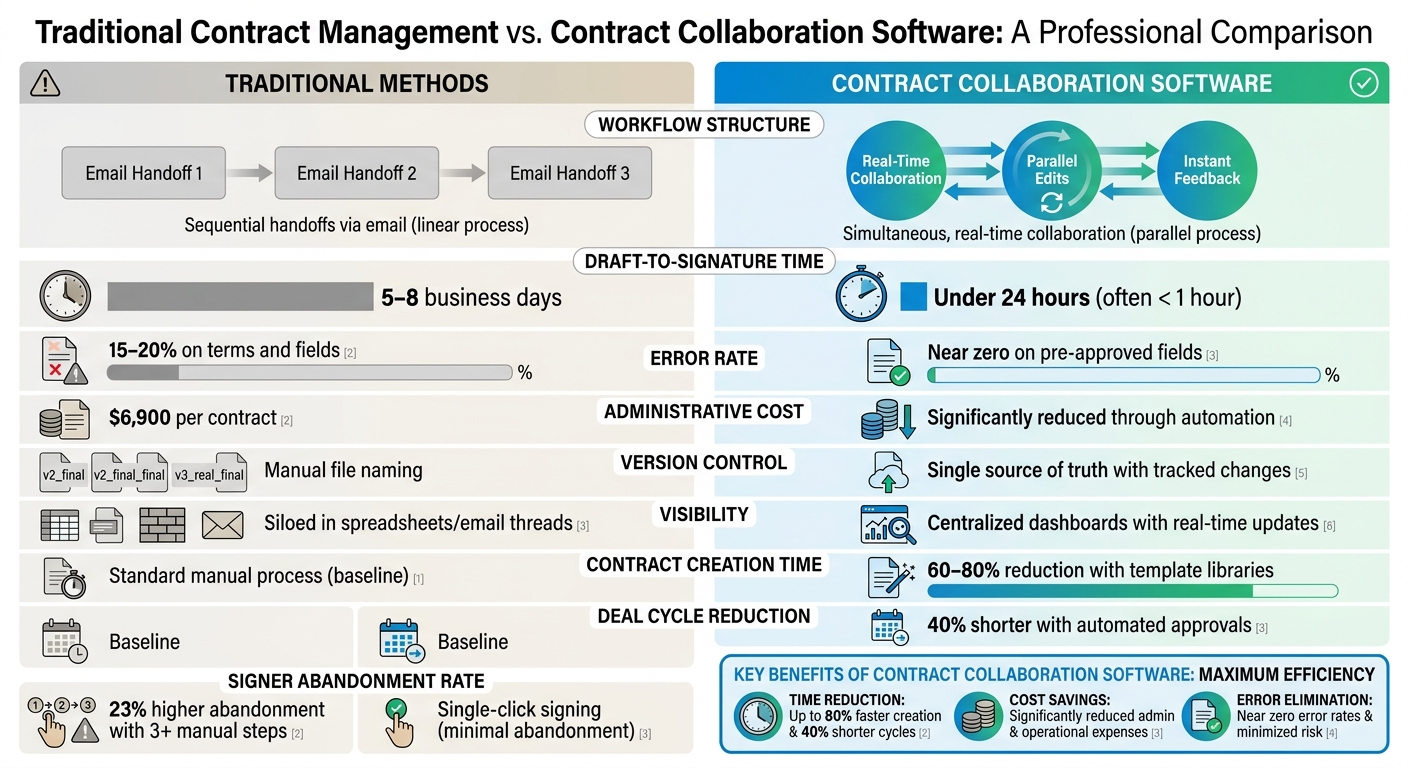
Traditional vs Modern Contract Management: Key Metrics Comparison
Switching from traditional contract management to modern collaboration software isn't just about adopting efficient business tools - it's about transforming how teams work together. Traditional workflows often rely on sequential handoffs, where one department finishes its part before passing the contract to the next. This "baton-passing" approach creates delays, with contract cycles often stretching to 5–8 business days or more. On the other hand, collaboration software allows parallel processing, enabling legal, finance, and sales teams to work on the same document at the same time. The result? Contracts are often finalized in less than 24 hours.
The cost difference is just as striking. Fully manual processes rack up $6,900 in administrative labor costs per contract. By automating workflows and centralizing tracking, collaboration software slashes these costs while also reducing errors and speeding up the process. Compliance also gets a boost, thanks to features like locked legal fields and automated checks, which nearly eliminate the 15–20% error rates seen in manual workflows.
The signer experience is another area where modern software shines. Contracts that involve three or more manual steps before signing have a 23% higher abandonment rate than those with single-click signing options. Traditional methods often require printing, scanning, or creating an account, while modern platforms simplify the process with unique signing links - no registration needed.
To sum it up, modern contract collaboration software outperforms traditional methods in nearly every aspect. Here's a quick side-by-side comparison:
Comparison Table
| Aspect | Traditional Methods | Contract Collaboration Software |
|---|---|---|
| Workflow Structure | Sequential handoffs via email | Simultaneous, real-time collaboration |
| Draft-to-Signature Time | 5–8 business days | Under 24 hours (often under 1 hour) |
| Error Rate | 15–20% on terms and fields | Near zero on pre-approved fields |
| Administrative Cost | $6,900 per contract | Significantly reduced through automation |
| Version Control | Manual file naming ("v2_final_final") | Single source of truth with tracked changes |
| Visibility | Siloed in spreadsheets/email threads | Centralized dashboards with real-time updates |
| Contract Creation Time | Standard manual process | 60–80% reduction with template libraries |
| Deal Cycle Reduction | Baseline | 40% shorter with automated approvals |
The advantages of modern software are clear - faster processes, fewer errors, lower costs, and a smoother experience for everyone involved.
Conclusion
Contract collaboration software takes the headaches out of managing agreements by replacing scattered emails, manual version tracking, and slow approval processes with streamlined workflows. The result? Faster turnaround times, fewer mistakes, and reduced administrative expenses. But it's not just about speeding things up - it’s about creating a single source of truth. These platforms prevent version confusion, ensure compliance with automated checks and locked fields, and give everyone involved a clear view of the contract’s progress.
This shift in how contracts are managed signals a move toward smarter, more efficient solutions. For businesses looking to upgrade their processes, the real challenge is often finding the right tool among the business applications for small business growth. That’s where BizBot comes in. Their directory of business administration tools helps organizations - whether freelancers, small businesses, or growing companies - find platforms that fit their unique needs.
To sum it up: modern contract collaboration software means quicker cycles, fewer mistakes, lower costs, and improved teamwork. As Jessica Zwaan, COO of Talentful, notes:
"I would definitely recommend Juro, particularly if you're operating with a lean legal team that has to cover a lot of ground".
The tools to revolutionize your contract management are out there - choosing the right one is the first step.
FAQs
What features matter most in contract collaboration software?
Contract collaboration software comes packed with tools designed to make teamwork smoother and more secure. Some standout features include:
- Real-time editing and commenting: Collaborate instantly with team members, making updates and sharing feedback without delays.
- Version control: Keep track of every change, ensuring no edits are lost or overwritten.
- Structured approval workflows: Streamline the approval process with clear, step-by-step workflows.
- Clear redlining: Highlight changes and edits clearly, so everyone stays on the same page.
- Permission controls: Manage who can view, edit, or approve documents, keeping sensitive information secure.
These features work together to prevent version confusion and make collaboration both efficient and reliable.
How does it improve compliance and audit readiness?
Contract collaboration software helps businesses stay on top of compliance and audit readiness by offering tools to securely organize contracts, monitor performance, and ensure legal obligations are met. Features like centralized storage, role-based access, and automated tracking make managing compliance easier. Additionally, clear policy-setting capabilities ensure companies are always prepared when audits come around.
How quickly can a team implement it and see ROI?
Teams that adopt contract collaboration software often see a return on investment (ROI) in just weeks or a few months. Why? Features like automated workflows and centralized collaboration simplify the entire contract process. By cutting down on manual tasks and improving efficiency, these tools help speed up results while making the process smoother for everyone involved.