Feedback loops are a simple yet powerful way to improve continuously. They work by taking results from a system (like customer or employee feedback), analyzing them, making changes, and repeating the process. This cycle helps businesses refine strategies, fix problems, and build stronger connections with customers and employees.
Key Takeaways:
- Two Types of Feedback Loops: Positive loops reinforce what works; negative loops address problems.
- Why They Matter: 85% of companies using feedback loops see higher customer satisfaction, but only 10% act on feedback effectively.
- Real-World Examples: Companies like Microsoft, Slack, and Atlassian use feedback to improve products, save time, and solve issues.
- Steps to Implement: Define goals, choose feedback channels (like surveys or social media), use tools to analyze data, and communicate changes.
Feedback loops aren’t just about collecting opinions - they’re about acting on them and closing the loop by showing customers and employees their input matters. Businesses that prioritize this see better retention, loyalty, and performance.
What Are Continuous Improvement Feedback Loops For Projects?
Research Findings: How Feedback Loops Affect Business Performance
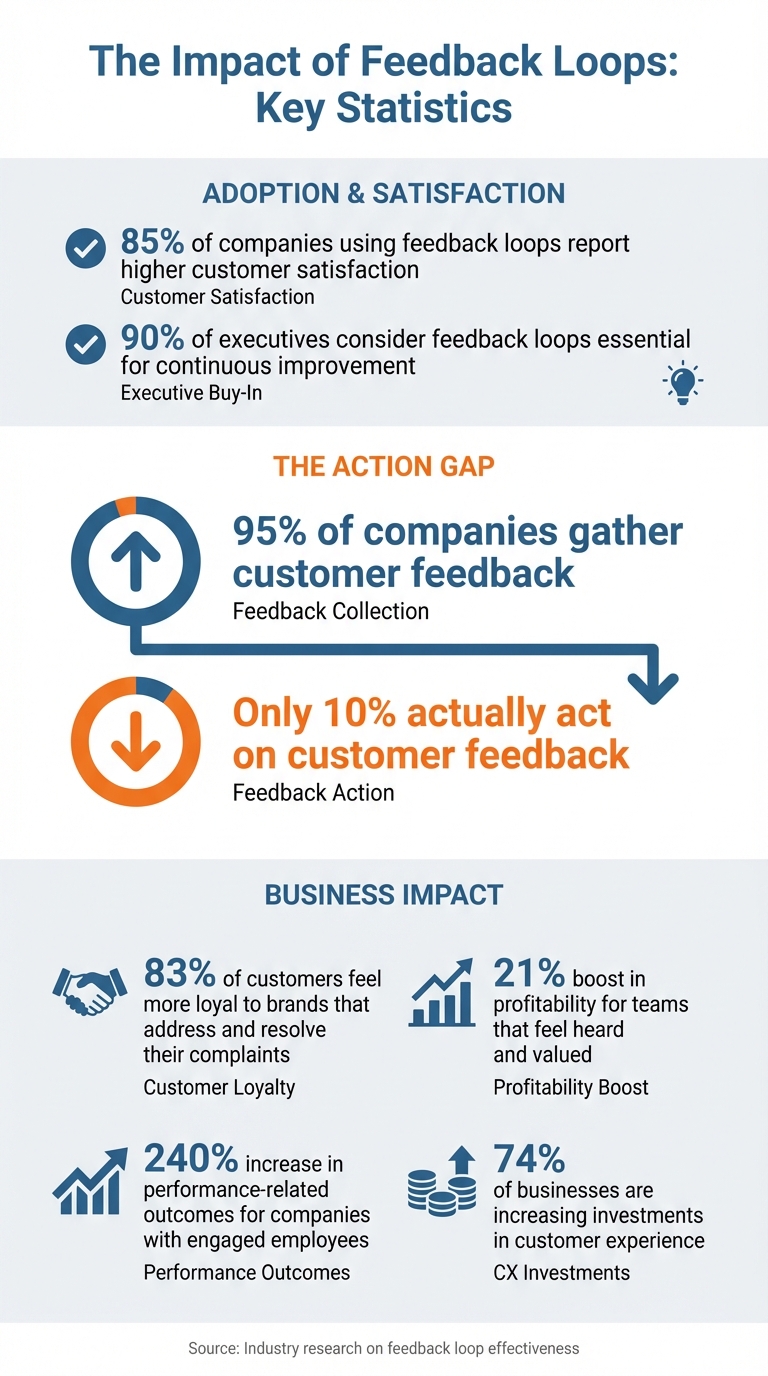
Feedback Loop Statistics: Impact on Business Performance and Customer Loyalty
Key Statistics on Feedback Loops
Research confirms that feedback loops can significantly impact business outcomes. For instance, 85% of companies using feedback loops report higher customer satisfaction. When businesses actively listen to and act on customer input, they create a sense of value that strengthens loyalty and retention.
Executives are also on board with this approach. 90% of executives consider feedback loops essential for continuous improvement. This strong endorsement reflects the growing importance of feedback systems as a core business strategy rather than an optional tool.
Teams that engage in ongoing feedback outperform those relying solely on traditional annual reviews. In fast-paced industries, waiting an entire year to make adjustments isn’t practical. Continuous feedback aligns individual efforts with company objectives, enabling smarter decisions and reducing inefficiencies. These findings highlight the benefits while also pointing to challenges that businesses must address.
Benefits vs. Challenges
While feedback loops offer clear advantages, they also introduce some hurdles that require careful management.
| Advantages | Challenges |
|---|---|
| Innovation and Product Development: Customer feedback helps refine products and inspire new features | Data Analysis: Extracting meaningful insights from large volumes of feedback data |
| Customer Retention: Resolving customer concerns through feedback reduces churn and builds loyalty | Implementation Delays: Acting on feedback quickly can be difficult |
| Proactive Problem-Solving: Identifies and resolves issues early, before they escalate | Information Overload: Handling the sheer volume of feedback can overwhelm teams |
| Trust and Credibility: Demonstrates to customers that their opinions matter, fostering repeat business | Strategic Alignment: Ensuring feedback initiatives align with broader company goals |
| Better Decision-Making: Provides real-time insights for quicker, more informed decisions | Consistency: Maintaining a uniform feedback process across multiple channels |
The real challenge lies in overcoming these obstacles. Companies that set clear goals, use effective tools to gather and analyze feedback, and close the loop by communicating actions back to customers and stakeholders achieve the most success.
Case Studies: How Businesses Use Feedback Loops
Microsoft: Employee Feedback Driving Cultural Change
Microsoft Digital, the IT arm of Microsoft, has embraced a culture of continuous improvement by focusing on eliminating inefficiencies and refining processes. David Laves, director of business programs at Microsoft Digital, described this approach:
"Continuous improvement is a natural, formal extension of our culture that applies rigor, structure, and methodology to enacting a growth mindset through understanding waste and opportunities for optimization."
In September 2025, Microsoft Digital tackled challenges faced by its Designated Responsible Individuals (DRIs) by introducing the Smart DRI Agent, an AI-powered tool designed to automate status updates. During the first 30 days of its pilot phase, the tool analyzed 101 of 301 incidents, saving DRIs around 100 hours and improving a critical network performance metric by 40%. This initiative shows how leveraging feedback can lead to streamlined operations and measurable results.
Slack: User Feedback Shaping Product Development
Slack's meteoric rise to a billion-dollar valuation in just eight months is a shining example of a feedback-centric approach. Initially created for internal use, the platform was gradually introduced to larger groups to collect user feedback and refine its features. As Stewart Butterfield, Slack’s Co-founder, explained:
"Slack expanded its user groups progressively, refining features as feedback increased."
Instead of opting for a traditional beta release, Slack launched a media campaign to invite users to try the product and share their experiences. The company also created a shared channel with over 100 champion users to gather real-time feedback. This direct connection allowed Slack to make quick improvements and address issues efficiently, setting a strong foundation for its growth.
Other companies, such as Atlassian, also rely on advanced tools to turn feedback into actionable insights, demonstrating the power of user-driven development.
Atlassian: AI-Powered Feedback Analysis
Atlassian highlights how businesses can use AI to process customer feedback effectively. With organizations often overwhelmed by vast amounts of data, AI tools provide a way to extract actionable insights quickly. This approach not only speeds up data analysis but also reduces the delays typically associated with implementing feedback-driven changes. While detailed results from Atlassian’s efforts are limited, their example underscores the growing reliance on AI to enhance responsiveness to customer needs.
These case studies illustrate how businesses across different industries are leveraging feedback loops to improve processes, refine products, and respond to customer expectations. By applying similar strategies, companies can unlock new opportunities for growth and efficiency.
sbb-itb-d1a6c90
How to Implement Feedback Loops in Your Business
Setting Goals and Choosing Feedback Channels
Before diving into feedback collection, start with a clear purpose. What are you aiming to improve? Whether it’s product usability, customer service, or employee satisfaction, defining your goals ensures you’re gathering insights that matter.
Once your objectives are set, choose multiple feedback channels to make participation easy and accessible. Quantitative tools like NPS, CSAT, and CES scores can provide measurable data, while methods like live chats, focus groups, and one-on-one interviews offer richer, qualitative insights. Don’t overlook social media listening, in-app reviews, and feedback widgets - they’re great for capturing real-time reactions from users. Planning a new feature? Beta testing with diverse user groups can help you catch usability issues early.
Timing is everything. Send surveys strategically - right after a purchase, on a quarterly basis, or following a customer interaction. Offering incentives like discounts can also encourage higher response rates. Be transparent about how their feedback will be used to improve their experience; this fosters genuine engagement. With the right channels and timing in place, you’ll be ready to turn feedback into actionable insights.
Tools and Platforms for Managing Feedback
After setting up your feedback channels, managing the data effectively becomes the next step. Dashboards and visual reports can help you spot trends and prioritize areas for improvement based on frequency, impact, and relevance to your goals. Automation tools can handle routine tasks like sending follow-up surveys or summarizing responses, freeing your team to focus on more complex challenges.
For businesses seeking streamlined solutions, platforms like BizBot offer directories of tools to support feedback collection and analysis. Whether you’re looking for HR software to gather employee insights or subscription management tools to track customer satisfaction, having centralized resources simplifies the process and integrates feedback seamlessly into daily operations.
Modern performance management tools can go a step further by linking feedback with broader goals and reviews. This gives you a full picture of how changes impact performance and ensures feedback becomes a natural part of your workflow - not an extra chore.
Tracking Results and Refining Your Process
The real value of feedback lies in turning it into action. Track how feedback correlates with key metrics like customer retention, employee engagement, or product adoption. Break down responses by demographics or customer history to understand how different groups react to changes. And don’t stop at collecting data - communicate the actions you’ve taken. This builds trust and reinforces the importance of their input.
Here’s a startling fact: 95% of companies gather customer feedback, but only 10% act on it - and even fewer communicate those changes back to their customers. Avoid falling into this trap. Close the loop by acknowledging feedback and sharing updates through emails, blogs, or social media. This demonstrates that their voices influence real change.
Improvement is an ongoing process. Regularly gather fresh feedback, refine your strategies based on what’s working, and avoid getting bogged down in unnecessary bureaucracy. Create a culture where feedback is seen as a chance to grow, not a source of blame. When employees receive regular feedback - multiple times a week, even - engagement levels soar. By making feedback an integral part of your operations, you’ll establish a cycle of improvement that builds momentum over time.
Conclusion: Key Points About Feedback Loops for Business Success
Feedback loops are more than just a process - they're a continuous cycle of listening, analyzing, acting, and communicating that drives real improvement. The best-performing organizations recognize that feedback fuels innovation. It helps teams figure out what’s working, what’s not, and where to go next. Instead of treating feedback as a one-off survey, they turn it into an ongoing dialogue that builds trust and keeps pace with evolving market demands.
The numbers tell a compelling story. Despite the importance of feedback, only 10% of companies actually act on customer feedback, and even fewer close the loop by communicating those changes back. Yet, 83% of customers feel more loyal to brands that address and resolve their complaints. On the employee side, teams that feel heard and valued experience a 21% boost in profitability, and companies with engaged employees see a staggering 240% increase in performance-related outcomes. With 74% of businesses ramping up investments in customer experience, it’s clear that feedback is driving change.
These figures highlight a crucial point: feedback isn’t the finish line - it’s the spark for continuous improvement. Early and consistent feedback lets businesses test ideas and refine strategies before making major commitments. But this requires going beyond simply collecting data. It’s about digging into the "why" behind the feedback, which is where true growth happens. Whether it’s insights from customers, employees, or frontline staff, the ultimate goal is the same: translate feedback into actionable steps that deliver measurable outcomes.
Creating a culture of listening demands transparency, accountability, and open communication. This includes giving employees a voice in decisions and ensuring management is receptive to their input. Companies that embed feedback loops into their core strategy gain the agility to adapt, innovate, and stay ahead in an ever-changing landscape. By making feedback part of everyday operations, businesses set themselves up for long-term success.
FAQs
How can businesses use feedback to continuously improve customer satisfaction?
To make the most of feedback and boost customer satisfaction, businesses should treat it as a continuous process, not a one-off task. Start by defining clear, measurable goals - for example, aiming to raise your Net Promoter Score (NPS) by 5 points or cutting down support ticket volumes by 10%.
Then, gather feedback from diverse sources to get a complete picture. This could include post-purchase surveys, social media comments, and customer support interactions. The broader the input, the better your understanding of customer experiences.
Once you’ve collected the feedback, analyze it to uncover patterns and pinpoint pain points. Look for areas where small changes could make a big difference, and prioritize actions that will have the most impact. After implementing improvements, let your customers know about the updates - this reinforces that their opinions are valued.
Finally, evaluate the results by comparing them to your original goals. Use these insights to refine your approach for the next cycle. Tools like BizBot can simplify the process by helping you collect, analyze, and act on feedback, building stronger customer loyalty over time.
What challenges do businesses face with feedback loops, and how can they address them?
Implementing feedback loops can be challenging for many businesses. One common hurdle is relying on slow, reactive processes that deliver insights too late to drive meaningful change. Feedback itself can sometimes be confusing or overwhelming, making it difficult to pinpoint actionable steps. On top of that, workplace dynamics - like fear of criticism or a lack of follow-through - can further undermine the effectiveness of feedback systems.
To tackle these challenges, businesses should prioritize gathering feedback early and frequently. Quick surveys or testing prototypes can provide valuable insights before large resources are committed. Instead of focusing solely on polished outcomes, shift attention to examining assumptions and testing ideas through small, strategic experiments. Creating a culture of continuous improvement is essential - integrate feedback into regular check-ins, one-on-one meetings, and open reporting processes. Platforms like BizBot can simplify this process by automating feedback collection and analysis, ensuring insights are actionable and reach the right people at the right time.
How do companies like Microsoft and Slack use feedback loops to foster innovation and improvement?
Feedback loops are organized systems that take the results of a product, service, or system and use them to shape future improvements. By gathering insights early - often during the development phase - businesses can test ideas, confirm assumptions, and make adjustments. This process ensures steady progress and helps refine ideas effectively.
Take Microsoft, for example. The company has mastered the art of feedback loops, especially in its focus on continuous improvement and AI. Microsoft incorporates real-time telemetry, user testing, and AI-powered analytics into its development process. By collecting feedback from both customers and internal teams and running small-scale experiments, they fine-tune features before rolling them out more broadly. This approach not only speeds up delivery but also ensures their products consistently provide value.
Though details about Slack’s specific feedback loop methods are scarce, it’s clear that many leading companies rely on similar strategies to stay agile and meet user demands effectively.