Social media segmentation allows businesses to group customers based on their online behavior and engagement. By integrating this data into CRMs, teams can create detailed customer profiles and target groups more effectively. This article reviews the best CRMs offering advanced social media segmentation tools, comparing features like integration depth, segmentation types, pricing, and dynamic updates.
Key Highlights:
- HubSpot: Syncs social interactions with contact profiles and offers dynamic segmentation with over 250 filters. Pricing starts at $0/month for basic tools.
- Salesforce: Combines social listening with AI-driven segmentation. Advanced features start at $1,500/month.
- Klaviyo: Focuses on predictive and behavioral segmentation, with plans starting at $0/month for basic usage.
- Nimble: Simplifies social segmentation with its Prospector browser extension. Pricing starts at $24.90/user/month.
- Zoho CRM: Offers broad social platform integration and segmentation models like RFM. Plans start at $14/user/month.
- Pipedrive: Relies on third-party integrations for social media data. Pricing begins at $14/user/month.
- ActiveCampaign: Syncs CRM data with social ads and offers advanced segmentation starting at $29/month.
- BuddyCRM: Provides advanced geographic segmentation and detailed social tools, starting at $94/user/month.
Quick Comparison
| CRM Platform | Social Media Integration | Segmentation Types | Starting Price (USD) | Dynamic Updates | Supported Channels |
|---|---|---|---|---|---|
| HubSpot | Moderate (Native + 3rd Party) | Behavioral, Demographic | $0/month | High | FB, IG, LinkedIn, X, YouTube |
| Salesforce | High (Native) | Sentiment, AI Predictive | $1,500/month | High | FB, IG, X, WhatsApp |
| Klaviyo | High (Native) | Predictive, Behavioral | $0/month | High | FB, IG, TikTok, Pinterest |
| Nimble | Moderate (Native) | Demographic, Behavioral | $24.90/user/month | Moderate | LinkedIn, X, Facebook |
| Zoho CRM | High (Native) | RFM, Demographic | $14/user/month | High | FB, IG, X, LinkedIn, TikTok |
| Pipedrive | Basic (3rd Party) | Behavioral, Demographic | $14/user/month | Moderate | LinkedIn, FB Messenger |
| ActiveCampaign | Moderate (Native + 3rd Party) | AI-Suggested, Behavioral | $29/month | High | FB, WhatsApp, SMS |
| BuddyCRM | High (API/Webhooks) | Geographic, Behavioral | $94/user/month | High | Multiple via API |
Choosing the right CRM depends on your business size, budget, and need for social media integration. Platforms like Salesforce and HubSpot cater to larger teams with advanced tools, while Zoho CRM and Klaviyo are better suited for small to medium-sized businesses. Start by identifying your key requirements and testing platforms through free trials.
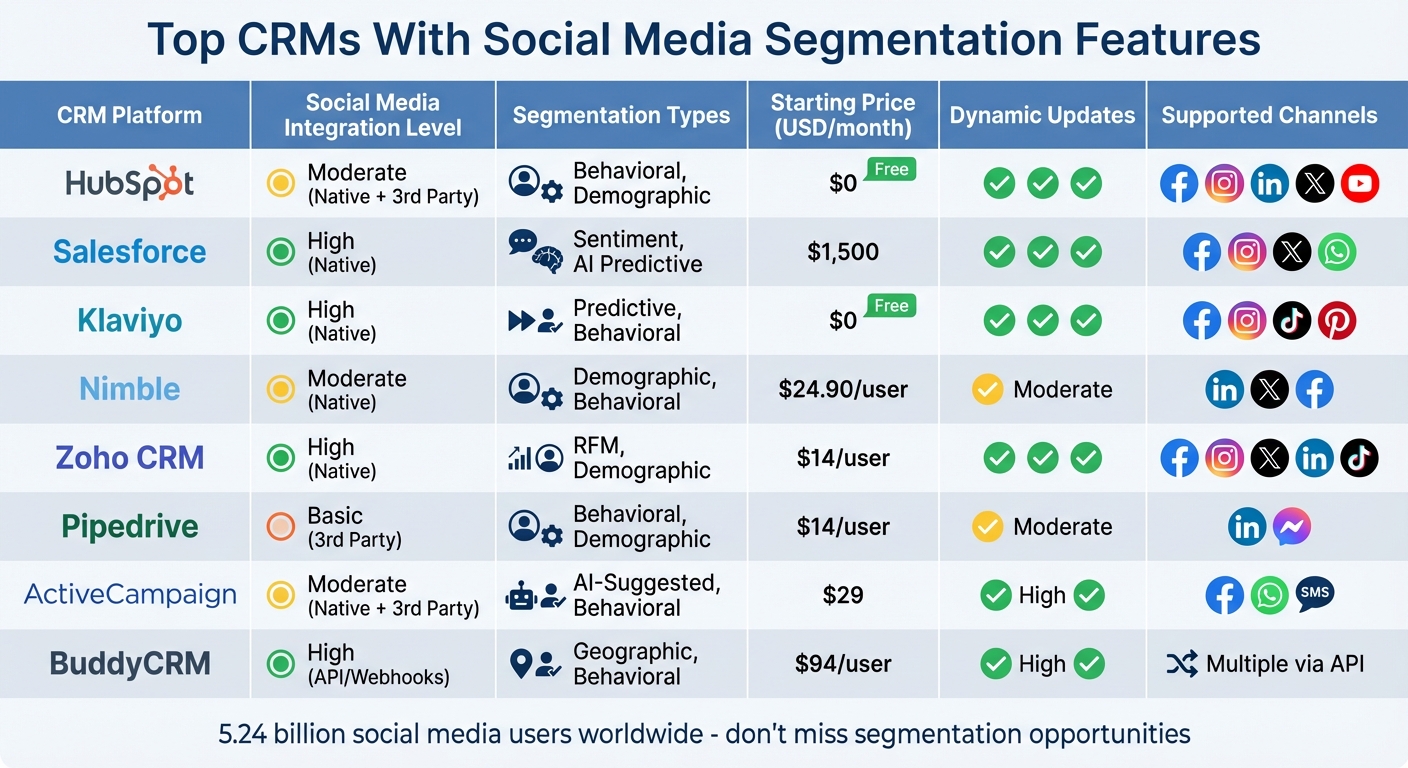
CRM Social Media Segmentation Features Comparison Chart
1. HubSpot
Social media integration depth
HubSpot provides native integration with Facebook, Instagram (Business accounts), LinkedIn (Personal and Company pages), X (formerly Twitter), and YouTube. This integration pulls comments, mentions, and direct messages into a single customer timeline, syncing all social interactions directly with contact profiles in the Smart CRM. When you connect an account, HubSpot imports up to 60 days of previous posts and keeps syncing interactions going forward.
Additionally, HubSpot automatically enriches contact records with public social profile data, such as employment details and interests. This data powers demographic segmentation and contributes to lead scoring. While TikTok and Pinterest don't have native integrations, third-party tools like Zapier or Make can be used to sync leads into HubSpot.
Segmentation types supported
HubSpot's integration also supports advanced segmentation options through its "Segments" feature (previously called "Lists"). It enables both behavioral and demographic segmentation. Behavioral segmentation tracks actions like clicks on social-generated URLs, engagement with posts, or lead ad form submissions. Demographic segmentation uses enriched profile data to target audiences based on factors like location, language, job role, seniority, company size, and industry.
You can create Active segments that update automatically as contacts meet or stop meeting specific criteria, or Static segments for fixed groups meant for one-time campaigns. With over 250 filters available, HubSpot allows for highly detailed audience targeting based on property values, event interactions, and social media activity.
Pricing tiers (USD)
| Tier | Price (USD/Month) | Social Media Features Included |
|---|---|---|
| Free Tools | $0 | Basic CRM and limited social tools |
| Marketing Hub Starter | $890 | Full social media management and lead syncing |
| Marketing Hub Professional | $1,170 | Advanced social automation and workflows |
| Marketing Hub Enterprise | $4,300 | Custom social reporting and brand add-ons |
Social media management features, including tracking interactions back to individual CRM records for segmentation, start with the Marketing Hub Starter tier. For example, fulfillmentcrowd reported a 3,298% increase in website visitor sessions and a 2,411% increase in contact creation year-over-year after implementing HubSpot's workflows.
Ease of dynamic updates
HubSpot's segmentation tools are supported by dynamic update capabilities. Active segments refresh automatically as contact data changes, making them ideal for ongoing campaigns like newsletters or automated follow-ups on social media. The "Test matches" feature lets you preview which records meet your criteria before finalizing a segment. This ensures your segments remain up-to-date and aligned with HubSpot's robust social media segmentation features.
sbb-itb-d1a6c90
2. Salesforce
Social Media Integration Depth
Salesforce seamlessly integrates with major social platforms like Facebook, Instagram, LinkedIn, X (formerly Twitter), and YouTube. This allows the platform to pull social interactions directly into customer profiles while keeping track of mentions, keywords, and hashtags to assess customer sentiment. Teams can respond to messages and comments straight from the CRM, with every interaction automatically logged alongside email and phone records. Salesforce also streamlines lead generation by creating new contact or lead records from social media engagement. However, it’s important to set up rules to filter for meaningful interactions, such as pricing inquiries, rather than capturing every casual "like". Its AI tool, Agentforce, further enhances engagement by analyzing patterns to identify the most responsive audience segments.
Segmentation Types Supported
Salesforce pairs its social media integration with powerful segmentation tools, offering seven primary segmentation types: demographic, geographic, technographic, needs-based, value-based, psychographic, and behavioral. Its Marketing Cloud’s Audience Builder consolidates social interaction data into unified customer profiles, enabling the creation of detailed audience segments. Social listening tools also classify posts by sentiment, allowing teams to tailor responses based on how customers feel about the brand. By combining sentiment analysis with segmentation, Salesforce helps businesses create highly targeted strategies. According to Salesforce, 74% of marketers using AI report better customer segmentation. The system dynamically updates audience segments as customer behaviors shift, using Data 360 to integrate insights from social media, web analytics, and other data sources.
Pricing Tiers
| Tier | Price (USD/Month) | Social Media Features |
|---|---|---|
| Free Suite | $0 (max 2 users) | Basic CRM only |
| Starter Suite | $25/user | Simple email marketing |
| Marketing Cloud Growth | $1,500/org | Multi-channel journeys with AI campaign creation |
| Marketing Cloud Advanced | $3,250/org | Two-way SMS/WhatsApp conversations |
| Engagement+ | $2,000/org | Advanced AI for cross-channel journeys |
To access advanced social media segmentation features, a Marketing Cloud subscription is required. Entry-level pricing starts at around $1,000 per month, while enterprise-level plans are custom-quoted. Interestingly, companies that use multiple Salesforce modules report closing 31% more deals compared to those using just one module.
Ease of Dynamic Updates
Salesforce excels at keeping customer insights up-to-date through its dynamic update features. Its AI tools analyze both current and historical data to create real-time audience segments. Sales teams also benefit from having access to past social conversations stored within the CRM timeline, which adds a layer of personalization to their outreach efforts. This dynamic tracking ensures that segments remain accurate as customer engagement patterns evolve.
3. Klaviyo
Social Media Integration Depth
Klaviyo connects seamlessly with major advertising platforms like Facebook, Instagram, Google Ads, TikTok, and Pinterest, ensuring audience segments sync in real time. After acquiring Gatsby, Klaviyo enhanced its Instagram integration by importing DMs, comments, and tags, while also tracking metrics like follower count. This feature helps brands turn anonymous followers into identifiable contacts. With Instagram keyword campaigns, you can gather email and SMS consent and automatically assign users to specific segments.
Kulani Kinis, a swimwear brand with a global presence, leveraged Klaviyo's Instagram integration to grow their SMS list. Using a single keyword campaign, they achieved a cost of $3.39 per acquisition in 2024. Kirsten Laurendet, their digital marketing lead, shared, "We needed a scalable solution to acknowledge micro-influencers who provided valuable UGC without individual interaction. [Klaviyo] delivers that".
These integrations create a solid foundation for advanced audience segmentation.
Segmentation Types Supported
Klaviyo supports a variety of segmentation types, including behavioral, demographic, predictive, and psychographic. For behavioral segmentation, it tracks actions like purchase history, website activity (e.g., product views or cart abandonment), and email/SMS engagement. Demographic segmentation allows targeting based on factors like location (including proximity radius targeting, such as within 30 miles of an event), age, and even predicted gender based on first names. Predictive segmentation, powered by AI, identifies churn risk, forecasts customer lifetime value, and predicts when a customer is likely to place their next order.
For example, Garrett Popcorn used Klaviyo's "predicted date of next order" feature in 2024 to create reorder reminder segments. This strategy led to 4× higher revenue per recipient and generated $12,000 in revenue within a single month. Similarly, July, a luggage brand, used geographic segmentation to target customers within a 12-mile radius of their retail stores in Melbourne, Sydney, and Brisbane. This approach contributed to a 52% year-over-year growth in revenue attributed to Klaviyo.
These segmentation tools are available across all pricing plans.
Pricing Tiers
Klaviyo offers a free trial along with tiered paid plans based on the number of contacts and monthly message volume. Unlike some competitors, Klaviyo doesn’t charge extra for accessing historical data or performing detailed segmentation. Social media segmentation features are included in all paid plans.
Ease of Dynamic Updates
Klaviyo's segments update automatically as customer data evolves, removing the need for manual list management. For instance, customers are added or removed from segments based on actions like cart abandonment or completed purchases. The Segments AI tool further simplifies this process by allowing marketers to create complex audience groups using plain language. These groups refresh in real time based on live behavioral data. This ensures that your social ad audiences stay relevant, while tools like audience suppression exclude recent buyers from campaigns, helping you optimize advertising budgets.
4. Nimble
Social Media Integration Depth
Nimble takes its social segmentation capabilities to the next level with its Prospector browser extension. This tool integrates seamlessly with LinkedIn, X (Twitter), Facebook, and AngelList, allowing users to create and enrich contact records effortlessly. By automatically matching contacts with social handles, business data, and Influence Groups, Nimble simplifies data entry and enables multi-dimensional segmentation.
DLA Ignite's CEO Tim Hughes shared that Nimble Prospector reduced data entry time by a staggering 95%, allowing his team to create new contact records in seconds simply by hovering over LinkedIn names (source:).
Amanda Robinson, Founder of The Digital Gal, remarked, "Nimble Prospector works where I work and allows me to tag and add contacts without having to do any data entry" (source:).
Segmentation Types Supported
Nimble offers a wide range of segmentation options to tailor your outreach. You can use demographic segmentation to filter contacts by location, education, job title, or company. Social segmentation taps into Influence Groups and connections like "Twitter friends", while behavioral segmentation focuses on touchpoints such as birthdays, interaction histories, and "Stay in Touch" reminders. Custom segments can also be created using criteria like dates, tags, numbers, or company descriptions, enabling advanced targeting - think "Twitter friends in San Francisco."
Sid Bhatt, Senior Advisor at Saunders Real Estate, leveraged Nimble's segmentation tools and graphical email templates to market listings, achieving twofold growth (source:).
Pricing Tiers
Nimble's pricing is straightforward. The core plan costs $24.90 per seat per month (billed annually) or $29.90 on a monthly basis. This includes essential business applications for growth like social segmentation, support for up to 25,000 contacts, and 2 GB of storage per seat. For additional functionality, optional add-ons are available:
- Email Marketing: $15 per month for the entire company
- Data Enrichment: $10 per month for 100 credits
- Web Forms: $12 per month per team
If you need more storage, you can increase your contact limit by 10,000 records for an extra $10 per month (source:,).
Ease of Dynamic Updates
Nimble stands out for its real-time segmentation updates. With Smart Segments, contacts are automatically added to the appropriate groups as soon as they meet your predefined criteria. For example, if you add a contact with a specific job title or social handle, they’ll instantly join the relevant segment - saving you time and ensuring your messaging and workflows stay up-to-date.
5. Zoho CRM
Social Media Integration Depth
Zoho CRM connects with a wide range of platforms, including Facebook, X (Twitter), Instagram, LinkedIn, YouTube, Pinterest, TikTok, Mastodon, Threads, Google Business Profile, and Bluesky. Its Social Tab simplifies managing your brand's presence by letting you monitor mentions, respond to comments, and handle direct messages - all without leaving the CRM. Through listening streams, you can track keywords, hashtags, and competitor accounts in real time. Plus, the SalesSignals feature ensures you’re instantly notified of brand mentions, giving you the chance to act quickly on new opportunities. Social interactions, like Facebook likes or LinkedIn ad submissions, are automatically converted into CRM leads with detailed contact information and follow-up workflows.
Segmentation Types Supported
Zoho CRM takes customer segmentation to another level with its RFM model (Recency, Frequency, Monetary value), focusing on purchase behavior rather than just social engagement. This approach helps identify high-value customers and frequent buyers, while also pinpointing your most active social followers. Actions like retweets, mentions, and comments can even trigger lead generation.
Beyond purchase patterns, Zoho CRM supports segmentation by website behavior, such as tracking email link clicks or site exits. It also offers demographic segmentation through tools like territory management and social analytics, enabling grouping by geography, age, and gender. For businesses, firmographic segmentation is available via keyword tagging, allowing contacts to be grouped by industry or lead source. Additionally, Zoho's AI assistant, Zia, suggests the best times and channels to contact leads based on historical interactions, making outreach more effective. These segmentation tools are included across Zoho's pricing plans, offering flexibility for businesses of all sizes.
Pricing Tiers
Zoho CRM provides a Free Edition for up to 3 users, which includes basic lead management and mobile access. Paid plans are as follows:
- Standard: $14 per user/month (annual billing) or $20 per user/month (monthly billing).
- Professional: $23 per user/month (annual billing) or $35 per user/month (monthly billing).
- Enterprise: $40 per user/month (annual billing) or $50 per user/month (monthly billing), offering full social integration and 1 active segmentation rule.
- Ultimate: $52 per user/month (annual billing) or $65 per user/month (monthly billing), supporting up to 5 active segmentation rules.
All paid plans include the Social Tab with integration for Facebook and X. These pricing tiers make it easier for businesses to access advanced social data features and segmentation tools, regardless of their budget.
Ease of Dynamic Updates
Zoho CRM ensures that updates are actionable the moment they occur. For example, the SalesSignals feature alerts you immediately when a prospect mentions your brand, enabling quick follow-up. Automated lead generation streamlines the process further - actions like retweets or Facebook likes can automatically add prospects to your sales pipeline, with predefined rules assigning them to the right team member.
Thomas John, Managing Director at Agappe, shared: "With our complete business under control, our productivity is up by 80% in the last year that we have been using Zoho".
6. Pipedrive
Social Media Integration Depth
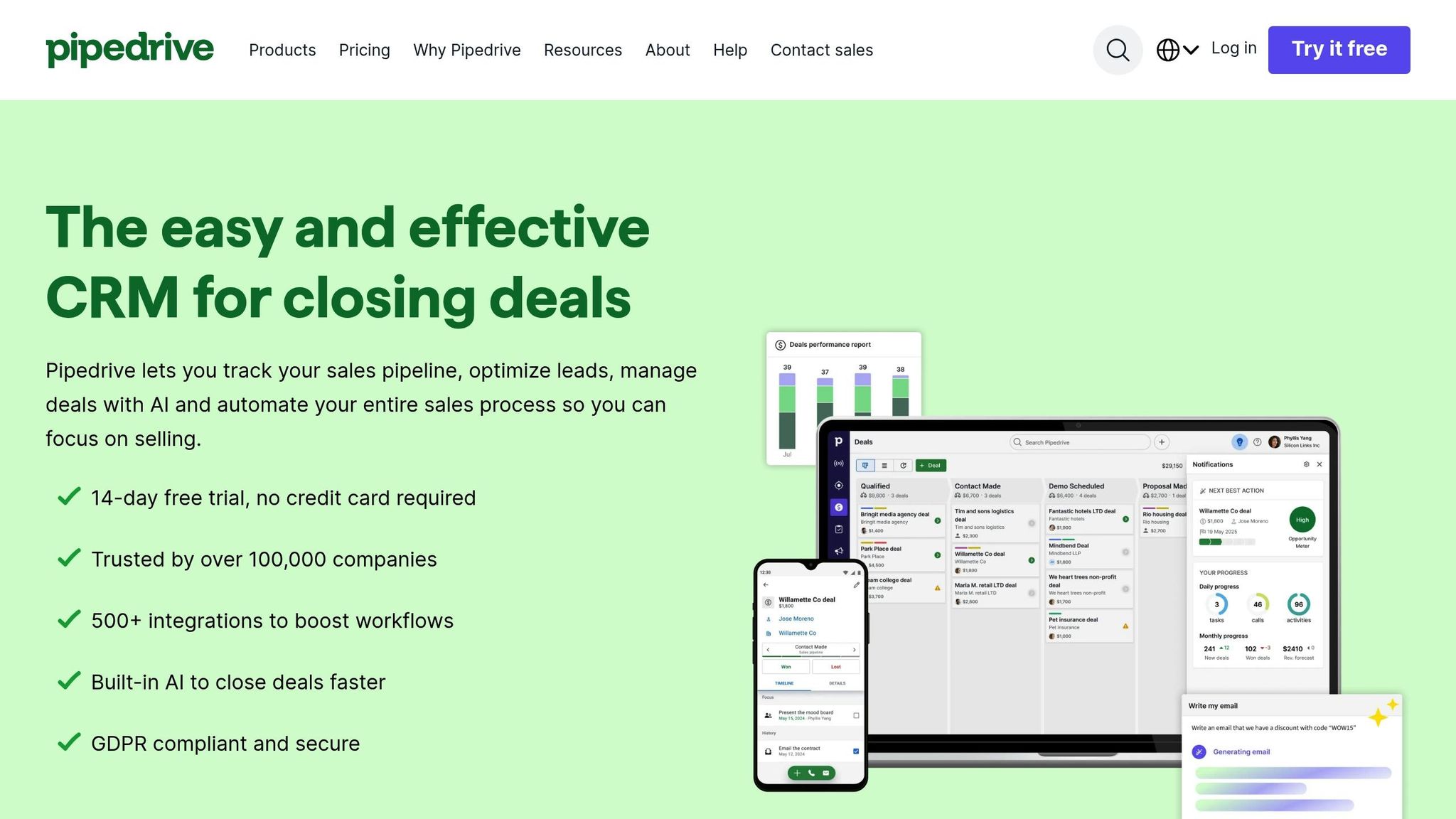
Pipedrive doesn't rely on native social media integration but instead connects through over 500 third-party tools like Zapier, Quickdialog, and Surfe to manage social interactions. Its Smart Contact Data feature pulls publicly available details from social media profiles to streamline contact management, cutting down on manual data entry. For example, the Surfe integration allows users to import LinkedIn contacts and sync chat conversations, while Reportei aggregates data from platforms like Facebook, Instagram, and LinkedIn.
Segmentation Types Supported
Pipedrive supports seven segmentation models: demographic, behavioral, geographic, psychographic, technographic, firmographic, and transactional. With custom labels and person filters, you can organize contacts based on motivations, values, or even their tech stack. A success story comes from Quru, a digital analytics company that used Pipedrive's Leadfeeder integration to monitor real-time website activity, boosting their deal win rate from 36% to 40%.
Pricing Tiers
Pipedrive offers four pricing plans billed annually: Lite at $14 per user/month, Growth at $39 per user/month, Premium at $59 per user/month, and Ultimate at $79 per user/month. Premium and Ultimate plans also include the Smart Contact Enrichment feature, which automatically gathers social and company data. Add-ons like Campaigns start at $13.33 per month, while LeadBooster, which provides access to over 400 million profiles, starts at $32.50 per month. A 14-day free trial is available for all plans, no credit card required.
Ease of Dynamic Updates
Pipedrive ensures real-time updates for contacts, instantly processing interactions like calls and emails. By integrating with tools like Zapier, users can automate workflows to add prospect details and social interactions to their CRM as they happen. For instance, in 2025, Trainify adopted Pipedrive's Campaigns feature to unify its email marketing and CRM data. Viktors Pedčenko, Trainify's CEO, used the tool to segment audiences more effectively, saving two hours each week on campaign preparation.
"Having CRM and email marketing in one tool has accelerated the preparation of campaigns, as there is no extra data export/import necessary."
- Viktors Pedčenko, CEO, Trainify
With real-time updates and robust segmentation tools, Pipedrive ensures your data stays accurate and actionable, making it a strong choice for businesses looking to streamline their CRM and marketing efforts.
7. ActiveCampaign
Social Media Integration Depth
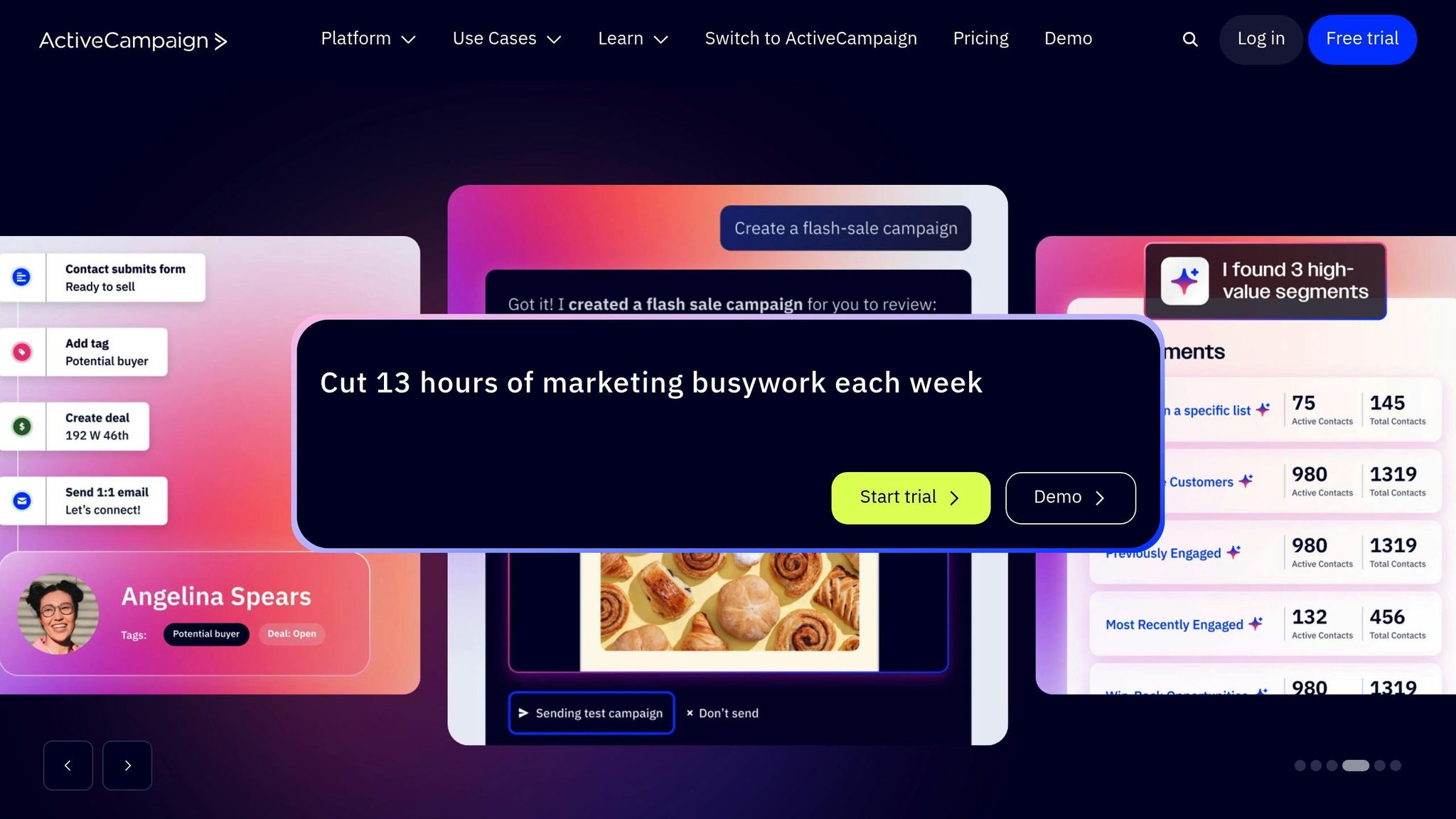
ActiveCampaign connects seamlessly with platforms like Facebook, Instagram, and LinkedIn through a network of over 1,000 apps. It allows you to push audience segments directly to Facebook Ads for targeted campaigns, syncing CRM data with social media advertising. Starting with the Plus tier, you can access features like prospecting and retargeting ads for both Facebook and LinkedIn. On top of traditional social ad tools, ActiveCampaign also supports WhatsApp automation, enabling direct communication with your audience.
Segmentation Types Supported
ActiveCampaign offers robust segmentation options, including demographic (like age, job title, or company size), behavioral (such as site visits, email engagement, and purchase history), geographic (location and timezone), and psychographic (values and interests). Its AI-Suggested Segments analyze customer data to uncover patterns that might otherwise go unnoticed.
The platform's impact is evident in real-world examples. For instance, Motrain, an education gamification platform, used ActiveCampaign to personalize outreach and track trials, boosting their trial conversion rate by 120% - from under 10% to over 20% - while saving 15 hours of manual work weekly. Similarly, Ducks Unlimited Canada saw their email click-through rates double within three months of leveraging ActiveCampaign's segmentation tools. With these advanced capabilities, the platform’s tiered pricing ensures businesses can choose features that align with their specific needs.
Pricing Tiers
ActiveCampaign offers four pricing plans: Starter (basic segmentation without social ad integration), Plus (standard segmentation with Facebook and LinkedIn ad features), Pro (advanced segmentation with predictive sending), and Enterprise (premium segmentation, including custom objects). Social media retargeting becomes available starting at the Plus level. Additionally, the platform offers a 14-day free trial and a 30-day money-back guarantee. With over 12,500 reviews averaging 4.5 out of 5 stars, 88% of users report faster results compared to other solutions.
Ease of Dynamic Updates
ActiveCampaign ensures that segments update in real-time as contacts meet or exit specific criteria. Its "floating" segment builder allows users to create segments on the fly from various parts of the interface, such as automation triggers or campaign workflows. Site and event tracking further enhance automation by capturing user behavior and automatically updating segments. Features like Predictive Sending fine-tune message timing for each segment, leading to a 17% increase in click-through rates.
Top 5 Reasons to Integrate Your CRM with Social Media
8. BuddyCRM
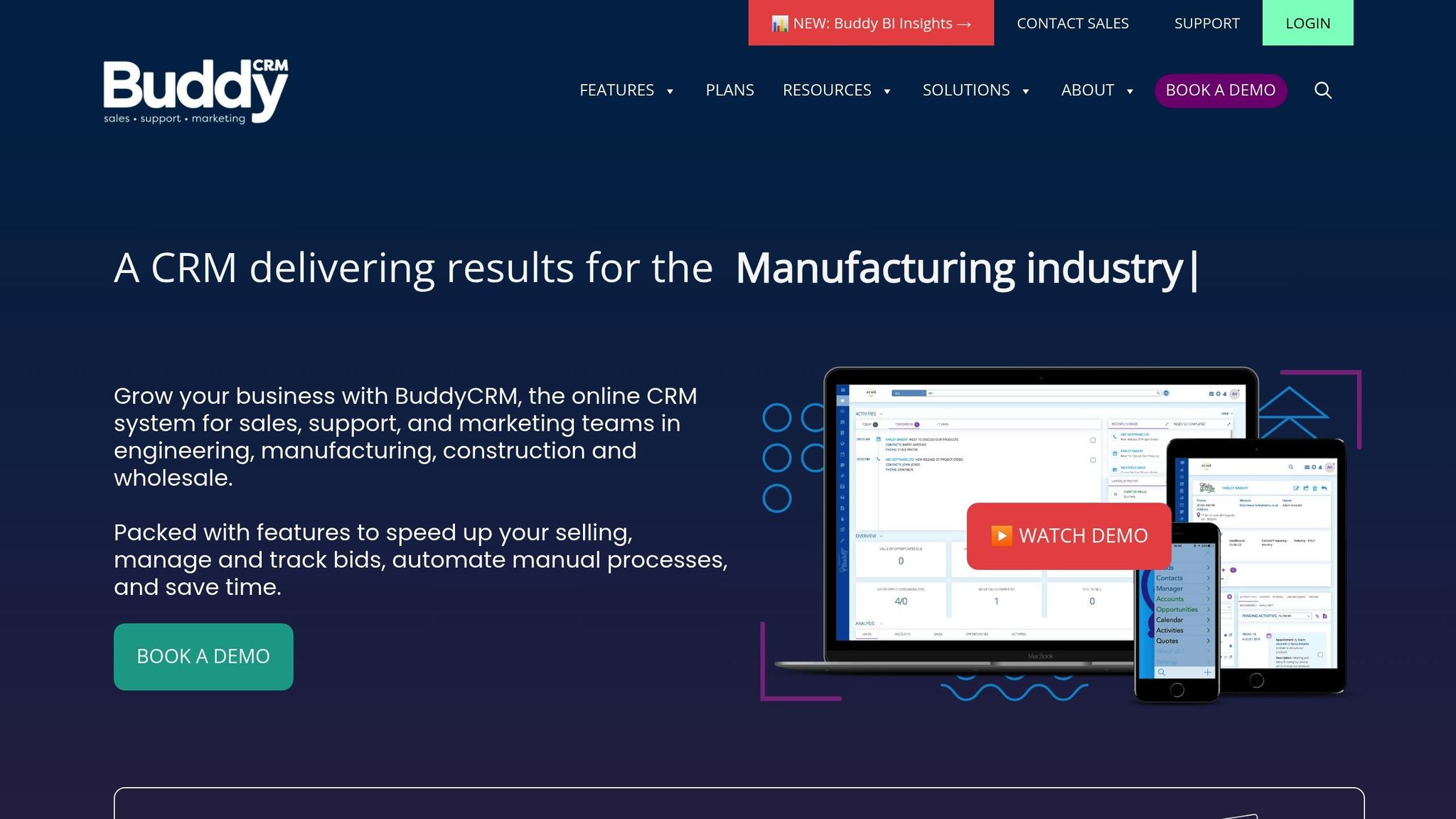
BuddyCRM earns attention for its advanced social media segmentation features and seamless API integrations, making it a strong contender in the CRM space.
Social Media Integration Depth
With its Buddy API and webhooks, BuddyCRM integrates directly with social media analytics, pulling interactions into customer profiles for a comprehensive view of social touchpoints. This integration enables real-time updates that support psychographic profiling by capturing preference data as users engage online.
Segmentation Types Supported
BuddyCRM excels in segmentation, offering a range of options including psychographic, behavioral, geographic, demographic, and value-based categories. Its geographic segmentation is particularly noteworthy, featuring a Maps tool that allows targeting by specific postcodes and visualizing data by location. Behavioral segmentation tracks a variety of interactions - social media activity, website visits, and purchase patterns - to group customers based on their engagement habits. Advanced filters let users combine criteria, like blending social media activity with purchase history, to create highly detailed audience segments.
Pricing Tiers
The platform offers three pricing plans: Professional at approximately $94 per user per month, Elite at $119 per user per month, and Elite+ at $188 per user per month (based on GBP conversion), all requiring a minimum of five users on a 36-month contract. The plans include ~$12,500 in setup services at no extra cost. Social media segmentation tools, such as marketing automation, lead nurturing, and dynamic segmentation, are only available with the Elite and Elite+ tiers.
Ease of Dynamic Updates
BuddyCRM takes dynamic segmentation to the next level by updating audience groups in real time as new data comes in. For instance, a customer browsing high-end products could instantly shift from a "casual wear" segment to "luxury fashion", triggering automated actions like sending a tailored email or discount offer. The system also integrates with external platforms, such as eCommerce sites and mobile apps, to continuously gather behavioral data, ensuring segments remain accurate and campaigns stay relevant. These real-time updates make it easier to deliver timely, personalized marketing efforts.
Feature Comparison Table
Here's a quick look at how various CRMs stack up when it comes to social media integration, segmentation features, pricing, dynamic updates, and multi-channel support. This table highlights the core strengths of each platform, helping you evaluate their ability to boost customer engagement through social data.
| CRM Platform | Social Media Integration | Segmentation Types | Starting Price (USD) | Dynamic Updates | Supported Channels |
|---|---|---|---|---|---|
| HubSpot | Moderate via third-party partners | Lists, Workflows, Social Actions | $45/user/mo | High (Automated) | FB, IG, LinkedIn, X, YouTube |
| Salesforce | High (Native + Partner) | Sentiment, AI-Predictive, Real-time | $75/user/mo | High (Einstein AI) | FB, IG, X, WhatsApp |
| Nimble | Moderate (Native) | Connectivity Status, Enrichment | $24.90/user/mo | Moderate | LI, X, FB |
| Zoho CRM | High (Native) | Demographics, Behavior, Lead Score | $57/user/mo (Plus) | High (Zia AI) | FB, IG, X, LI, YT |
| Pipedrive | Basic (Add-on) | Pipeline Stage, Email Drip | $14/user/mo | Moderate | LI, FB Messenger |
| ActiveCampaign | Moderate (Zapier/Native) | Behavior Triggers, AI Insights | $29/mo | High | FB, SMS, WhatsApp |
| BuddyCRM | High (API/Webhooks) | Advanced Geographic | $94/user/mo | High (Real-time) | Multiple via API |
Each platform brings something different to the table. Salesforce leads with its native AI-powered real-time segmentation, making it a strong choice for businesses that demand cutting-edge features. HubSpot, on the other hand, simplifies segmentation with user-friendly lists and workflows. Zoho CRM impresses with its robust native integration with Zoho Social and its AI assistant, Zia, which handles tasks like lead scoring and anomaly detection automatically.
For relationship-driven sales teams, Nimble shines by enriching contact records with social handle data, helping you build deeper connections. Meanwhile, BuddyCRM stands out with its advanced geographic segmentation, though its pricing structure requires a minimum of five users on a long-term contract. If you're looking for budget-friendly options, Pipedrive and ActiveCampaign offer lower entry points, although their social media features are less comprehensive compared to platforms like Salesforce.
Pricing varies significantly across these CRMs. If your business needs extensive multi-channel support and advanced AI segmentation, platforms like Salesforce, HubSpot, or Zoho CRM justify their higher costs with their robust capabilities. This breakdown serves as a guide to align your CRM choice with your social media segmentation goals.
Conclusion
Social media segmentation plays a crucial role in building stronger customer relationships. With over 5.24 billion social media users worldwide, overlooking the wealth of insights from social platforms means missing opportunities for personalization, quicker response times, and revenue growth. By linking social media accounts to contact records and automating follow-ups, businesses can significantly enhance customer engagement. Using this data-driven approach ensures smarter decision-making.
When it comes to choosing the right CRM, it all boils down to your business's unique needs and scale. For enterprise teams handling complex workflows in regulated industries, Salesforce offers AI-powered routing and advanced SLA tracking to keep things on track. On the other hand, small businesses looking for simplicity and quick setup might lean toward Nimble or Zoho CRM. If your focus is on managing social conversations and converting them into service tickets without losing context, platforms like HubSpot, with its unified timeline, can help eliminate the hassle of channel-hopping. The key is to pick a CRM that matches your team’s workflow and goals to fully leverage the power of social segmentation.
To optimize your social workflows, start by mapping out any manual bottlenecks. Test your CRM’s channel coverage during live demos, as social platform APIs often change, and what works now might not work tomorrow. Additionally, decide whether you need a native integration, middleware partner integration, or custom API builds - this choice directly affects data accuracy and team productivity.
The potential impact of CRM systems is hard to ignore. They can increase sales by 29%, while segmented strategies can boost repeat purchases by 40% and improve click-through rates by an impressive 74%. With the Social CRM market projected to grow from $231 billion in 2025 to $1,284 billion by 2029, companies that align their platforms with their audience's preferred channels and their team’s technical skills will gain a significant edge.
To get started, begin small by integrating one key social platform. Use free trial periods to test the system thoroughly and expand as your team becomes more comfortable with the tools. Investing in a social CRM now can lead to improved customer satisfaction, greater efficiency, and long-term revenue growth.
FAQs
What is social media segmentation in a CRM?
Social media segmentation within a CRM means breaking down your social media audience into smaller, defined groups based on specific criteria. This approach allows businesses to create more targeted marketing campaigns, provide personalized support, and foster meaningful engagement. By understanding and addressing the unique needs of each segment, companies can fine-tune their strategies and achieve better results.
Which social platforms can these CRMs connect to?
These CRMs work seamlessly with platforms such as LinkedIn, Twitter (X), Facebook, Instagram, YouTube, Pinterest, Telegram, Google Business Profile, Mastodon, Bluesky, WhatsApp, and TikTok. They also support tools like Salesforce, SugarCRM, Zoho, Socialinsider, Agile CRM, Highperformr, DMpro, and Saascrmreview.
How do dynamic segments update in real time?
Dynamic segments work by constantly pulling in data from sources like social media, customer interactions, and engagement metrics. This real-time tracking ensures that profiles are updated instantly based on current behavior, keeping segmentation accurate and relevant.