Want to measure your marketing campaigns against industry standards? Campaign benchmarking tools can help you compare metrics like engagement, ROI, and ad spend to industry averages or competitor performance. In 2025, advanced AI-powered tools make this process faster and more precise, offering real-time insights and tailored benchmarks.
Here’s a quick overview of the top tools for campaign benchmarking in 2025:
- Google Analytics 4 (GA4): Free tool focused on tracking user behavior, conversions, and engagement metrics. Ideal for small businesses and eCommerce.
- Semrush: Paid platform starting at $139.95/month, offering detailed SEO, PPC, and competitor research with over 27 billion keywords.
- AgencyAnalytics: Starting at $59/month, this tool integrates data from 80+ channels, providing client-focused reporting and benchmarks for agencies.
- Databox: Combines data from 70+ sources into real-time dashboards. Free plans available, with advanced features in paid tiers.
- BizBot: A directory for managing business tools and subscriptions, perfect for small businesses juggling multiple platforms.
Each tool has unique strengths, from real-time alerts to comprehensive integrations, making them essential for optimizing your campaigns. Below is a comparison table to help you decide which one fits your needs.
Quick Comparison
| Tool | Key Metrics Tracked | Pricing (USD) | Integrations | Best Use Case |
|---|---|---|---|---|
| Google Analytics 4 | Traffic, Conversions, Engagement | Free | Google Ecosystem | Website behavior tracking |
| Semrush | SEO, Keywords, Competitor Traffic | From $139.95/month | 8,000+ via Zapier | SEO and competitor analysis |
| AgencyAnalytics | CTR, ROI, CPA, Conversion Rates | From $59/month | 80+ Channels | Multi-client agency reporting |
| Databox | KPIs, CTR, CPC, ROAS | Free / Paid Plans | 100+ Tools | Real-time performance dashboards |
| BizBot | N/A | N/A | N/A | Tool and subscription management |
These tools simplify the benchmarking process, helping you make informed decisions and improve campaign performance. Choose the one that aligns with your goals and budget.
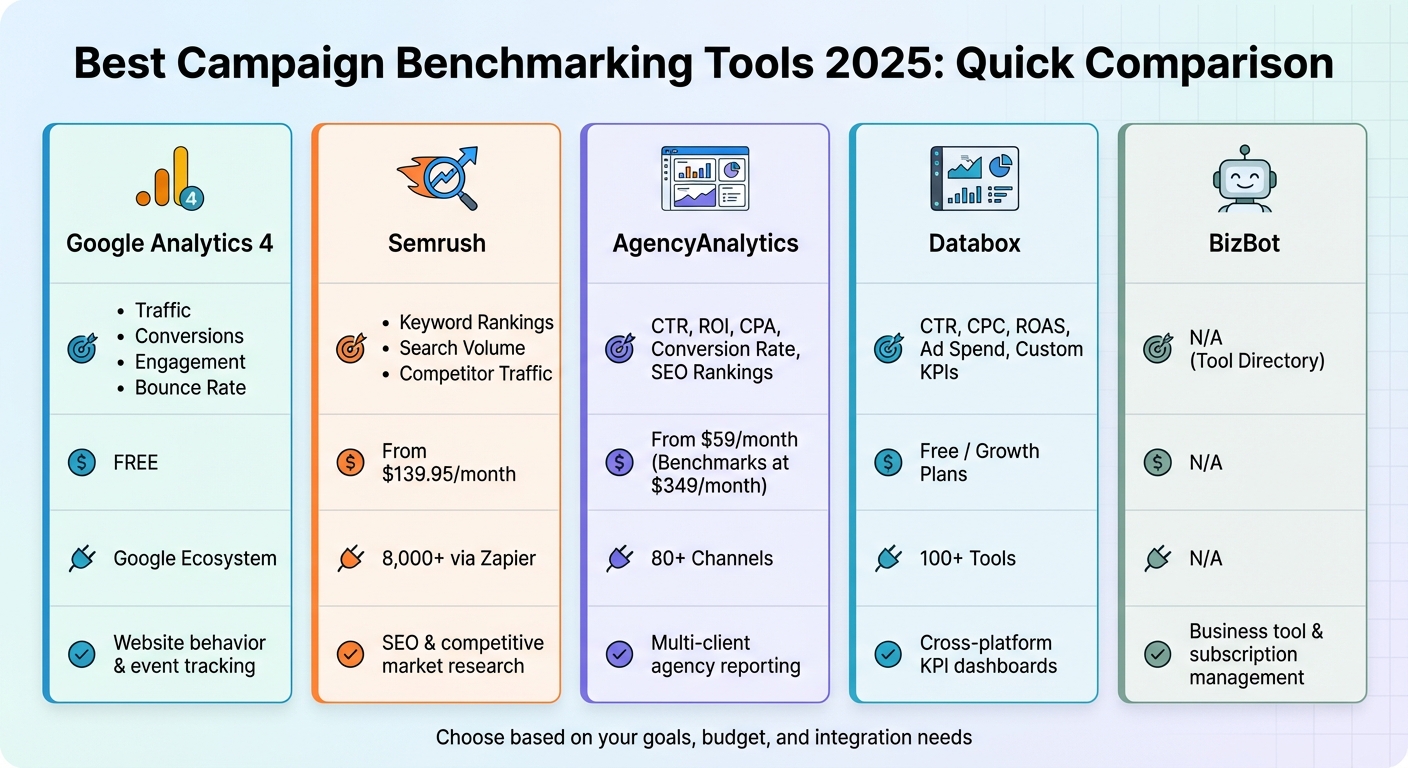
Campaign Benchmarking Tools Comparison 2025: Features, Pricing & Best Use Cases
Best Campaign Benchmarking Tools for 2025
Google Analytics 4
Google Analytics 4 (GA4) shifts from traditional session-based tracking to an event-based model, where every user interaction is logged as a unique event. This approach organizes data into key customer lifecycle stages: Acquisition, Engagement, Monetization, and Retention. For small businesses, enabling benchmarking in GA4 can provide insights into their standing within the industry. The platform's predictive audiences, powered by AI, help target users most likely to convert. For instance, one retailer reported a 56% boost in sales after implementing GA4's features. This tool is especially useful for retail businesses and app developers looking to monitor eCommerce conversions or measure iOS app campaign performance via SKAdNetwork integration.
While GA4 excels in detailed tracking, other platforms bring unique competitive insights to the table.
Semrush
Semrush is trusted by over 10 million marketing professionals, including 35% of Fortune 500 companies. Its Advertising Toolkit reveals competitor strategies, budgets, and top-performing keywords across platforms like Google and Meta. Andrea Cruz, Digital Marketing Manager at KoMarketing, highlighted its value:
"Semrush has been pivotal in helping me better understand the competitive landscape of my ad campaigns".
The platform’s Growth Quadrant feature lets users filter by channel and identify which strategies drive competitors' success. With a database of 27 billion keywords and 808 million domain profiles, Semrush is a powerhouse for competitive benchmarking. Its AI Visibility tools also track how brands appear in Large Language Models and AI-driven search results. This makes Semrush an effective choice for businesses like dental practices, B2B companies, and eCommerce brands focused on SEO, PPC, and content marketing.
AgencyAnalytics
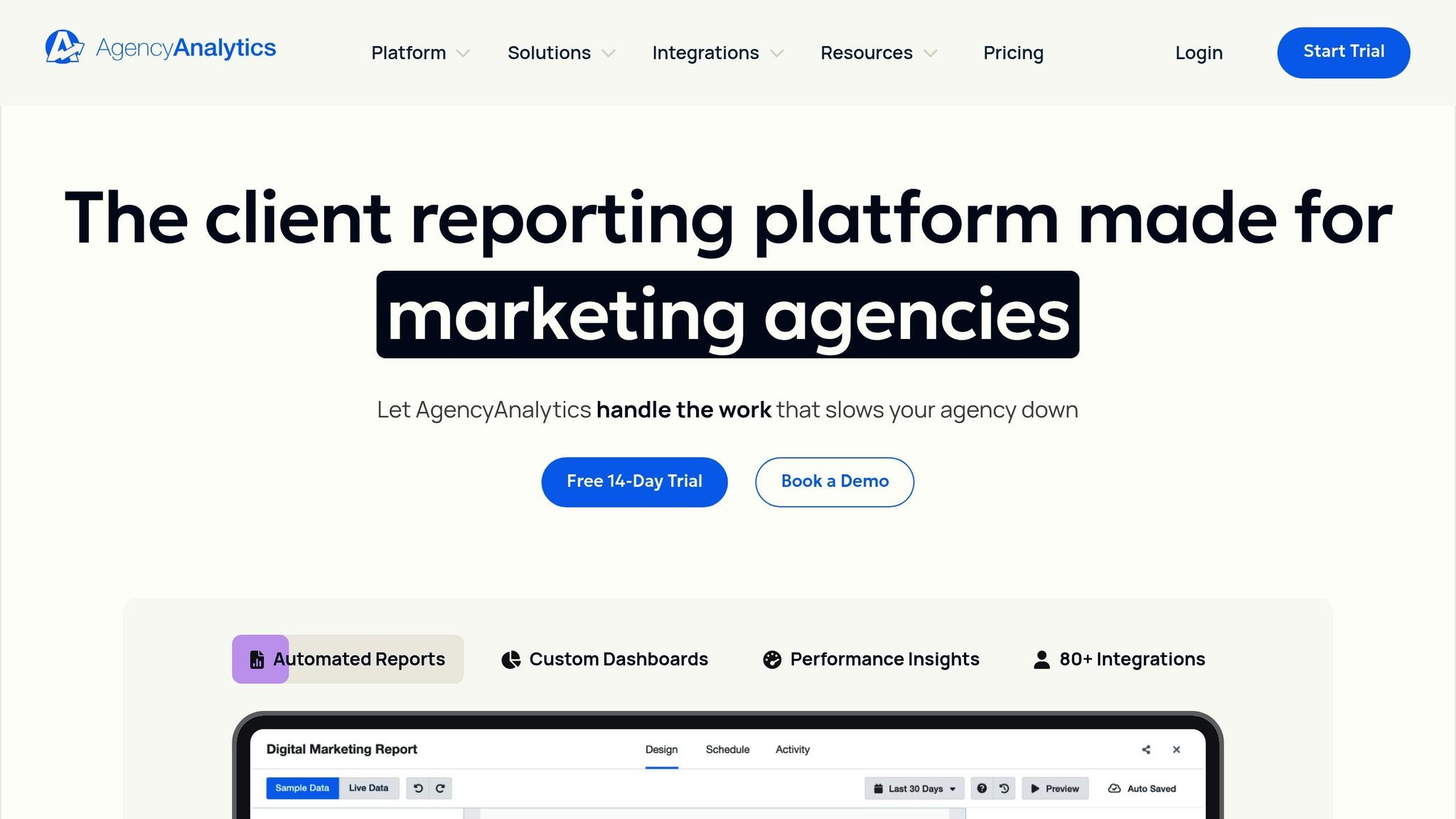
AgencyAnalytics is built on insights from 150,000 campaigns and 7,000 agencies. It integrates data from over 80 marketing channels - including Google Ads, Facebook, and Mailchimp - into a single, user-friendly dashboard. This consolidated view benefits both agencies and their clients. Ben Spray, Managing Director at We Are Marketable, shared:
"AgencyAnalytics allows us to make data-informed decisions quickly".
The platform boasts a customer satisfaction rating of over 95% and an average support response time of under three minutes. Users report saving up to 15 hours weekly on reporting tasks. For agencies on premium plans starting at $349 per month, the Benchmarks feature compares lead costs against industry standards - for example, a $12.50 cost per lead versus an $18.00 median. AgencyAnalytics is ideal for agencies managing clients across industries like SaaS, roofing, and apparel.
Databox
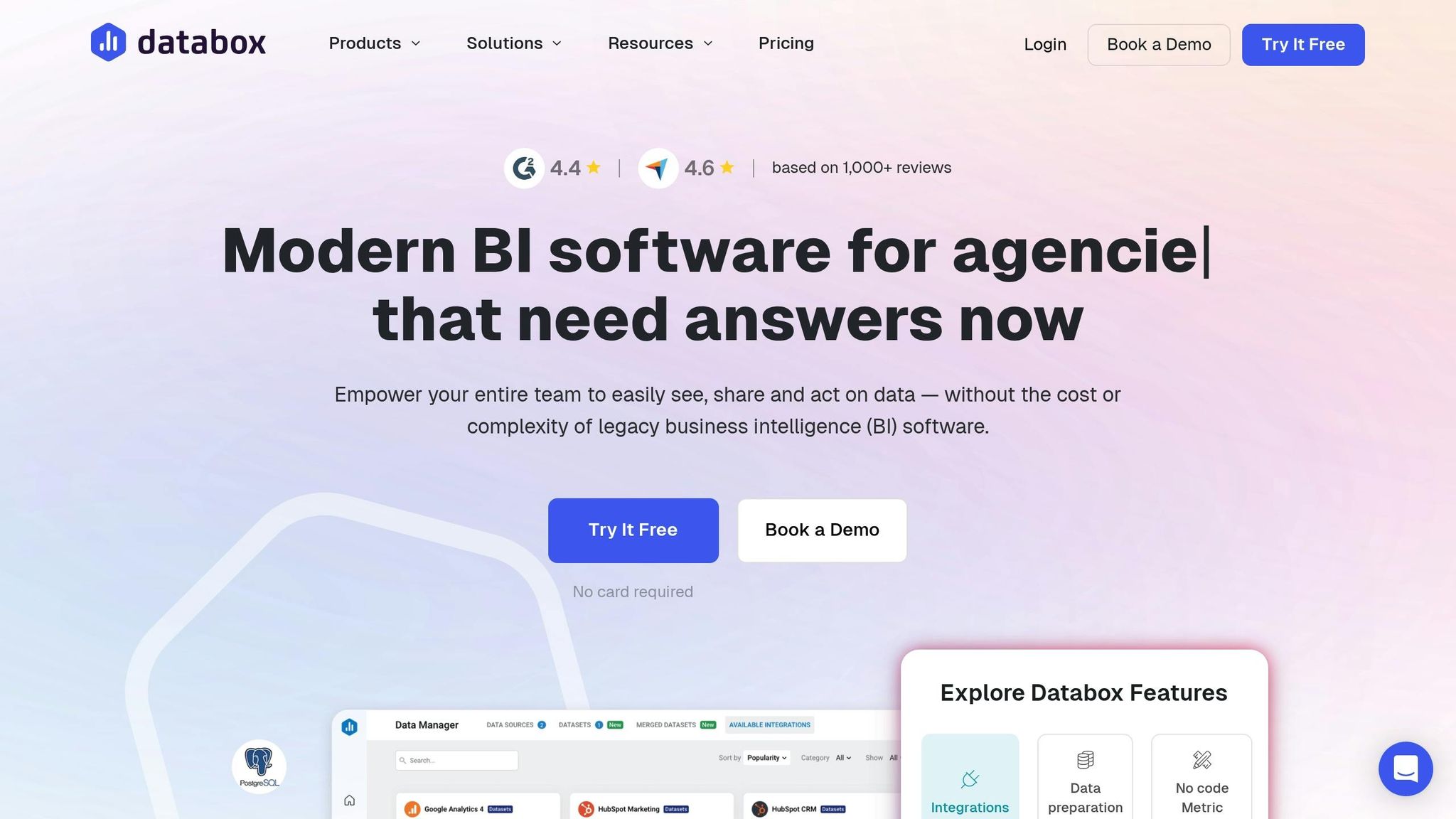
Databox simplifies data management by pulling information from over 70 sources into real-time dashboards with automated metric alerts. More than 20,000 businesses rely on it to monitor and refine their marketing funnels. One user remarked:
"Databox solved a big problem for us. It made data accessible and actionable for everyone".
The platform includes peer group comparisons and anomaly detection to pinpoint unusual trends in campaign data. Small businesses can set up real-time alerts for key metrics and automate performance report delivery to stakeholders. For those testing the waters, Databox offers a "Try It Free" tier that covers basic marketing analytics and dashboarding.
BizBot

BizBot is a go-to resource for businesses looking to streamline operations. It offers a curated directory of tools across categories like accounting software, banking, HR, legal services, and management tools. This makes it particularly valuable for small businesses and freelancers. Its subscription management feature helps track and optimize software expenses, which is especially helpful when juggling multiple benchmarking and marketing platforms simultaneously.
Feature Comparison Table
Tool Comparison
Here’s a clear rundown of some top benchmarking tools for 2025, showcasing their strengths and key features.
Google Analytics 4 is a go-to option for tracking website traffic, user behavior, and conversions like sales or sign-ups - all at no cost. Semrush focuses on SEO analytics, keyword rankings, and competitor traffic patterns, with plans starting at $139.95 per month. AgencyAnalytics monitors multi-channel metrics such as CTR, ROI, CPA, and conversion rates. Its basic reporting starts at $59 per month, while advanced benchmarking features are available with premium plans priced at $349 per month. Databox excels in centralizing KPIs like CTR, CPC, and ROAS, offering both a free plan and a 14-day trial for its Growth plans.
When it comes to benchmarking, each tool brings something different to the table. AgencyAnalytics compiles anonymized data from over 150,000 active campaigns to establish industry averages, such as an average bounce rate of 45.52% and 1,505 average monthly views. Meanwhile, Databox allows users to overlay benchmark lines on dashboards for real-time comparisons. For instance, Google Ads industry medians in January 2026 revealed a CTR of 4.3%, a CPC of $1.54, and a conversion rate of 2.8%.
Integration capabilities further set these tools apart. AgencyAnalytics connects with over 80 marketing channels, while Databox supports more than 100 software integrations, including APIs, MySQL databases, and spreadsheets. Google Analytics 4 integrates seamlessly with the Google Marketing Platform, and Semrush connects to over 8,000 apps via Zapier.
The table below provides a quick comparison of metrics, pricing, and integrations for these tools:
| Tool | Key Metrics Tracked | Pricing (USD) | Integrations | Best Use Case |
|---|---|---|---|---|
| Google Analytics 4 | Traffic, Conversions, Engagement, Bounce Rate | Free | Google Ecosystem | Website behavior and event tracking |
| Semrush | Keyword Rankings, Search Volume, Competitor Traffic | From $139.95/mo | SEO/PPC/Social, 8,000+ via Zapier | SEO and competitive market research |
| AgencyAnalytics | CTR, ROI, CPA, Conversion Rate, SEO Rankings | From $59/mo (Benchmarks at $349/mo) | 80+ Channels | Multi-client agency reporting |
| Databox | CTR, CPC, ROAS, Ad Spend, Custom KPIs | Free / Growth Plans | 100+ Tools | Cross-platform KPI dashboards and benchmarking |
| BizBot | N/A | N/A | N/A | Directory of business tools and subscription management |
Note: BizBot is included for its unique role as a centralized directory for managing business tool subscriptions.
How to Choose the Right Campaign Benchmarking Tool
Set Your Campaign Goals
Before diving into tools, take a moment to clearly define your campaign objectives. Are you looking to boost ROI, improve click-through rates, lower cost per acquisition, or better understand audience engagement? Each of these goals requires tracking different metrics and features to measure success effectively.
It’s also important to distinguish between KPIs and benchmarks. KPIs measure your internal progress toward specific goals, while benchmarks help you see how your results stack up against industry norms. Without clear objectives, you might end up paying for features you don’t need - or worse, missing out on the ones that could actually help you grow. Once your goals are in place, you can move on to evaluating budget and tool features. Using efficient business tools can help you scale these efforts quickly.
Review Budget and Features
Campaign benchmarking tools come with a wide range of pricing options. For smaller businesses, it’s smart to opt for scalable, usage-based pricing models rather than committing to costly contracts upfront. One key consideration is whether the time saved by using the tool justifies its cost. For example, some users report reducing manual reporting time by 40–50%, saving as much as 10–15 hours per week.
But pricing isn’t the only factor. Make sure the tool offers data tailored to your industry. Metrics like ROAS and engagement rates can vary greatly between sectors, so generic benchmarks may not provide the insights you need. Look for platforms that let you filter benchmarks based on factors like company size, revenue, and business type. Comparing your small business to a global corporation won’t yield actionable insights. And don’t overlook tools that include confidence scores or dataset size details - these features ensure the benchmark data is statistically reliable.
Check Integration and Usability
A tool that integrates seamlessly with your existing tech stack can save you from tedious manual data entry and provide a more cohesive reporting experience. Check that the platform connects directly with your key ad platforms, web analytics tools, and CRM systems.
Ease of use is equally critical. Choose tools with user-friendly interfaces and pre-built templates to cut down on training time. Automation is another must-have feature. Platforms that automatically pull data from multiple channels can spare you the hassle of manual tracking, freeing up time for more strategic tasks.
sbb-itb-d1a6c90
How to Analyze Facebook Ads Data the Right Way (The 2026 Guide)
Conclusion
Campaign benchmarking has become the bridge between making informed decisions and relying on guesswork. For example, a bounce rate of 45.52% might initially seem troubling - until you realize it aligns perfectly with the industry median.
The numbers back it up: benchmarking can lead to a 25% boost in ROI, enable 30% quicker strategic adjustments, and improve decision-making confidence by 40%. As Anya Curry from Ambidextrous Services explains:
Accurate information helps us make informed decisions and provide recommendations. Using a tool like AgencyAnalytics helps us do this efficiently so we can spend more time improving results for our clients.
Whether your focus is on free website tracking with Google Analytics 4, competitive insights through Semrush, automated benchmarking via AgencyAnalytics, or real-time performance monitoring with Databox, the right tool depends on your specific goals and budget. These platforms transform raw data into actionable insights, making them indispensable for effective campaigns.
Beyond performance improvements, consolidating your tools can simplify operations even further. For small businesses juggling multiple platforms, BizBot offers a centralized solution. Acting as a hub, it helps you discover and manage business tools - from choosing the right accounting software to digital marketing solutions - all tailored to your company’s size and budget. This complements analytics tools by streamlining subscriptions and tool management.
To get the most out of your efforts, define clear objectives, choose tools that integrate smoothly with your systems, and regularly update your benchmarks. A well-chosen benchmarking tool won’t just present data - it’ll illuminate the way forward.
FAQs
What are the main advantages of using AI-powered benchmarking tools in 2025?
AI-driven benchmarking tools in 2025 are reshaping how marketers gather and analyze data. By automating these processes, they deliver faster and more precise insights, eliminating the need for tedious manual research. These tools let you measure your performance against relevant industry standards, making it easier to spot areas for improvement and uncover new opportunities. Plus, with data updated regularly, you can stay on top of market trends and fine-tune your campaigns as needed.
But it doesn’t stop at efficiency. AI brings predictive insights and actionable suggestions to the table. By reviewing historical campaign data, these tools can estimate future results, recommend where to allocate budgets, and pinpoint the most effective channels. This empowers marketers to make confident, data-backed decisions that boost ROI and help businesses thrive in an ever-evolving digital world.
What makes Google Analytics 4 different from traditional tracking tools?
Google Analytics 4 shifts to an event-based tracking model, leaving behind the older session-based system. This change enables businesses to gain deeper insights into how users interact with websites, apps, and devices.
Another standout feature is its built-in machine learning capabilities, which provide automated trend detection and anomaly alerts. This means businesses can uncover actionable insights without having to rely heavily on manual analysis.
What should I look for in a campaign benchmarking tool?
When choosing a campaign benchmarking tool, it’s important to find one that aligns with your marketing goals and delivers insights you can act on. Tools with multi-touch attribution are especially valuable - they help you identify which channels contribute the most to your success, making budget allocation more effective. Another must-have is a customizable dashboard, so you can adjust metrics and visualizations to fit your specific campaign objectives.
Look for a tool that brings together data from all your campaigns into a single platform. This gives you a clear, comprehensive view of your performance. It’s also essential that the benchmarking data is specific to your industry, regularly updated, and suitable for your business size, ensuring you’re comparing apples to apples. Lastly, ease of use is key. Choose a tool that integrates smoothly with your existing ad platforms, analytics tools, and CRM systems. This makes it easier to adopt and allows you to track critical metrics - like impressions, click-through rates, and ROAS - in real time.

![Thumbnail for: Waterfall Project Management: Complete Guide [2024]](https://mars-images.imgix.net/seobot/bizbot.com/664d461aa353cbfc95764a08-189fa643dd049a0e675c824a39fe14fd.png?auto=compress)